
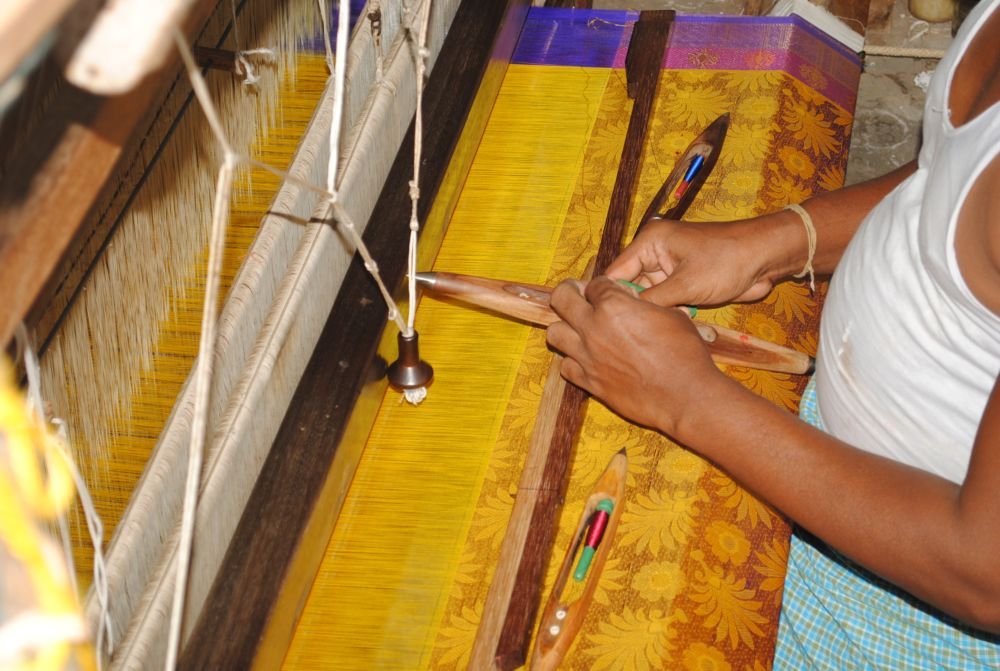
Arani Silk Saree
In the sun-drenched town of Arani, nestled in the Tiruvannamalai district of Tamil Nadu, the air is filled with a rhythmic, metallic clicking—the heartbeat of a thousand handlooms. This is the “Silk City,” a place where history is not just read in books but woven into every inch of shimmering mulberry silk. While the world often bows to the grandeur of Kanchipuram, the Arani Silk Saree stands as its elegant, agile cousin—a masterpiece of lightweight durability and ingenious design that has quietly defined South Indian grace for centuries.
The Genesis: A Confluence of Dynasties and Displaced Artisans
The story of Arani silk is a sprawling epic that began over a thousand years ago. The region flourished under the patronage of the Pallavas and Cholas, but its true textile identity crystallized during the Vijayanagara Empire. It was during this “Golden Age” of the 14th century that silk weaving was formally introduced to the region, reportedly under the encouragement of Emperor Krishna Devaraya, who was born in nearby Devikapuram.
The craft received a significant cultural infusion from the Saurashtrian community. Displaced from North India by successive invasions, these master weavers migrated south, eventually settling in the Arani cluster. They brought with them specialized North Indian weaving secrets, which they seamlessly blended with local Tamil aesthetics. This fusion created a unique “dobby” variety of silk that prioritized a soft, airy texture over the stiff, heavy drapes of neighboring regions. By the 1920s, Arani had established itself as a hub of excellence, where every street became a workshop and every family a repository of ancestral patterns.
The Alchemy of Arani: From Mulberry to Masterpiece
Creating an Arani saree is a marathon of patience involving a specialized preparatory process known as street sizing. Walk through the lanes of Kosapalayam or Onnupuram, and you will see silk yarn stretched the entire length of the street, meticulously brushed and starched by family members.
The silk itself is high-quality mulberry, prized for its natural sheen and tensile strength. Before it reaches the loom, the yarn undergoes a rigorous dyeing process in massive copper boilers. The water chemistry of the region is said to play a vital role in the longevity of the colors. Artisans constantly turn the yarn to ensure even saturation, using a mix of traditional vegetable dyes and modern chemical pigments to achieve the striking reds, deep purples, and vibrant greens that define the Arani palette.
Unlike the Kanchipuram method, where the body and border are often woven separately and then joined (the Korvai technique), Arani sarees traditionally utilized the dobby and adai techniques to integrate motifs directly into the weave. This results in a seamless transition between the body and border, contributing to the saree’s legendary lightweight feel—typically weighing a mere 300 to 400 grams, compared to the nearly 1-kilogram weight of a heavy bridal Kanjeevaram.
The “Two-in-One” Wonder: A Stroke of Weaver’s Genius
If Arani has a signature innovation, it is the Half-and-Half concept. In a stroke of practical genius, Arani weavers developed a way to weave a single 6.2-meter fabric with two distinct color schemes or designs on either side.
A classic Arani “concept” saree might feature one color and motif on the first half of its length and a completely different color and pallu on the other half. For the wearer, this is a “two-in-one” miracle; by draping it differently, a single saree can appear as two entirely different outfits for two different occasions. This versatility, combined with the Kottadi (checked patterns) and Veldhari (wavy stripes), makes Arani silk the preferred choice for modern women who seek variety without sacrificing tradition.
Symbolic Motifs: The Language of the Loom
Every Arani saree tells a story through its Buttas (motifs). These are not merely decorative; they are symbols rooted in the local landscape and Dravidian temple architecture.
Thazhampoo Rekku: Inspired by the screw-pine flower, these serrated, temple-like borders are an Arani staple.
Mayilkan & Kuyilkan: Representing the “peacock’s eye” and “nightingale’s eye,” these tiny, intricate patterns require immense precision.
Mallimoggu: The jasmine bud motif, signifying purity and fragrance.
Iruthalaipakshi: The mythical two-headed bird, a symbol of royal power and vigilance.
While jacquard machines now allow for more complex, contemporary designs, these traditional motifs remain the soul of the Arani weave, acting as a link between the 21st-century wearer and her medieval ancestors.
The GI Tag: A Shield for the Silk City
In May 2008, the Arani Silk Saree was officially granted the Geographical Indication (GI) Tag. This was more than a legal formality; it was a victory for the 35,000+ weavers of the region. The GI status ensures that the term “Arani Silk” can only be applied to sarees produced within this specific handloom cluster using the mandated materials and techniques.
This protection is vital in an era of powerloom imitations. A genuine Arani saree is distinguished by its durability and tactile softness. It is a “breathable” silk, comfortable in the humid heat of South India. Furthermore, Arani has a proud place in the national narrative; local legend holds that the very first Indian flag hoisted at the Red Fort on August 15, 1947, was a silk flag woven by the master weavers of Arani.
Preserving the Heritage: The Modern Arani Weaver
Today, the Arani silk industry is a study in contrasts. While technology has introduced computer-aided design and automatic card-punching machines, the essential work remains deeply manual. The industry is currently facing a generational shift; low wages and the allure of urban jobs have led some traditional families away from the loom.
However, a new wave of “Silk Parks” and direct-to-consumer digital platforms are breathing fresh life into the cluster. By showcasing the Arani Pattu not just as a wedding garment, but as a versatile, lightweight luxury for festivals and ceremonies, the weavers are finding a global audience. From the sacred temple visits to sophisticated corporate events, the Arani Silk Saree continues to drape the modern Indian woman in a heritage that is as light as air and as strong as the history that forged it.
Arani Silk Sarees, Arni Pattu Saree, Silk City of Tamil Nadu, Arani Handloom Silk, Tiruvannamalai Silk Weaving.
Difference between Arani and Kanchipuram silk sarees, Arani silk saree GI tag significance, lightweight traditional silk sarees for weddings, Arani half and half silk saree designs, history of Arani silk weavers.
#AraniSilk #ArniPattu #TamilNaduHeritage #HandloomSarees #SilkCity #IndianTextiles #GITagIndia #SustainableFashion #WeavesOfIndia #TraditionalSaree