
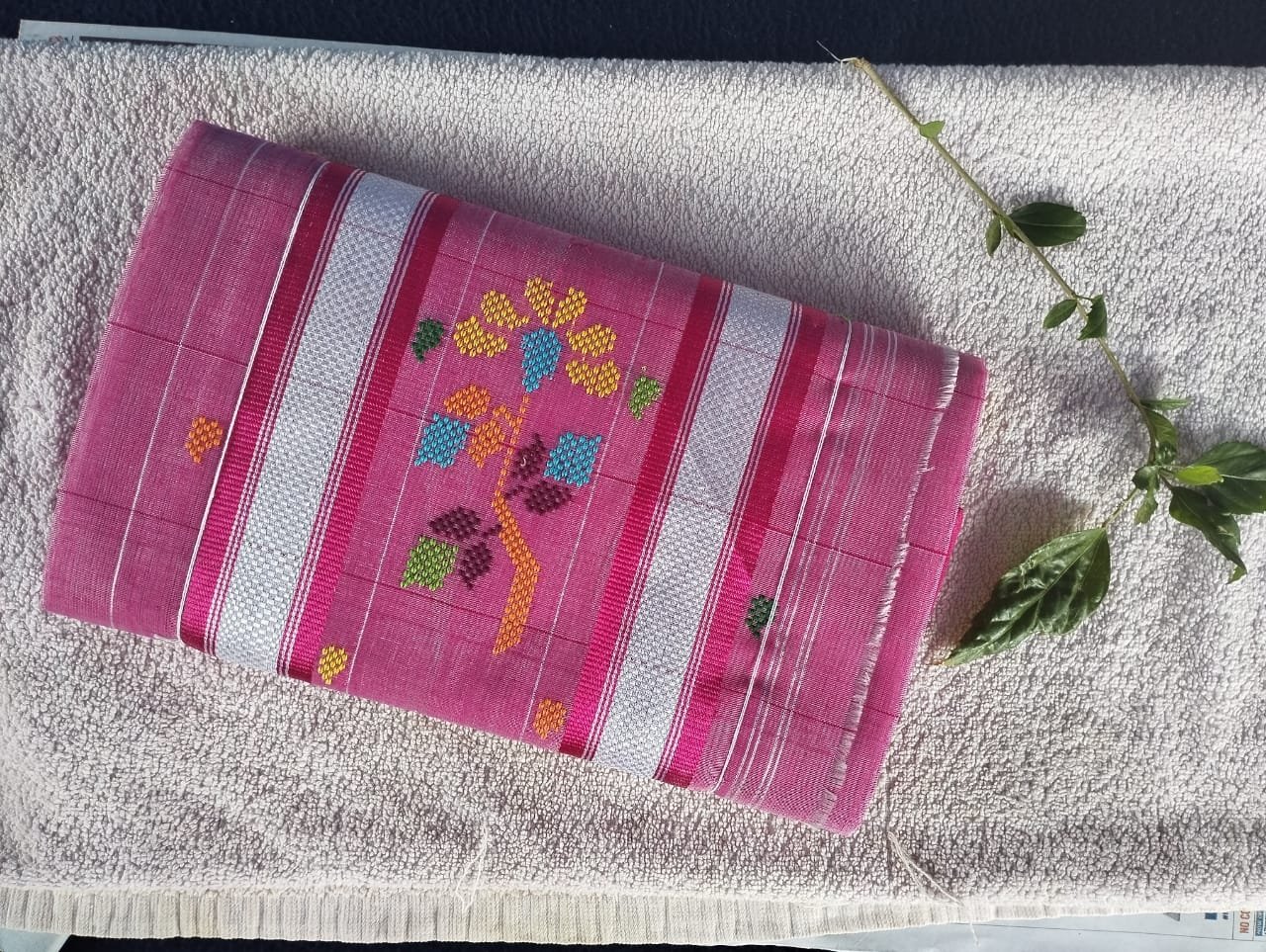
Chedibutta Saree
The Loom’s Lullaby: Unraveling the Legacy of the Chedibutta Saree
When you click on a link like “[Creating Chedibutta saree – Wikipedia]” on a quiet afternoon, you might expect a dry, technical description of a regional textile. However, what you actually stumble upon is a vibrant, living history. When we speak of the great weaving traditions of Tamil Nadu, the mind instantly gravitates toward the heavy, gold-drenched silks of Kanchipuram or the vibrant, resist-dyed cottons of Madurai Sungudi. Yet, tucked away in the deep south, in the Tirunelveli district near the perennial Thamirabarani River, lies the modest town of Veeravanallur. Here, amidst the rhythmic clatter of wooden shuttles, a quiet masterpiece is born daily: the Chedibutta saree.
In an era dominated by relentless mechanization and the deafening roar of power looms, the Chedibutta saree stands as a defiant testament to human dexterity, generational memory, and cultural synthesis. It is not just a piece of unstitched fabric; it is a wearable archive of a nomadic people, a marvel of manual engineering, and a triumph of geographical authenticity.
The Anatomy of a Name: What is ‘Chedibutta’?
To understand the soul of this textile, one must first deconstruct its name. The word “Chedibutta” is a beautiful linguistic amalgamation that hints at the saree’s cross-cultural origins. In Tamil, Chedi translates to “plant.” The word Butta (or Buti), however, is a pan-Indian textile term of Persian origin, referring to a repeated floral or geometric motif woven into a fabric.
True to its name, the defining characteristic of this saree is its iconic “plant and flower” motif. Unlike the rigid geometric patterns or the mythical temple borders found in other South Indian textiles, the Chedibutta design is organically fluid. The saree features these intricate plant motifs predominantly woven along the borders and the pallu (the decorative edge draped over the shoulder). Furthermore, smaller, delicate buttas are punctuated beautifully all across the main body of the saree.
The mathematics of the traditional design are strictly adhered to: a classic, authentic Chedibutta saree will proudly display exactly eight distinct plant motifs across its body and five prominent, larger motifs on its pallu. This precise aesthetic signature is what makes the Chedibutta instantly recognizable to the trained eye.
A Thousand-Mile Journey: The Weavers of Veeravanallur
The hands that weave the Chedibutta saree do not originally belong to the southern soil. The story of this textile is intricately bound to the epic migration of the Sowrashtra (or Saurashtra) community.
Centuries ago, the ancestors of these weavers lived in the Saurashtra region of modern-day Gujarat. Renowned across the Indian subcontinent for their unparalleled skills in silk weaving and natural dyeing, their craftsmanship was highly sought after. However, historical records suggest that frequent foreign invasions and political instability in the north forced this artisan community to flee their homeland. Seeking peace and royal patronage, they embarked on a massive, generational migration southward.
Their journey brought them through the Deccan plateau, eventually leading them to the flourishing Vijayanagara Empire, and later, to the culturally rich court of the Nayak kings in Madurai. The Nayak rulers, great patrons of the arts, welcomed the Sowrashtra weavers, recognizing the immense value of their craft. Over time, segments of this community migrated further south, settling in various pockets of Tamil Nadu, including the town of Veeravanallur.
When these master weavers settled by the Thamirabarani River, a beautiful cultural synthesis occurred. They brought with them the northern techniques of weaving delicate buttas, but they adapted their art to suit the tropical climate, local sensibilities, and the available raw materials of their new southern home. The Chedibutta saree is the direct offspring of this historical union—a Gujarati weaving philosophy executed with a distinctly Tamil aesthetic.
The Architecture of the Weave: A Hybrid Marvel
What makes the Chedibutta saree a tactile delight is its unique composition. Traditional Indian handlooms are usually purists: they are either entirely spun from silk (like Kanjeevaram) or entirely woven from cotton (like Bengal Jamdani). The Chedibutta, however, is a brilliant hybrid.
The warp—the foundational longitudinal threads held in tension on the loom—is made of Art Silk (artificial silk or rayon), which gives the saree a beautiful, subtle sheen and a fluid, elegant drape. The weft—the transverse threads drawn through the warp—is made of high-quality cotton.
But the true magic lies in the buttas themselves. The intricate plant and flower motifs are woven using brightly colored, pure cotton threads (often 60s count). This brilliant juxtaposition of lustrous art silk against the matte, vibrant finish of the cotton motifs creates a stunning three-dimensional effect. The flowers and plants seem to physically pop off the fabric, giving the saree a rich, embossed texture.
Defying the Machine Age: A Purely Manual Masterpiece
If you were to visit a modern textile factory, you would see complex Jacquard machines or Dobby attachments perched atop the looms. These machines use punched cards or computer programs to automatically lift the warp threads, making it incredibly easy to weave complex patterns in mass quantities.
The artisans of Veeravanallur strictly reject these mechanical shortcuts.
The creation of a Chedibutta saree is an entirely manual process. From the spinning of the cotton yarn using a traditional charkha (spinning wheel) to the preparation of the warp beam, human hands guide every step. When it comes to the actual weaving, the artisans use traditional pit looms. There are no power looms, no peddle looms, and absolutely no Jacquard machines involved.
To create the Chedibutta design, the weaver must manually interlock the brightly colored cotton threads into the art silk warp. They use small wooden spools called pirns to wind the weft yarn, and shuttles to carry the yarn back and forth across the loom. Because each motif is introduced using an “extra weft” technique, the weaver must memorize the pattern, manually lifting the exact warp threads required for the design, passing the colored cotton through, and beating it into place.
This requires immense concentration. A single mistake in counting the threads can ruin the entire motif. Because multiple colored yarns are used for the flora, there are striking color variations from design to design within a single saree, making every authentic Chedibutta slightly asymmetrical and entirely unique. It is a slow, grueling, yet deeply meditative process that cannot be replicated by any machine.
Tropical Elegance: The Saree for All Seasons
Beyond its visual appeal and historical depth, the Chedibutta saree is a triumph of functional design. Traditional heavy silk sarees, while majestic, are notoriously uncomfortable in the sweltering, humid heat of the Indian summer. They are heavy, they trap heat, and they require high maintenance.
The weavers of Veeravanallur engineered the Chedibutta to be the perfect antidote to the tropical climate. The blend of art silk and cotton results in an incredibly lightweight fabric with a phenomenally soft texture. The cotton weft ensures breathability, making it exceptionally comfortable during the scorching summer months, while the art silk warp provides just enough insulation to keep the wearer comfortably warm during the mild, breezy southern winters.
Furthermore, the specific tension of the weave and the nature of the blended threads make the Chedibutta saree highly resistant to wrinkling. It drapes effortlessly, holds its pleats beautifully, and is surprisingly easy to wash and maintain. For the modern working woman who wants to wear traditional handlooms without the cumbersome weight and high maintenance of pure silk, the Chedibutta is nothing short of a wardrobe revelation.
The Shield of Authenticity: The GI Tag Victory
Despite its brilliance, the Chedibutta saree recently faced an existential threat. The rise of cheap power looms meant that the market was suddenly flooded with mass-produced, machine-made imitations. These fake sarees mimicked the plant motifs using synthetic threads and were sold at a fraction of the cost. For the authentic handloom weavers of Veeravanallur, whose intricate manual process takes days to complete a single saree, competing with these factory-churned knockoffs became impossible. The younger generation began abandoning the looms, seeking more lucrative employment in the cities.
Realizing that this centuries-old craft was on the brink of extinction, the Veeravanallur Sowrashtra Weavers Cooperative Production and Sales Society Limited took a stand. Following a rigorous legal and historical documentation process, their efforts bore fruit.
In a monumental victory for the artisans, the Geographical Indications Registry of India officially granted the GI Tag to the Chedibutta Saree in 2023.
This coveted intellectual property status acts as a legal fortress. It mandates that any saree sold under the name “Chedibutta” must strictly originate from the Veeravanallur region and must be woven using the authentic, manual, Jacquard-free handloom techniques. The GI tag not only protects consumers from counterfeits but also elevates the global prestige of the saree, ensuring that the master weavers receive the premium price their artistry commands.
Conclusion: Wearing a Work of Art
To drape a Chedibutta saree is to wrap yourself in a story that began in the deserts of Gujarat and culminated on the banks of the Thamirabarani. It is to wear the relentless dedication of the Sowrashtra weavers who refused to surrender their ancestral art to the cold efficiency of machines. The next time you see those vibrant, embossed floral motifs dancing across a soft silk-cotton canvas, you will know you are looking at more than just fashion. You are witnessing a living heritage.