
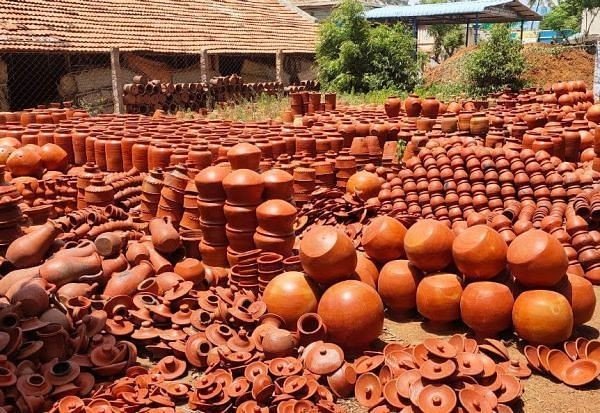
Manamadurai Pottery
The Soul of the Soil: The Enduring Legacy and Art of Manamadurai Pottery
If you travel down the dusty, sun-baked Kochi-Dhanushkodi National Highway, roughly 60 kilometers southeast of Madurai, you will cross the legendary Vaigai River. Here lies the ancient town of Manamadurai, a place where time seems to slow down, dictated by the rhythmic spinning of wooden potter’s wheels and the crackling of earthen kilns. To the untrained eye, the pots drying in the sun might look like ordinary clay vessels. But within the walls of these earthen creations lies a millennia-old tradition, a unique geographical phenomenon, and a symphony of the five elements.
Recently recognized on the global stage with a Geographical Indication (GI) tag, Manamadurai pottery is not just a rural craft; it is a masterpiece of indigenous science and artistry. From the humble cooking pot that balances the acidity of a South Indian curry to the complex percussion instrument that resonates in global concert halls, the story of Manamadurai pottery is a fascinating journey from the riverbed to the pinnacle of cultural heritage.
The Mythological Echoes: “The Land of the Valiant Monkeys”
To understand the reverence the locals hold for their land, one must look at the etymology of Manamadurai itself. According to regional lore, the town’s history is deeply intertwined with the Indian epic, the Ramayana.
When Lord Rama was marching towards Lanka to rescue his wife, Sita, it is believed that his army of monkey warriors—the Vanara Sena—camped along the banks of the Vaigai River in this exact region to rest and strategize. In honor of their bravery, the area was supposedly named “Vanara Veera Madurai” (The Madurai of the Valiant Monkeys). Over centuries of linguistic evolution, the name gracefully morphed into “Vanamadurai” and eventually settled into the “Manamadurai” we know today.
Historical inscriptions from the Pandyan era, dating back to the 1700s, actually refer to the town as “Vana Veera Madurai,” corroborating this ancient nomenclature. This deep-seated mythological connection instills a sense of sacredness into the very earth of the town, an earth that forms the foundation of its most famous export.
The Vaigai’s Gift: The Secret in the Soil
Pottery is made all over India, from the blue ceramics of Jaipur to the black clay of Nizamabad. What, then, makes the pottery of a small town in the Sivaganga district so exceptionally durable and highly sought after? The secret lies entirely in the unique composition of the local soil, a gift from the Vaigai River.
As the Vaigai winds its way through mountains and forests before reaching Manamadurai, it carries with it a rich, dense load of minerals. The potters do not just dig up any dirt; they source a highly specific type of clay from rain-fed water bodies and tanks surrounding the town, such as Nedunkulam, Nathapurakki, Sundaranadappu, and Seikalathur.
This specific clay boasts an incredibly high tensile strength and a unique porous nature. It is naturally rich in essential minerals, which gives the finished products an unparalleled ability to withstand extreme thermal shock. A Manamadurai cooking pot can go from a cold kitchen counter to a roaring open flame without cracking—a feat that standard terracotta struggles to achieve.
The Alchemy of the Elements: The Crafting Process
Creating Manamadurai pottery is an intricate dance of the Pancha Bhoota—the five elements of nature: Earth, Water, Fire, Air, and Space. The Wikipedia documentation and traditional artisan practices reveal a highly specialized, scientific process that has been passed down through generations.
- Preparation and Purification: The raw clay is never used immediately. It is collected and left to dry in the harsh sun for several days. Once dried, it undergoes a rigorous sieving process to remove stones, twigs, and coarse impurities. The pure, fine mud is then mixed with water from the Vaigai to create a thick, pliable slurry.
- The Mineral Cocktail: This is where the Manamadurai artisans act as master chemists. To achieve the signature durability and specific acoustic properties (especially for musical instruments), the clay slurry is fortified with a precise, closely guarded ratio of additives. These include fine river sand, calcium lime, ash, sodium silicate, manganese, iron, and crucially, trace amounts of lead and graphite. This mixture dramatically improves the structural integrity and tonal quality of the baked clay.
- Shaping on the Wheel:
The kneaded clay is placed on the center of the potter’s wheel. As the wheel spins, the artisan’s wet hands coax the lifeless lump into a perfect vessel. The geometry must be flawless. The circumference of the belly and the width of the neck must be mathematically proportionate so that the final pot sits perfectly flat on the ground.
- Tempering and Beating: Perhaps the most physically demanding stage is the tempering. After the pot is partially dried in the shade, the artisan uses a smooth, round stone held inside the pot and a flat wooden spatula (paddle) on the outside. They rhythmically beat the walls of the pot. This compresses the clay molecules, eliminates hidden air bubbles, and ensures a perfectly uniform wall thickness—a critical factor for both cooking pots and musical instruments.
- The Baptism of Fire: The dried pots are stacked in traditional wood-fired kilns. For over 12 hours, they are subjected to intense heat. The fire interacts with the iron and manganese in the clay, permanently transforming the gray mud into a brilliant, deep reddish-brown hue. Once cooled, they are often finished with natural plant-based polishes.
The Heartbeat of Carnatic Music: The Manamadurai Ghatam
While the town produces thousands of cooking pots, its most prestigious creation is the Ghatam—one of the oldest percussion instruments in Indian classical music. Though it looks like a standard water pot, a musical Ghatam is an entirely different beast.
In the world of Carnatic music, there are generally two types of Ghatams: the Madras Ghatam and the Manamadurai Ghatam. The Madras version is lighter, thinner, and easier to play, making it ideal for students. The Manamadurai Ghatam, however, is the weapon of choice for masters.
It is significantly thicker, heavier (weighing up to 16 kilograms before firing), and incredibly difficult to play, requiring immense finger strength. But the reward is a breathtaking, deep, sharp, and metallic ringing tone that cuts through a concert hall. This metallic resonance is achieved by mixing brass and copper dust into the clay during the preparation stage.
Grammy Award-winning percussionist T.H. Vinayakram (fondly known as Vikku Vinayakram) catapulted the Manamadurai Ghatam onto the global stage, using it in fusion concerts worldwide. Today, musicians from Japan, the USA, and Europe travel to the narrow lanes of Manamadurai specifically to commission these earthen drums, matching the pitch of the pot to their exact vocal or instrumental requirements.
Festivals, Gods, and Daily Life
Beyond the concert halls, the potters of Manamadurai are the unsung heroes of South Indian festivals. Their repertoire expands vastly depending on the religious calendar.
- Pongal: In January, the town produces tens of thousands of beautifully painted pots for the harvest festival. Cooking the new rice in a fresh Manamadurai pot is considered highly auspicious.
- Karthigai Deepam: During the festival of lights, artisans work overtime to craft millions of Kiliyan Chatti (small earthen oil lamps) that illuminate homes across the state.
- Navaratri Golu Dolls: Come October, the town transforms into a sculptural studio. Artisans mold exquisite, eco-friendly clay idols of deities—from towering statues of Goddess Meenakshi to intricate sets of the Dasavatara. Because these are painted with natural, water-soluble colors, they dissolve harmlessly in rivers and lakes, offering a sustainable alternative to toxic Plaster of Paris idols.
The pottery also holds the key to incredible health benefits. The porous nature of the clay allows heat and moisture to circulate evenly during cooking, preserving vital nutrients that are often destroyed in modern metal cookware. Furthermore, clay’s natural alkalinity neutralizes the acids in food, making traditional gravies significantly easier to digest.
The Shield of the GI Tag
For decades, the artisans of Manamadurai faced a silent crisis. Cheap, mass-produced clay pots from other districts were being fraudulently sold under the “Manamadurai” name, undercutting the genuine artisans and diluting the town’s hard-earned reputation.
To combat this, the Manamadurai Pottery Works Cottage Industrial Co-operative Society launched a long legal battle. Their efforts bore fruit on March 31, 2023, when the Government of India officially granted Manamadurai Pottery the Geographical Indication (GI) tag (Certificate No. 446).
This intellectual property right acts as a legal shield. It formally recognizes that the unique qualities of this pottery—its strength, color, and acoustic resonance—are directly attributable to the geographic environment of the Vaigai river basin and the ancestral skills of the local potters. Today, no one outside the specified geographic area can legally market their wares as “Manamadurai Pottery,” ensuring that the economic benefits flow directly back to the true creators.
Modern Challenges and the Artisan’s Resilience
Despite the glory of the GI tag, the reality on the ground remains harsh. In neighborhoods like Kulalar Street, Udaykulam, and Thiruppuvanam, around 350 families have been practicing this craft for over four generations.
Pottery is an unforgiving, weather-dependent profession. During the heavy monsoon months, the artisans cannot dry their clay or fire their kilns, leaving them without income for extended periods. Furthermore, the grueling physical labor and the lure of lucrative corporate jobs are driving the younger generation away from the potter’s wheel.
The artisans are advocating for sustainable government interventions to keep the craft alive. A popular proposal is for the state’s horticulture and forestry departments to replace single-use plastic nursery bags with small, biodegradable Manamadurai clay pots for saplings. Such initiatives would provide year-round financial stability to the artisans while simultaneously combating plastic pollution.
Manamadurai pottery is far more than baked mud. It is a tangible piece of Tamil Nadu’s history, a marvel of indigenous geology, and the rhythmic heartbeat of classical music. It represents an era where human beings worked in perfect synergy with nature, taking only what the river offered and transforming it into functional art.
In a modern world cluttered with Teflon, aluminum, and synthetic plastics, returning to earthenware is not just a nod to nostalgia; it is a conscious choice for better health and environmental sustainability. The next time you listen to the hypnotic beats of a Carnatic percussion ensemble, or savor a slow-cooked traditional stew, remember the tireless hands of the Manamadurai potters who shaped the earth to bring you that joy.