
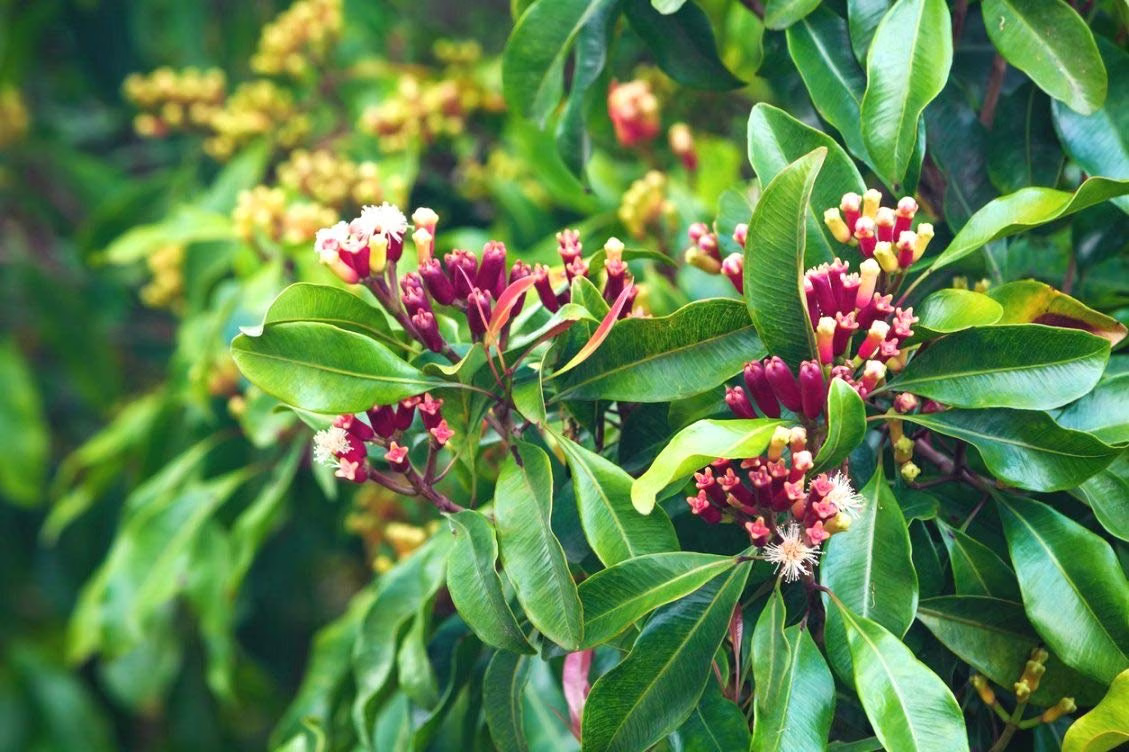
The Scent of the Southern Ghats: The Chronicles of the Kanniyakumari Clove
High above the tip of the Indian peninsula, where the Western Ghats make their final, majestic descent toward the confluence of three oceans, lies a landscape perpetually shrouded in a mysterious, fragrant mist. For centuries, travelers have sought the “Land’s End” at Kanyakumari for its spiritual resonance and sunrises, but few realized that just a few thousand feet above the bustling coast, a botanical treasure was quietly evolving. This is the realm of the Kanniyakumari Clove, a spice so potent and storied that it has transcended its Indonesian origins to become the undisputed “Ruby of the South.”
To understand the Kanniyakumari Clove is to understand a history of global trade, colonial ambition, and a unique geological fluke that turned a small corner of Tamil Nadu into a spice powerhouse. Today, this clove stands as a sentinel of quality, distinguished by a Geographical Indication (GI) tag and a chemical profile that makes it the envy of spice merchants from Zanzibar to Amsterdam.
A Global Wanderer Finds a Home: The Colonial Origins
The story of the clove is, at its heart, a story of an ancient wanderer. Long before it graced the hills of Tamil Nadu, the clove (Syzygium aromaticum) was a fiercely guarded secret of the “Spice Islands”—the Moluccas in modern-day Indonesia. For nearly two millennia, these dried flower buds were worth more than their weight in gold, fueling the rise and fall of empires. The Chinese Han Dynasty utilized them as breath fresheners for courtiers meeting the Emperor, while the Romans sought them for their numbing medicinal properties.
The clove’s journey to the Indian mainland was orchestrated by the East India Company in the early 19th century. Around 1800, British planters, eager to break the Dutch monopoly on the spice trade, introduced the first clove seedlings into their “spice gardens” in Courtallam. While the seedlings flourished in several parts of the Western Ghats, it was in the high-altitude, densely wooded regions of the erstwhile South Travancore region—today’s Kanyakumari district—that the plant found its ultimate sanctuary. By the mid-19th century, estates like Maramalai and Blackrock began to emerge as specialized centers of cultivation. These pioneers realized that the particular ecology of the Mahendragiri and Veerapuli Reserve Forest hills offered something no other Indian terrain could replicate.
The Geography of Perfection: Sea Mist and Dual Monsoons
What makes a clove from Kanyakumari different from one grown in Madagascar or even neighboring Kerala? The answer lies in a phenomenon the local planters call the “sea mist.” Kanyakumari district is uniquely positioned to receive both the Southwest and the Northeast monsoons. This dual rainfall ensures that the soil remains consistently moist, but it is the proximity to the ocean that provides the secret ingredient.
As the warm air from the Arabian Sea and the Bay of Bengal rises against the steep slopes of the Western Ghats, it cools and forms a dense, salty mist. This mist blankets the clove estates of Maramalai, Karumparai, and Vellimalai at elevations between 400 and 900 meters. The humidity, combined with the rich, black loamy soil high in humus content, creates a micro-climate that stresses the tree just enough to concentrate its essential oils. In these hills, the trees do not merely grow; they thrive in a state of aromatic intensity. It is this specific intersection of mountain altitude and maritime influence that gives the Kanniyakumari Clove its signature dark brown hue and its exceptionally plump, well-formed buds.
The Artisan’s Harvest: A Tradition of Heights
The cultivation of cloves in Kanyakumari is not a task for the faint of heart. The evergreen clove tree can reach heights of 15 to 20 meters and can live for well over a century. In many of the larger estates, trees planted during the British era are still yielding harvests today, their gnarled trunks standing as silent witnesses to generations of farming families. The harvest season, typically falling between December and April, transforms the quiet hills into hives of specialized activity.
The harvesting process is an art form passed down through lineage. Because the clove of commerce is actually the unopened flower bud, timing is everything. If the bud is picked too early, it lacks oil; if it is picked after it blooms, it loses its value as a spice. Laborers must identify the exact moment when the base of the green calyx turns a delicate shade of pink.
To reach these buds, workers utilize “rope stilts” and traditional bamboo ladders, performing a precarious dance high above the forest floor. They must pluck the clusters by hand, taking care not to damage the tender branches, as the tree bears fruit on the terminal shoots of its twigs. Once harvested, the buds are separated from their stalks—a process that must be done immediately to prevent fermentation—and spread out on mats to dry in the mild mountain sun. This natural drying process, occurring at high altitudes with moderate temperatures, ensures that the volatile oils do not evaporate but rather concentrate within the bud.
The Chemistry of Quality: A 21% Miracle
In the world of spices, the “Standard Clove” typically contains a volatile oil content of about 18%. However, laboratory analysis of the Kanniyakumari variety consistently reveals a staggering 21% oil concentration. This is not a mere statistical vanity; it translates directly into flavor, aroma, and medicinal efficacy. The primary component of this oil is Eugenol, a chemical compound renowned for its antiseptic and anesthetic properties.
The Kanniyakumari Clove contains a higher percentage of Eugenol and Eugenol Acetate than almost any other variety in the world. This is why it is the preferred choice for high-end perfumery and pharmaceutical preparations. When you crush a Kanniyakumari Clove, the scent is not just “spicy”—it is heady, woody, and slightly sweet, with a lingering warmth that speaks of its high resin content. This chemical superiority was a driving factor in the district administration’s push to secure the Geographical Indication (GI) tag, an effort championed by the Maramalai and Blackrock Hill Planters Associations. Awarded in 2021, the GI tag officially recognized that the “Kanniyakumari Clove” is a unique product of its environment, impossible to replicate elsewhere.
The Medicinal Heritage: From Ayurveda to Modern Clinics
The historical significance of the clove in India extends far beyond the kitchen. In the traditional Ayurvedic and Siddha systems of medicine, the clove is regarded as a powerful Vata-balancing agent. For centuries, practitioners in the Nanjil Nadu region (modern Kanyakumari) have used clove oil for dental emergencies, utilizing its natural numbing effect to treat toothaches and gum infections.
Beyond oral health, the Kanniyakumari Clove is central to respiratory treatments. A traditional decoction of these cloves is often prescribed for asthma and chronic coughs, acting as an expectorant. Modern science has begun to validate these ancient practices, with studies highlighting the spice’s antioxidant and antimicrobial properties. In the local culture, a piece of clove is often kept in the mouth as a natural digestive aid after a heavy meal—a practice that reflects the deep integration of this “immigrant” spice into the local lifestyle.
Culinary Royalty: The Soul of the Biryani
While its medicinal uses are profound, the clove’s most visible impact is on the plate. In the rich culinary landscape of South India, particularly in the Nanjil Nadu and Chettinad styles, the clove is a cornerstone of the Garam Masala. It provides the base note for the legendary biryanis of the region, where its robust flavor holds up against the long cooking times and heavy fats.
Because the Kanniyakumari Clove is so oil-rich, chefs find that they need far fewer buds to achieve a deep, aromatic profile. It doesn’t just provide heat; it provides a “roundedness” to gravies. In the traditional spice markets of Nagercoil, traders often demonstrate the quality of the clove by pressing it with a fingernail; if a bead of oil appears instantly, it is identified as the true “Kanyakumari Clove.” It has also found a place in the international chocolate and confectionery industry, where its high eugenol content is used to enhance the complexity of dark cocoa.
A Legacy at Risk: The Modern Challenges
Despite its global reputation, the future of the Kanniyakumari Clove is not without its shadows. The cultivation is centered around approximately 760 to 1,000 hectares of land, much of it in the hands of small-scale farmers and a few historic estates. Climate change is perhaps the greatest threat, as the “sea mist” is becoming more unpredictable. Excessive rain during the flowering season can wash away the pollen, while prolonged dry spells can lead to “khoker” cloves—buds that are pale, wrinkled, and lacking in oil.
Furthermore, the labor-intensive nature of the harvest is leading to a shortage of skilled climbers. The younger generation, drawn to urban centers, is less inclined to spend their days atop twenty-meter ladders in the humid forests. However, the GI tag has provided a renewed sense of pride and economic incentive. By ensuring that the “Kanniyakumari” name carries a premium price, it has encouraged planters to rejuvenate their century-old plantations and adopt more scientific post-harvest technologies.
The Eternal Aroma
As one stands on the heights of the Maruthuvazh Malai, looking out toward the distant glitter of the Cape, it is easy to see why this region was chosen for the clove. It is a land where the elements conspire to create perfection. The Kanniyakumari Clove is more than just a dried flower bud; it is a symbol of the district’s agricultural resilience. It is a spice that survived a 4,000-mile journey from the Moluccas, adapted to the salt and soil of the Tamil hills, and rose to become the finest of its kind in the world.
From the first British seedlings in Courtallam to the modern-day GI-tagged exports, the journey of this clove is a testament to the fact that when nature and human tradition align, the result is nothing short of legendary. For the general audience, the next time you encounter that sharp, comforting scent of a clove in your tea or meal, remember the “sea mist” of the Southern Ghats. Remember the century-old trees and the brave climbers of Kanyakumari, who continue to harvest the “Ruby of the South” so that the world may continue to taste the history of Land’s End.
The story of the Kanniyakumari Clove is far from over; it is a living, breathing history, renewed with every monsoon and every pink-tipped bud that reaches for the sun.