
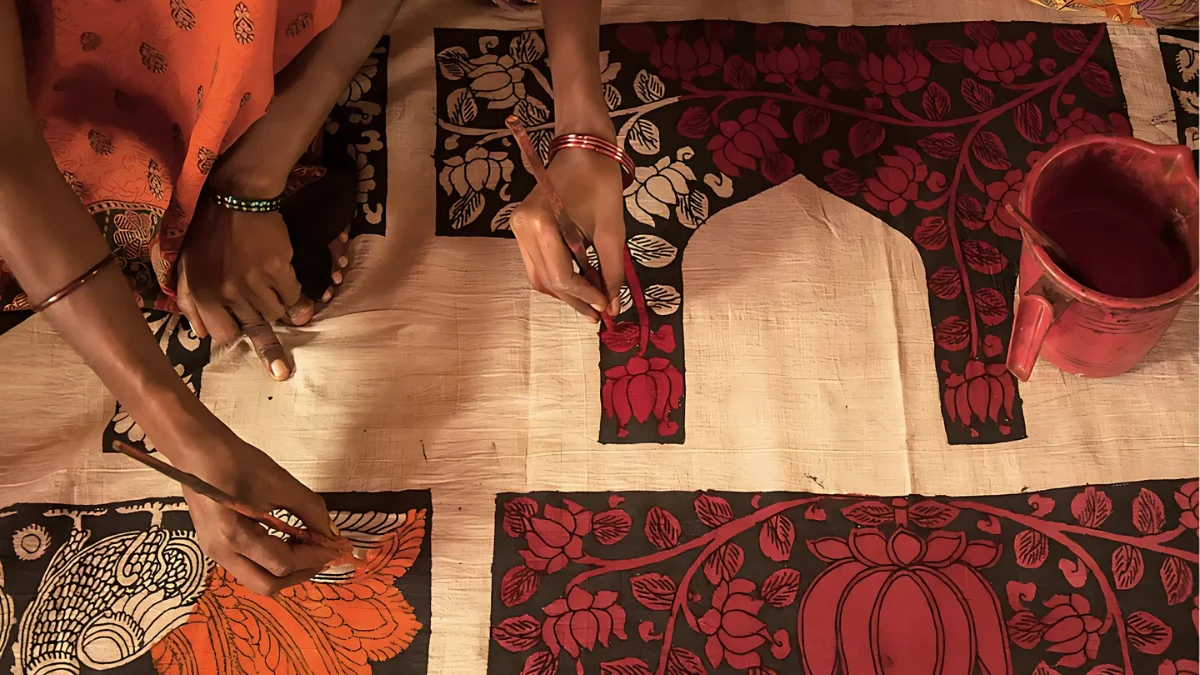
Karuppur Kalamkari Paintings
In the quiet, sun-drenched town of Thanjavur, where the air is often thick with the scent of jasmine and the distant tolling of temple bells, there exists a craft so rare that for nearly a century, it was whispered of only in the memories of aged royal weavers. This is the story of Karuppur Kalamkari, a textile art that does not merely sit upon the cloth but is birthed into it through a ritual of fire, water, and an alchemist’s devotion to nature.
As a historical writer, one finds that the most profound stories are often hidden in the smallest details—the curve of a bamboo pen, the specific shade of a madder root, or the way a river’s mineral content can permanently bond a color to a fiber. Karuppur Kalamkari is one such story. It is a tale that bridges the gap between the nomadic storytellers of ancient India and the high courts of the Maratha Kings, creating a legacy that was recently resurrected from the brink of extinction.
The Pen and the Pulse: Origins of the ‘Chithira Paddam’
The word ‘Kalamkari’ itself is a Persian construct—Kalam meaning pen and Kari meaning craftsmanship. It suggests an intersection of cultures, a middle ground where the sophisticated aesthetics of the Persian courts met the raw, devotional fervor of Indian temple art. However, in the heart of Tamil Nadu, the locals historically knew this art by a more evocative name: Chithira Paddam, or “Picture Trace.”
While many associate Kalamkari with the famous centers of Srikalahasti and Machilipatnam in Andhra Pradesh, Karuppur Kalamkari is a distinct, more elusive sibling. Its origins are often traced back to the 16th century, during the reign of Sevappa Nayak, the first Nayaka ruler of Thanjavur. Legend has it that Sevappa, a man of profound aesthetic sensibilities, invited a contingent of master artists from Karuppur to settle near the capital. Their mission was not merely to paint, but to turn the very walls and ceilings of the palaces and temples into visual scriptures.
A Royal Obsession: The Gold-Tinted ‘Kodali Karuppur’
By the 18th and 19th centuries, under the Thanjavur Marathas, the art reached its zenith. The Maratha rulers, particularly the polymath Raja Serfoji II, were legendary patrons of the arts. It was during this period that a specific variation emerged, known as the Kodali Karuppur Saree.
These were not ordinary garments. They were textiles of extreme luxury, intended exclusively for the Maratha royalty and high-ranking nobility. The technique was revolutionary: the weavers would first create a saree with intricate gold zari (brocade) work. Once the loom was finished, the Kalamkari artists would step in. Using their bamboo pens, they would paint intricate motifs around the gold work. This hybrid of weaving and hand-painting created a 3D effect that shimmered under the palace oil lamps. A single Kodali Karuppur saree could take up to a year to complete, involving the synchronized efforts of master weavers and master painters. It was said that the queens of Thanjavur valued these sarees more than their jewels, for while gold could be bought, the “soul” of the Karuppur brush could only be gifted.
The Alchemist’s Ritual: The 23 Steps of Creation
To describe Karuppur Kalamkari as “painting on cloth” is an injustice. It is a laborious, 23-step metallurgical and biological process. The journey of a single piece of fabric begins with Gada cloth, a pure, unbleached cotton. But the cloth cannot simply be painted; it must be tamed.
The first stage is a series of “washes” that sound more like a witch’s brew than a manufacturing process. The fabric is treated with a mixture of cow dung and water to bleach it naturally, followed by a soak in buffalo milk mixed with Myrobalan (Kadu-kai) seeds. This isn’t for softening; the fats in the buffalo milk act as a mordant, creating a chemical bond that prevents the dyes from smudging. As the artist moves their pen across the milk-treated surface, the lines stay sharp, as if etched into stone.
The Palette of the Earth: Dyes from the Wild
One of the most fascinating aspects of Karuppur Kalamkari is its strict adherence to natural pigments. In a world of synthetic neons, the Karuppur artist works in the colors of the earth:
The Black (Kasimi): This is perhaps the most magical concoction. It is made by fermenting rusted iron scraps with palm jaggery and water for 21 days. The result is a deep, indelible black that only grows richer with age.
The Red: Derived from the roots of the Manjistha (Madder) plant or the bark of certain local trees.
The Yellow: Extracted from pomegranate peels or turmeric.
The tools themselves are extensions of the forest. The Kalam is a piece of bamboo or a stick from the Echam (date palm) tree. A small piece of wool or felt is tied around the tip, acting as a reservoir for the dye. When the artist squeezes the wool, the liquid flows down the sharpened bamboo tip with the precision of a fountain pen.
The Secret Ingredient: The Waters of the Cauvery
Historians and artisans alike agree that Karuppur Kalamkari owes its existence to the Cauvery River. The specific mineral content of the river water around Thanjavur and Kumbakonam is the silent partner in the art. After each color application, the cloth must be washed in running water. The minerals in the Cauvery act as natural fixing agents, ensuring that the reds remain vibrant and the blacks don’t bleed.
In the old days, a traveler walking along the banks of the Cauvery during a festival season would see hundreds of feet of painted cloth laid out on the sand to dry under the tropical sun. The sun’s ultraviolet rays were the final “baking” process, permanentizing the bond between the vegetable dye and the cotton fiber.
Srikalahasti vs. Karuppur: A Tale of Two Styles
To the untrained eye, all Kalamkari looks similar. However, the Karuppur style has its own unique visual vocabulary that distinguishes it from the better-known Srikalahasti style. While Srikalahasti is deeply narrative—often depicting entire episodes of the Ramayana or Mahabharata with sprawling figures—the Karuppur style is more ornamental and geometric.
Karuppur motifs often lean heavily into nature and courtly life. You will see the Thazhampoo (screw-pine flower) motif, intricate vine patterns known as Kodival, and the majestic Annapakshi (mythical swan). Under the Marathas, the designs became even more stylized, incorporating Persian-influenced floral borders that reflected the cosmopolitan nature of the Thanjavur court. While Srikalahasti tells a story, Karuppur sets a mood—one of regal elegance and rhythmic symmetry.
The Sacred Canopy: Art for the Deities
Beyond royal garments, Karuppur Kalamkari held a sacred status in South Indian temples. It was used to create Asmanagiris (false ceilings for the sanctum sanctorum), Vasamalais (door hangings), and Thombais (cylindrical hangings). During the Panguni Uthiram festival, the giant temple chariots of Thanjavur were adorned with these hand-painted cloths, turning the wooden structures into moving galleries of art.
Because the dyes were all-natural and the motifs followed the Agama Shastras (temple laws), these textiles were considered “pure” and fit for the presence of the gods. The act of painting was, in itself, an act of meditation. An artist would often fast or pray before beginning a major temple canopy, believing that their hand was merely a vessel for divine inspiration.
The Long Winter and the 2021 Resurrection
With the fall of the Thanjavur Maratha kingdom in 1855 and the subsequent British industrialization, Karuppur Kalamkari began a slow decline. The advent of machine-printed textiles and cheap chemical dyes made the 23-step manual process economically unviable. By the mid-20th century, the art of the Kodali Karuppur saree had virtually disappeared, and only a handful of families in Karuppur and nearby Sikkanayakkanpettai kept the flame alive, mostly by making simple temple hangings.
However, the tide turned in October 2021. In a historic move, the Geographical Indication (GI) Tag was awarded to Karuppur Kalamkari Paintings. This legal protection meant that no one else in the world could use the name “Karuppur Kalamkari” for machine prints or non-traditional products. This recognition, sparked by the efforts of the Tamil Nadu Handicrafts Development Corporation (Poompuhar), acted as a lightning bolt for the community.
Epilogue: The Living Canvas
Today, Karuppur is seeing a quiet renaissance. Young artists, some of whom are 10th-generation practitioners, are returning to the bamboo pen. They are no longer just making temple hangings; they are collaborating with high-fashion designers to bring the “Karuppur aesthetic” to scarves, wall art, and contemporary sarees.
As a historical writer, observing this revival is like watching a dormant seed finally find water. Karuppur Kalamkari is a reminder that some things cannot be rushed. You cannot machine-print the smell of fermented jaggery or the specific vibration of a sun-dried cloth. In every stroke of the Karuppur pen, there is 500 years of Thanjavur history, the spirit of the Maratha kings, and the eternal flow of the Cauvery. It is a canvas that breathes, a piece of art that lives, and a story that—thanks to the resilience of a few—will continue to be told in the language of color and cloth.