
Thanjavur Netti Works
In the heart of the Cauvery delta, where the river’s silt-laden waters have nurtured empires for millennia, a quiet art form breathes life into the humble reeds of the marshland. To a traveler, the aquatic plant known as Aeschynomene aspera might seem like mere greenery clogging the irrigation tanks of Thanjavur and Mannargudi. But to the hereditary artisans of this region, it is “Netti”—the “White Gold” that, under the sharp edge of a knife, transforms into celestial chariots and miniature temples so delicate they seem to be carved from ivory or frozen moonbeams.
As a chronicler of Thanjavur’s heritage, one finds that Thanjavur Netti Works (Pith Work) is more than just a craft; it is a spiritual geography of the region, recently elevated to the global stage with its Geographical Indication (GI) Tag in 2020. It is a story of how a weed from the swamp became a centerpiece in the Maratha palaces and a timeless symbol of Tamil architectural genius.
The Marshland Alchemists: Origins and Ritual Roots
The story of Netti work is deeply entwined with the agrarian calendar of Tamil Nadu. Long before it became a refined palace craft, it was a utilitarian folk art born out of the harvest festivals. During Mattu Pongal, the day dedicated to honoring cattle, farmers would slice the pith into thin, translucent wafers, curling them into vibrant garlands and ornaments for their bulls. This “ritual origin” is the heartbeat of Netti; it was a way for the common man to offer the beauty of nature back to the land.
However, the craft’s transition from folk ornament to high art occurred during the Maratha rule in Thanjavur (1676–1855). The Maratha kings, especially the polymath Raja Serfoji II, were legendary patrons who established a creative ecosystem in the Thanjavur court. They invited craftsmen to experiment with the pith, encouraging them to create architectural models that could withstand the passage of time. The Maratha records in the Tanjore Gazette note that by 1907, the industry had become a prestigious mainstay of the region, with its products being sought after by nobility across the Madras Presidency.
Aeschynomene Aspera: The Anatomy of a Hydrophyte
The material itself is a botanical wonder. Unlike wood, which is dense and fibrous, the Netti plant is a hydrophyte—a water reed that grows in marshy wetlands. Its stem contains a milky-white, spongy core that is exceptionally lightweight, porous, and malleable.
The artisans harvest these reeds between December and February, when the stems are at their thickest. The process of preparation is a study in patience. The brown, woody outer skin is carefully shaved away with long, razor-sharp knives, revealing a core that is as white as freshly fallen snow. This core is then sliced into translucent sheets—often as thin as tissue paper—that can be moulded, bent, or carved into microscopic details. This raw material is so delicate that it requires a “feather-light” touch; a single errant breath or a heavy-handed grip can crush the fragile cells of the pith.
The Chisel-less Sculpture: The Master’s Process
Unlike stone or wood carving, where a hammer and chisel are the primary tools, Thanjavur Netti work is a “knife-and-paste” art. The workshop of a Netti artisan is surprisingly quiet. There is no loud hammering, only the soft shush of a blade through sponge.
Preparation: The dried pith sticks are cut into manageable lengths and the cortex is removed.
Slicing: Using a specialized long knife, the artisan “unrolls” the pith cylinder into thin, flat sheets, much like peeling an apple in one continuous strip.
Carving: These sheets are then cut into thousands of tiny components—individual pillars, tiny bells, delicate floral motifs, and the intricate tiers of a Vimana (temple tower).
Assembly: Using a natural adhesive (often a gum made from local seeds), the components are assembled piece by piece.
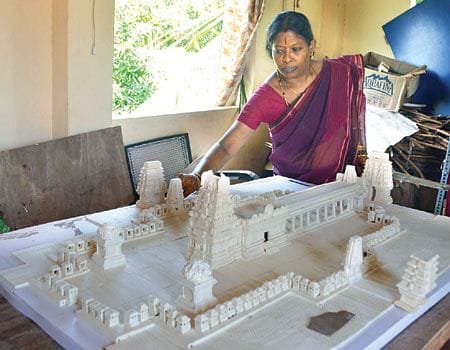
The true test of a Netti master is the Thanjavur Brihadeeshwara Temple replica. To recreate the 216-foot-tall “Big Temple” in a twelve-inch Netti model requires an intimate knowledge of Chola architecture. Every tiny sculpture on the gopuram, every pillar in the Nandi Mandapam, must be rendered with mathematical precision. Because pith does not warp or rot easily if kept dry, these models can last for over a century, preserved within glass cases that shield them from their only true enemies: moisture and dust.
The “Ivory of the Poor” and the Maratha Synthesis
Historically, Netti work was often referred to as the “Ivory of the Poor,” but this moniker is somewhat misleading. While the material was accessible, the level of skill required to manipulate it was so high that its products were far from “common.” During the Maratha period, the synthesis of Maratha aesthetics and Tamil craftsmanship resulted in highly ornate designs.
The Maratha rulers commissioned Netti models of famous buildings—not just temples, but also the Sarja Madi (part of the Thanjavur Palace) and even secular structures like the Arsenal Tower. These models served as architectural blueprints and commemorative gifts. The artisans also developed the art of making Dindaram—jasmine-like strands made of Netti that Bharatnatyam dancers wear in their hair. Since real jasmine wilts under the stage lights, the “ever-blooming” Netti jasmine became a staple of the classical dance world.
From Extinction to the GI Tag: A Modern Resurrection
By the late 20th century, Thanjavur Netti work faced a silent crisis. The vanishing of water bodies around Thanjavur made raw material scarce, and the rise of cheap thermocol (polystyrene) models threatened to push the craft into the footnotes of history. Thermocol, while easy to shape, is a non-biodegradable pollutant that lacks the luster and cultural weight of Netti.
The GI Tag awarded in May 2020 was the “victory of the wetlands.” This legal protection ensured that only products made from the authentic Aeschynomene aspera in the Thanjavur region could bear the name. This sparked a renewed interest among architecture students and heritage enthusiasts. In 2024 and 2025, efforts by organizations like INTACH and the Tamil Nadu Handicrafts Development Corporation (Poompuhar) have focused on “Modern Netti,” creating souvenirs like framed wall art and miniature deity idols that fit into contemporary urban homes.
Current news from 2026 suggests that Thanjavur is on track to lead the nation in GI tags, with Netti work being one of its most successful “revived” industries. The state government has even proposed the creation of a “Netti Cluster” in Pudukkottai to centralize raw material processing and provide better market access for the remaining master craftsmen.
The Legacy of the Marshland
To look at a finished Thanjavur Netti piece is to witness a paradox: it is an object made of a weed, yet it possesses the majesty of marble. It is as light as air, yet it carries the weight of a thousand years of history.
As a historical writer, I see the Netti work not just as a handicraft, but as an ecological lesson. It reminds us that our ancestors didn’t look for beauty in rare, imported materials; they found it in the marshes behind their homes. They saw the “White Gold” hidden inside a water reed and used it to build temples that never wilt. As long as the Cauvery flows and the marshlands are protected, the ethereal white towers of Arumbavur and Thanjavur will continue to rise—one thin slice of pith at a time.