
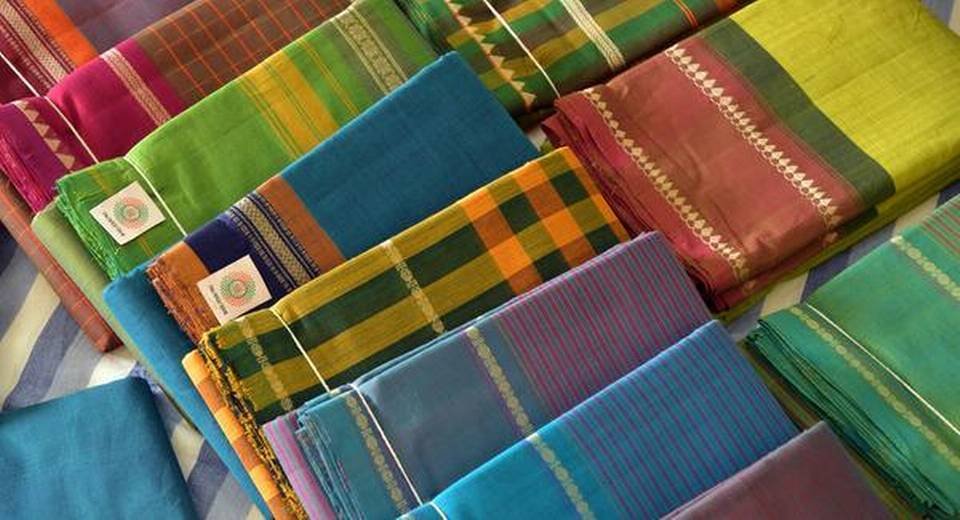
Kandangi saree
The Chromatic Soul: Red, Mustard, and Black
The visual identity of a Kandangi is unmistakable. Historically, the color palette was dictated by the geography of the Chettinad region. Because the land was harsh and resources were precious, weavers relied on natural dyes that could be sourced locally or traded easily. This led to the holy trinity of Kandangi colors: Deep Brick Red (Manchatti), Mustard Yellow (Manjal), and Vibrant Black.
These colors were not merely aesthetic choices; they were chosen for their permanence. In the blistering heat of the Tamil Nadu sun, these deep, saturated hues refused to fade. The saree is characterized by its bold “checks” and “stripes,” often arranged in a tripartite design known as Mubbagam. This design features a central body of checks flanked by two broad, contrasting borders. These borders are frequently adorned with the Gopuram (temple tower) motif, a nod to the spiritual anchors of the 75 villages that make up Chettinad.
The Anatomy of the Aachi: Anklets and Altitudes
Perhaps the most fascinating aspect of the Kandangi saree is how it was historically worn. In the late 19th and early 20th centuries, the women of the Chettiar community, known as Aachis, were the matriarchs of massive joint families while their men were away on sea voyages for trade. They required an attire that was practical yet regal.
The traditional Kandangi was shorter and narrower than the standard six-yard saree we see today. It usually measured between 4 and 4.5 yards. The Aachis draped it in a specific style that left the saree ending just above the ankles. This wasn’t a fashion statement—it was a necessity. Chettinad houses were gargantuan, and women were constantly in motion. A shorter drape ensured that the saree didn’t drag on the floor or get caught as they worked.
Moreover, the Nagarathar women were famous for their heavy, ornate silver anklets (Tandatti). The elevated drape of the Kandangi served as a deliberate stage to showcase these exquisite pieces of jewelry. Historically, these sarees were also worn without a blouse or an underskirt, which is why the weave had to be exceptionally thick and opaque.
“The Kandangi was built like the Chettiar mansions themselves—strong foundations, bold lines, and meant to last for generations.”
A North-Indian Hand in a South-Indian Loom
A historical irony lies at the heart of the Kandangi: this quintessentially Tamil saree was largely crafted by a community of weavers who migrated from the North. The Devanga Chettiars and Saurashtrians, who had moved South centuries ago under the patronage of various kings, became the primary architects of the Kandangi.
In the village of Karaikudi, these weavers established a hereditary practice that continues to this day, though on a much smaller scale. They brought with them specialized techniques of “warping” and “sizing” that gave the Kandangi its signature stiffness. The yarn used was traditionally a coarse 40s or 60s count cotton, which, when treated with rice starch (Kanji), became almost like a suit of armor. This durability meant that a Kandangi saree didn’t need ironing; it stood its ground, quite literally, through years of use.
The Alchemy of the Pit Loom: 3,200 Threads of Patience
The creation of a single Kandangi saree is an exercise in extreme patience. Even today, the most authentic pieces are woven on Pit Looms, where the weaver sits in a literal pit dug into the earth to operate the foot pedals.
The process begins with the “sizing” of the yarn. The cotton threads are stretched out on the street—a practice known as “Street Sizing”—where a mixture of rice gruel and oil is brushed into the fibers. This makes the yarn strong enough to withstand the tension of the loom. For a standard 48-inch-wide saree, over 3,200 individual threads run along the length (the warp).
The weaver then uses a “fly-shuttle” to throw the weft (horizontal) threads across. Every time the color changes—from the checked body to the solid border—the weaver must manually manage the transition. A single high-quality Kandangi can take a skilled artisan three to four days to complete. This labor-intensive process is what makes each saree a unique work of art, distinguished by tiny, beautiful irregularities that machine-made replicas can never capture.
The Saree as a Cradle: A Fabric for the Lifecycle
In Chettinad, a Kandangi saree was never truly “retired.” Its lifespan followed the lifecycle of the family. Once the fabric became soft from decades of washing, it lost its stiffness but gained a buttery texture.
At this stage, the saree was repurposed into Tottils (cradles). The strong, breathable cotton was perfect for hanging from the sturdy teak beams of Chettinad mansions to swing a newborn to sleep. Later, the same fabric might be used as kitchen wipes or even as the base for traditional quilts. In a region where nothing was wasted, the Kandangi was the ultimate sustainable fabric.
Preservation and the GI Recognition
By the late 20th century, the Kandangi was on the brink of extinction. The “Power Loom” revolution flooded the market with cheap, thin “Chettinad Cottons” that mimicked the Kandangi’s checks but lacked its soul and weight. The number of traditional weavers dwindled from thousands to less than a hundred.
However, a turning point came in 2019, when the Kandangi Saree was officially granted the Geographical Indication (GI) Tag. This legal protection ensures that only sarees woven in the Karaikudi taluk of Sivaganga district, using traditional methods, can carry the name “Kandangi.”
This recognition, coupled with a global resurgence in “Slow Fashion,” has breathed new life into the looms. Modern designers have intervened to make the sarees lighter (using 80s or 100s count cotton) to suit the tastes of working women, while strictly maintaining the traditional color palettes and motifs.
A Heritage in Every Fold
Today, as you walk through the majestic, echoing halls of a Chettinad mansion, the Kandangi saree remains the most vibrant link to the past. It is a testament to an era when luxury was defined by durability and when a woman’s attire was a reflection of her strength and her station in life.
The Kandangi is more than just a textile; it is a piece of South Indian history that you can wrap around yourself. It carries the smell of the loom, the grit of the red earth, and the indomitable spirit of the Aachis who first made it famous