
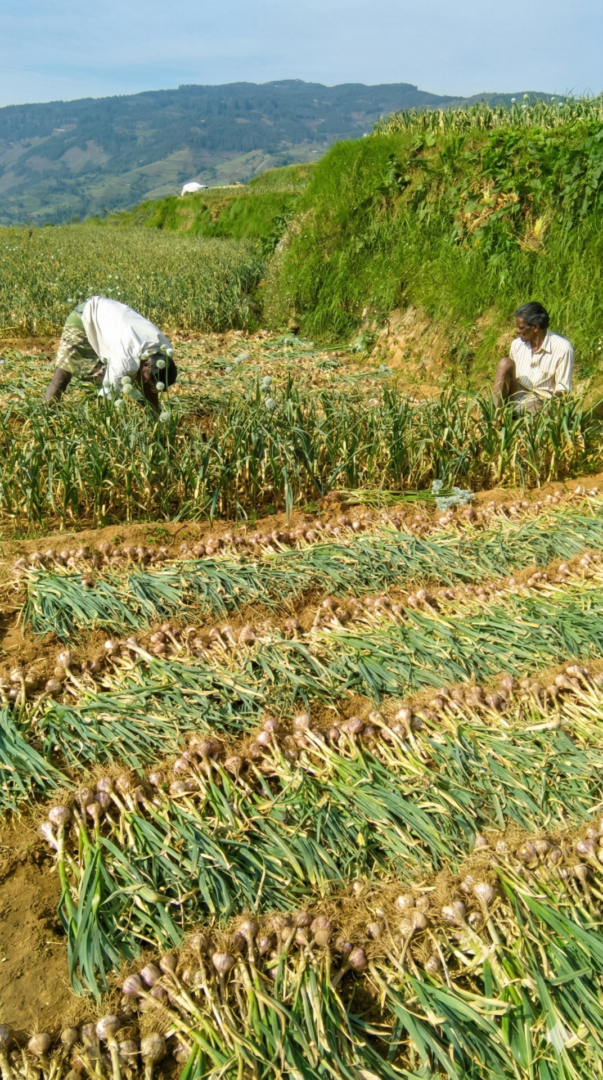
Kodaikanal Malai Poondu
The Mist-Drenched Legacy of the Garlic Continent
In the verdant, mist-shrouded peaks of the Palani Hills, where the air is perpetually tinged with the scent of pine and wild eucalyptus, a humble treasure lies buried beneath the rich, laterite soil. For centuries, the “Princess of Hill Stations,” Kodaikanal, has hidden a secret more valuable to the local populace than the gems of a royal treasury. This is the Kodaikanal Malai Poondu (Hill Garlic), a pungent, raindrop-shaped bulb that has transcended its role as a mere culinary spice to become a symbol of cultural identity, a medical panacea, and a legally protected heritage. To understand the Malai Poondu is to embark on a journey through ancient Tamil inscriptions, colonial-era adaptations, and the rigorous chemical labs of the modern day.
The Garlic Continent: Historical Roots and Ancient Edicts
The story of Kodaikanal’s garlic does not begin in a modern marketplace but in the annals of the Pandyan Dynasty. Historical records and copper plate inscriptions dating back to 1342 CE reveal a fascinating designation for the hill regions of Kodaikanal. The Pandyan King, Kulashekhara Pandyan, famously referred to the territories surrounding Poombarai, Mannavanur, and several other hill villages as the Vellaipoodu Kandam, which literally translates to the “Garlic Continent”. This moniker was not hyperbolic; it recognized the unique geographical enclave that had been producing high-quality garlic for centuries before the arrival of Europeans in the hills.
The spiritual heart of this “Garlic Continent” is the Kuzhanthai Velappar Temple in Poombarai, a site with over 3,000 years of history. Local lore and temple traditions suggest that the garlic grown in these heights was often considered a sacred offering, its purity and potency seen as a gift from the mountain deities. While ordinary garlic (Allium sativum) is found globally, the specific variety cultivated in these high-altitude terraces evolved in isolation, adapting to the thin air and specific mineral composition of the Palani Hills to become something entirely distinct.
Nature’s Laboratory: Why the Palani Hills?
What makes a bulb grown at 7,000 feet so different from its cousin in the plains? The answer lies in a rare confluence of soil chemistry and micro-climates. Most garlic varieties are sensitive to temperature extremes, but the Kodaikanal Malai Poondu thrives in a cool, temperate band between 11°C and 20°C. It is a long-duration crop, requiring approximately 120 days to reach maturity, a period during which it drinks from the unique rains of the Western Ghats and anchors itself in the region’s rich, laterite soil.
Scientific analysis conducted by institutions like Mother Teresa Women’s University has confirmed what the hill farmers have known for generations: this garlic is a nutrient powerhouse. It possesses exceptionally high levels of organosulfur compounds, phenols, and flavonoids—chemical signatures that give it an aroma so intense it can be smelled from a distance and a taste far more pungent than commercial varieties. Research suggests its medicinal potency is up to ten times more effective than other Indian garlic varieties, largely due to its concentrated antioxidant and antimicrobial properties.
The Alchemist’s Art: The Tradition of the Smoking Room
Harvesting the Malai Poondu is only the first act in a meticulous traditional process. Unlike commercial garlic, which is often chemically treated to prevent sprouting, the hill garlic relies on an ancient preservation technique known as “Pugai-koondu” or the Smoking Room. After being hand-harvested from the step-terraced farms, the garlic bulbs are tied into intricate bunches with their dried stalks.
In the villages of Villpatti, Poombarai, and Mannavanur, these bunches are hung in the rafters of traditional kitchens. As families cook over wood-burning stoves, the rising smoke envelops the garlic. This isn’t just for flavor; the smoke acts as a natural preservative, drying the outer skins to a light golden brown while keeping the inner cloves pearly white and potent. This process imbues the garlic with a phenomenal shelf life of 8 to 11 months at room temperature—unheard of in the world of fresh produce. It is this “smoked” quality that has made the Kodaikanal variety a prized export for over 150 years.
The Apothecary in a Bulb: A Traditional Medicine Chest
In the remote hill villages, where hospitals were once hours away by foot, the Malai Poondu served as the primary apothecary. Its uses in traditional Siddha medicine are vast and varied. It is the core ingredient in Poondu Laegiyum, a medicinal paste traditionally given to mothers after childbirth to aid healing, boost immunity, and stimulate lactation.
For the general populace, a few cloves of crushed hill garlic are the go-to remedy for everything from asthma and chronic headaches to indigestion and respiratory ailments. Modern science is now catching up to these traditional practices, with studies highlighting the garlic’s ability to lower blood pressure, reduce cholesterol, and even fight off certain cancerous cells. To the people of the Dindigul district, it is not just an ingredient; it is a “Kaya Kalpa”—a restorer of youth and health.
The Battle for Authenticity: The GI Tag Milestone
For years, the reputation of Kodaikanal Malai Poondu was threatened by “look-alikes”. Cheaper, lower-quality garlic from the plains was often sold to unsuspecting tourists under the “hill garlic” name. Recognizing the threat to this heritage crop, the Geographical Indications Registry finally granted the Geographical Indication (GI) tag to Kodaikanal Malai Poondu in 2019.
This legal protection, spearheaded by the Department of Biotechnology at Mother Teresa Women’s University, ensures that only garlic grown in the specific micro-climate of the Kodaikanal hills can carry the name. For the farmers, this was a hard-won victory. It not only stabilized prices—which can reach over ₹300 to ₹500 per kilogram—but also provided a platform for international recognition. Today, the GI tag serves as a shield, preserving the traditional knowledge of the “Vellaipoodu Kandam” for future generations.
A Culinary Soul: More Than Just a Spice
In the culinary landscape of Tamil Nadu, the Malai Poondu is a transformative agent. When used in the traditional Poondu Rasam (garlic soup), its intense oils create a depth of flavor that lingers on the palate long after the meal is finished. It is rarely used in the same quantities as regular garlic; because of its extreme pungency, a single clove often does the work of four or five ordinary ones.
Its role in the kitchen is also strategic. Because it can be stored for nearly a year without spoiling, it remains a reliable staple during the lean months between harvests. In recent years, local cooperatives have begun experimenting with value-added products, such as garlic powders, oils, and the world-famous hill garlic pickles, ensuring that the essence of Kodaikanal can reach kitchens across the globe without losing its potency.
The Future of the White Gold
As we look toward the future, the Kodaikanal Malai Poondu stands at a crossroads. While the GI tag has provided protection, the challenges of climate change and fluctuating yields remain a concern for the hill farmers. Yet, the resilience of this crop—which has survived since the days of the Pandyan kings—suggests that it will continue to thrive.
The next time you find yourself winding through the hair-pin bends of the Kodaikanal ghat road, look past the eucalyptus trees toward the steep, terraced fields. There, under the watchful gaze of the ancient Poombarai temple, the next generation of “white gold” is being nurtured by hand, smoke, and tradition. The Kodaikanal Malai Poondu is more than a bulb; it is a living history, a testament to the fact that some of the world’s most powerful treasures are often the ones found deep within the earth.