
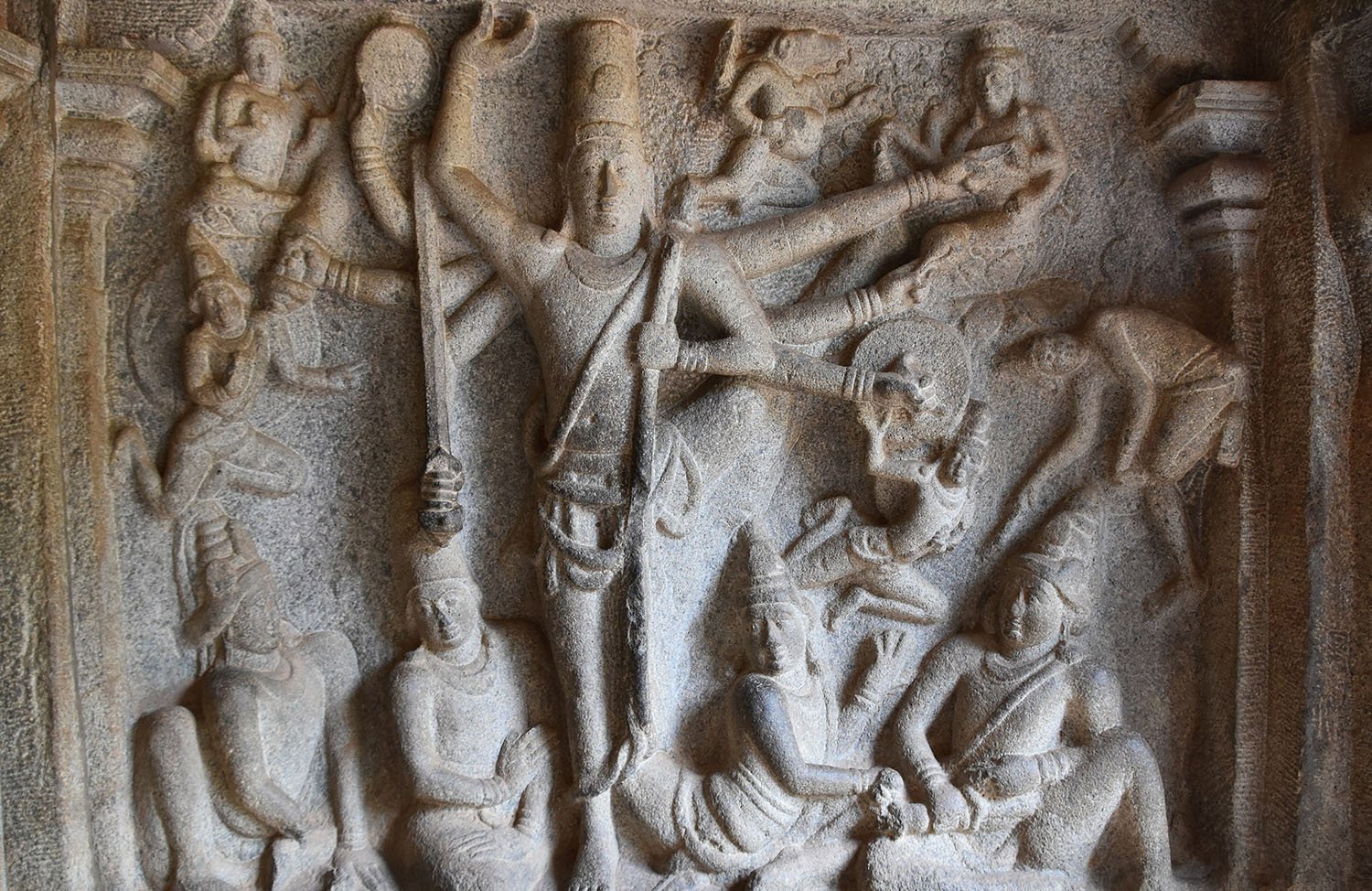
Mahabalipuram stone sculpture
As the golden orb of the sun ascends from the frothing depths of the Bay of Bengal, it first touches the salt-sprayed spires of a city that refuses to be forgotten. Here, on the Coromandel Coast of Tamil Nadu, the wind carries a distinct melody—not just the rhythmic crash of the surf, but the persistent clink-clink-clink of steel meeting granite. This is Mahabalipuram, or Mamallapuram, a place where history is not merely written in books but chiseled into the very bones of the earth. To walk through this landscape is to step into a 1,300-year-old dream of kings and artists, a dream that transformed stubborn boulders into celestial chariots and sheer rock faces into epic poetry.
The Birth of a Stone Vision: The Pallava Genesis
The story of Mahabalipuram’s stone sculptures is inseparable from the meteoric rise of the Pallava Dynasty, specifically during the 7th and 8th centuries. Before this era, Indian temples were largely ephemeral creations of wood, brick, and mortar—materials that surrendered to the humid breath of the tropics. It was the visionary King Mahendravarman I, a polymath who called himself Vichitrachitta (the curious-minded), who first dared to “carve without the use of brick, timber, or metal.” He sought a medium that would outlast time itself.
However, it was his son, Narasimhavarman I, who would truly earn the moniker “Mamalla” (the Great Wrestler) and turn this port city into an architectural laboratory. He did not merely build temples; he wrestled figures out of the mountains. Under his patronage, the “Mamalla style” was born, characterized by a transition from rock-cut caves to free-standing monolithic structures. These sculptures were not just religious icons; they were political statements of a maritime empire that traded with the likes of Cambodia, Java, and the Roman world. The stone used was primarily local granite—black, red, and white—a stone so hard that it requires a special kind of patience, a stone that forces the sculptor to think centuries ahead.
The Pancha Rathas: A Blueprint in Granite
South of the main hill lies a curious cluster of five monolithic structures known as the Pancha Rathas. To the casual observer, they are the chariots of the Pandavas from the Mahabharata, but to the architectural historian, they represent something far more profound: a frozen classroom. Each ratha is carved from a single, massive pink granite boulder that once sloped naturally toward the sea. They were never consecrated as temples; they remain unfinished, a silent testament to a project interrupted by the sudden death of King Narasimhavarman I in 668 CE.
In these five “chariots,” we see the diverse architectural vocabulary of ancient India being experimented with simultaneously. The Dharmaraja Ratha is a towering, three-storied pyramid that would become the prototype for the South Indian vimana. In contrast, the Bhima Ratha features a long, barrel-vaulted roof reminiscent of ancient Buddhist prayer halls, while the Draupadi Ratha mimics the humble, thatched-roof huts of the common folk. The precision is startling—the stone is worked to resemble the texture of wooden beams and thatched grass. Guarding these chariots are life-sized monolithic animals—an elephant, a lion, and a bull—each possessing a weight and dignity that makes them seem as though they might suddenly blink and breathe.
Descent of the Ganges: A Mural of Cosmic Proportions
If the Rathas are the blueprint, then the bas-relief known as “Arjuna’s Penance” or “The Descent of the Ganges” is the masterpiece. Carved upon two massive boulders nearly 100 feet long, it is one of the largest open-air rock reliefs in the world. It is a cinematic experience in stone, a teeming world of gods, celestial beings, hunters, and animals, all drawn toward a central vertical cleft.
The interpretation of this mural has long been a subject of scholarly debate, a testament to the “double meaning” often employed by Pallava poets. Some see the emaciated figure of Arjuna performing penance to obtain the Pasupata weapon from Lord Shiva. Others see King Bhagiratha imploring Shiva to break the fall of the heavenly Ganges with his matted hair. But the true genius lies in the details. At the bottom, a group of elephants—the most naturalistic in all of Indian art—protect their young. Nearby, in a bit of ancient artistic wit, a cat is depicted performing “penance” on one leg, while a group of mice play fearlessly at its feet—a sly reference to the hypocrisy of false ascetics. When it rains, the water flows down the natural cleft in the rock, simulating the living river, just as the ancient engineers intended.
The Shore Temple and the Legend of the Seven Pagodas
As the sun sets, the silhouette of the Shore Temple stands as a lonely sentinel against the encroaching tide. Built by Narasimhavarman II (Rajasimha) in the early 8th century, this was a departure from the monolithic style; it was constructed from blocks of cut granite, marking the maturity of structural temple architecture. For over a millennium, it has survived the relentless battery of salt spray and cyclones.
For centuries, European mariners whispered of the “Seven Pagodas of Mahabalipuram.” They claimed that as they sailed past, they could see seven glittering spires on the horizon, but only one remained on the land. Historians long dismissed this as a seafaring myth—until the ocean itself spoke. During the tragic Indian Ocean Tsunami of 2004, the sea retreated for a few brief moments before the wave struck. Those standing on the shore saw the dark, barnacle-encrusted remains of walls and submerged structures emerging from the seabed. Subsequent underwater archaeological explorations have confirmed the existence of a vast, submerged city, suggesting that the Shore Temple was once part of a much larger complex now claimed by the rising waters. The stone here is weathered, its sharp edges softened by centuries of salt, giving the sculptures a ghostly, ethereal quality as if they are slowly dissolving back into the sea.
The Alchemist’s Art: Techniques of the Sculptor
How did these ancient craftsmen turn a mountain into a poem? The process was as much about theology as it was about physics. Before the first strike of the hammer, the master sculptor would perform a Puja, asking the earth for forgiveness for wounding it. They used the “wedge and feather” method—drilling holes in a line, inserting wooden wedges, and soaking them in water until the expanding wood split the granite with surgical precision.
The tools were deceptively simple: hammers and a variety of steel chisels, such as the Palamunai uli for leveling. To guide their vision, they sketched designs using a red oxide solution, a practice that local artisans still use today. The Pallava style is distinguished by its “suppleness”—the figures are not rigid; they possess a rhythmic, flowing quality. The “Pallava sacred thread” seen on the deities often drapes over the arm, a subtle anatomical detail that provides a sense of depth and movement. This mastery over granite—a stone famously resistant to fine detailing—remains one of the great technical mysteries of the ancient world.
The Living Legacy: A Continuity of Gold
The most remarkable aspect of Mahabalipuram is that the உளியோசை (sound of the chisel) has never truly ceased. In 2017, the Mahabalipuram Stone Sculptures were granted a Geographical Indication (GI) tag, recognizing that the specific skill set found here is unique to this soil. Today, the town is home to hundreds of working sculptors who belong to a lineage of “Sthapatis” or master craftsmen.
Walking through the streets of modern-day Mamallapuram, one sees the descendants of the Pallava artisans at work. They still follow the Shilpa Shastras, the ancient manuals of proportion and iconography. While modern electric drills now hum alongside the traditional hammers, the soul of the craft remains unchanged. These contemporary masters carve everything from pocket-sized Ganeshas for tourists to massive temple icons bound for London, New York, or Singapore. They are the living bridge to a golden age, proving that while empires fall and shorelines recede, the human urge to carve beauty out of the void is eternal.
A Pilgrimage of the Senses
To visit Mahabalipuram is to perform a pilgrimage of the senses. It is the feeling of rough, warm granite under your palm; the smell of the salty breeze mixing with the dust of the workshops; the sight of a stone elephant that seems about to trumpet at the moon. These monuments are not “ruins” in the traditional sense; they are a vibrant, breathing testament to the Tamil spirit.
As you leave the “Garlic Continent” and the “Golden Soil” of the coast, the spires of the Shore Temple fade into the twilight. You carry with you the realization that these stones are the ultimate storytellers. They tell of kings who loved art more than war, of craftsmen who saw gods inside boulders, and of a sea that guards its secrets with a jealous heart. Mahabalipuram remains—majestic, mysterious, and permanently etched in the granite of time.