
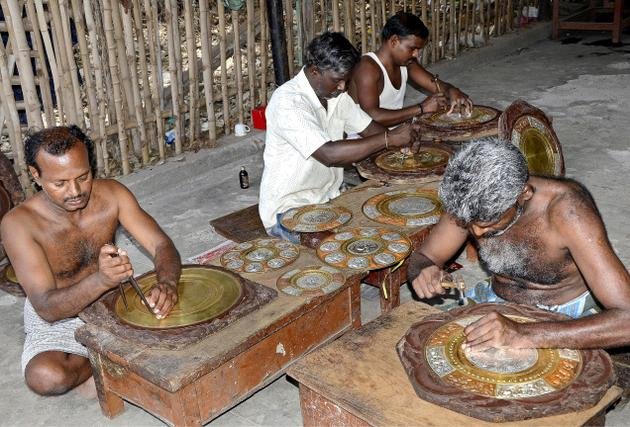
Thanjavur Art Plate
The history of Thanjavur is a tapestry woven with the threads of powerful dynasties—the Cholas, the Nayaks, and the Marathas. While the Cholas gave the city its towering granite temples and the Nayaks brought vibrant murals, it was under the refined patronage of the Maratha rulers that one of India’s most distinctive metallurgical marvels was born: the Thanjavur Art Plate.
Known locally as Thanjavur Kalai Thattu, this tri-metallic plaque is more than a decorative piece; it is a symphony of brass, copper, and silver. To hold one is to touch a tradition that has survived three centuries of shifting empires, colonial transitions, and the relentless march of the machine age.
The Royal Genesis: A King’s Vision
The story of the Thanjavur Art Plate begins in the late 18th century, during the reign of Rajah Serfoji II (1777–1832). Serfoji was a polymath—a scholar of sciences, a linguist, and a visionary who transformed Thanjavur into a “Centre of Enlightenment.” He sought to create a unique gift that would represent the grandeur of his kingdom to foreign dignitaries and visiting royalty.
Legend has it that the King called upon the Vishwakarma community, the traditional goldsmiths and metalworkers of the region, and challenged them to create something that had never been seen before. He wanted a piece that combined the strength of common metals with the elegance of precious ones. The artisans responded by adapting the Bidri work of the Deccan and the Kammala traditions of the South, creating a style known as “encrusting”—the art of overlaying metal on metal. What emerged was a “Ganga-Jamuna” style of craft, where the contrasting colors of silver and copper flowed together like the sacred rivers themselves.
The Alchemy of Three Metals
What makes the Thanjavur Art Plate a masterpiece is its complex “encrusting” technique, a process so labor-intensive that even today, it defies mass mechanization. The plate is a three-layered architectural wonder. It starts with a Brass base, which provides the structural integrity and a golden backdrop. Upon this, a Copper secondary relief is added to create a reddish-brown contrast. Finally, the Silver primary relief is encrusted to depict the central motifs.
The manufacturing process is a dance of precision. First, a designer sketches the central deity or motif. A lead mold is then created, and a thin silver foil is hammered into the mold to achieve a three-dimensional, high-relief effect. This is not mere engraving; it is repoussé—the art of pushing the metal from the back to create volume. To ensure these delicate silver figures do not collapse or dent over time, the hollow back of the embossed silver is filled with a special “mastic” paste—a secret mixture of brick powder, gingelly oil, and frankincense. Once hardened, this silver figure is “soldered” or mechanically pressed onto the copper and brass base, creating a permanent, shimmering icon that stands out in bold relief.
The Iconography: Stories in Silver
The heart of every Thanjavur Art Plate is a story. Traditionally, the central circular relief features figures from Hindu mythology. You might see Lord Ganesha in his many forms, the dancing Nataraja, or the ten incarnations of Vishnu (Dashavatara). One of the most famous historical pieces, housed in the Thanjavur Government Museum, depicts Goddess Sivakami and the sage Patanjali standing on a lotus, a testament to the spiritual depth embedded in the craft.
Surrounding the central deity is the “secondary relief,” usually decorated with intricate floral patterns, creeping vines, or the mythical Yali—a creature with the body of a lion and the trunk of an elephant, a symbol of protection found in Dravidian temples. These motifs aren’t just decorative; they are rhythmic, echoing the carvings of the Brihadeeswarar Temple nearby. The play of light on the polished silver against the dark copper and bright brass creates a “jeweled” effect that changes as you move around the room.
A Community’s Inheritance: The Vishwakarmas
The survival of the Thanjavur Art Plate is inextricably linked to the Vishwakarma community. For these families, the craft is not a business but a dharma (duty). It is an inherited skill passed from father to son in the narrow lanes surrounding the Thanjavur Palace. Historically, the work was divided by expertise: the blacksmiths prepared the heavy brass plates, the goldsmiths handled the delicate silver embossing, and the diamond-setting experts ensured the encrusting was seamless.
Even today, in 2026, the process remains a “cottage industry.” You can still walk through the streets of Thanjavur and hear the rhythmic tink-tink-tink of hammers hitting metal. However, the community faces modern challenges. The rising cost of silver and copper, combined with the weeks of labor required for a single large plate, has made it a luxury item. Yet, the artisans persist, driven by the pride of being the custodians of a royal legacy that bears a Geographical Indication (GI) Tag, a protection granted in 2007 to ensure that only plates made in this specific region can carry the prestigious name.
From Palace to Global Heritage
In the 19th and early 20th centuries, the Thanjavur Art Plate faced a decline as royal patronage withered under British rule. However, after Indian independence, the craft saw a resurgence. Influenced by Gandhian ideals of promoting village industries, the Indian government established the Thanjavur Art Plate Workers Co-operative Society in 1957. This move helped standardize the quality and provided a platform for artisans to reach international markets.
Today, the Thanjavur Art Plate is a coveted memento for global leaders and art collectors. It has transitioned from being a purely religious or royal object to a symbol of Indian luxury and heritage. It is frequently presented as a state gift to visiting heads of state, carrying the weight of Tamil Nadu’s history in its tri-metallic sheen. Modern versions have also evolved to include secular themes—nature scenes, birds, and even custom portraits—to appeal to a broader contemporary audience while maintaining the traditional metal-on-metal technique.
Preserving the Gleam: The Future of the Craft
As we look toward the future, the Thanjavur Art Plate stands at a crossroads. While the GI Tag protects the brand, the younger generation of artisans is increasingly drawn to more lucrative modern professions. To combat this, organizations like Poompuhar (The Tamil Nadu Handicrafts Development Corporation) have launched training centers and international marketing initiatives.
The beauty of a Thanjavur Art Plate is that it does not age; it merely patinas, gaining character with time. To own one is to possess a piece of the Maratha court, a slice of the Vishwakarma soul, and a shining example of Indian metallurgy. It serves as a reminder that in a world of 3D printing and mass production, there is still no substitute for the human hand, a heavy hammer, and a King’s vision of perfection.