
Chettinad Kottan
In the arid, sun-baked heartland of Tamil Nadu lies a region that seems to defy the passage of time. Chettinad, a cluster of villages and towns centered around Karaikudi and Sivaganga, is a place where history does not merely reside in textbooks; it is carved into Burma teak pillars, painted onto Italian ceramic tiles, and woven into the very fabric of daily life. The Nattukottai Chettiars, or Nagarathars, who inhabit this region, were once the financial titans of South and Southeast Asia. During the 19th and early 20th centuries, their maritime trade and banking networks stretched from the shores of Ceylon to the dense jungles of Malaya and the bustling ports of Burma. They returned to their arid homeland with unimaginable wealth, building palatial mansions that were a dizzying synthesis of global architectural styles. Yet, amidst the Bohemian crystal chandeliers, Belgian mirrors, and imported marbles, the truest reflection of Chettiar aesthetic sensibility was found in something profoundly local, humble, and entirely handmade: the Chettinad Kottan.
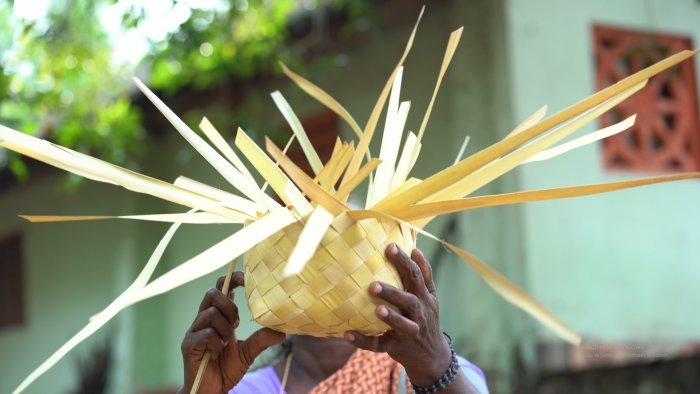
A Kottan is, in its simplest definition, a basket woven from the leaves of the palmyra tree. But to describe it merely as a basket is to do a grave injustice to a craft that encapsulates the soul of a community. The Chettinad Kottan is a marvel of geometric precision, vibrant color, and tactile beauty. It is a historical archive rendered in palm leaf, telling the story of the women who stayed behind while their men crossed oceans, the rituals that bound their society together, and the remarkable survival of a localized art form in the face of relentless globalization.
The Architects of Leisure: The Aachis of Chettinad
To understand the origin of the Kottan, one must first understand the social dynamics of the Nagarathar community during its golden age. The Chettiar men were itinerant bankers and merchants. They spent years, sometimes decades, away from home, managing vast financial empires across the Bay of Bengal. Back in Chettinad, the colossal mansions—often spanning tens of thousands of square feet—were governed by the women of the community, respectfully addressed as ‘Aachis’.
These women were the formidable custodians of Chettiar culture, managing massive households, overseeing agricultural lands, and executing complex family rituals. However, the immense wealth of the community meant that the Aachis did not have to engage in hard manual labor. The sultry afternoons in Chettinad, after the elaborate multi-course lunches had been served and the domestic staff had retreated, stretched out long and quiet. It was during these tranquil hours, sitting on the cool, polished Athangudi tiles of the mutram (the central, open-to-sky courtyard), that the Aachis turned to craft.
Weaving Kottans began as a leisure activity, a refined hobby for aristocratic women. They would gather in the courtyards, their fingers moving with practiced, rhythmic dexterity, transforming raw palm strips into vibrant, mathematically precise containers. This was a communal affair, a time for the exchange of news, the arrangement of matrimonial alliances, and the passing down of generational wisdom. The Kottan was not woven out of economic necessity, but out of an innate desire to create beauty for everyday use. In a house filled with imported treasures, the Kottan was a statement of indigenous pride and self-sufficiency.
The Kalpavriksha of the South: Preparing the Canvas
The creation of a Chettinad Kottan begins not in the courtyard, but in the rugged landscapes of Tamil Nadu, where the Borassus flabellifer—the Asian palmyra palm—grows in abundance. Known as the state tree of Tamil Nadu, the palmyra is deeply revered in Tamil culture, often referred to as the ‘Kalpavriksha’ (the wish-fulfilling tree) because every single part of it serves a human need. For the Kottan, however, only the most specific part of the tree will suffice.
The artisans require the tender, unopened fronds from the very heart of the palm crown. These young leaves are pale, pliable, and possess the necessary tensile strength to withstand intricate weaving. The harvesting is a precarious task, requiring skilled climbers to scale the towering, unbranched trunks. Once harvested, the meticulous preparation process begins. The leaves are separated and left to dry in the harsh Chettinad sun for several days until they turn a soft, pale beige.
The next step requires a specialized traditional tool, a small, curved knife specifically designed to strip the thick, rigid midrib from the center of the leaf. This leaves behind two flexible ribbons of palm. To ensure these ribbons do not crack during the weaving process, they are briefly boiled in water, a process that softens the fibers and enhances their pliability. The leaves are then dried again before being sliced into uniform, slender strips. The precision of this slicing is crucial; if the strips are of uneven width, the geometric symmetry of the final basket will be fatally compromised.
Before the weaving begins, the strips must be brought to life with color. The Chettiar aesthetic is famously vibrant, favoring deep, saturated hues that contrast beautifully with the earthy tones of their environment. Traditionally, the Aachis prepared natural dyes in large clay or aluminum pots over wood-fired stoves in the backyards of their mansions. They achieved deep magentas, emerald greens, mustard yellows, and indigo blues. A handful of coarse sea salt or alum was added to the boiling dye bath to act as a mordant, fixing the color deep into the palm fibers. The dyed strips were then shade-dried to ensure the colors remained vivid and resistant to fading, ready to be transformed into art.
The Geometry of the Weave: A Dance of Fingers and Toes
What sets the Chettinad Kottan apart from other basketry traditions is its sheer structural integrity and the complexity of its patterns. The weaving process is entirely manual; no wooden frames, molds, or machines are used. The artisan relies solely on spatial awareness, mathematical counting, and the coordination of her hands and feet.
The process begins at the base. The weaver sits on the floor, gripping the initial vertical strips (the warp) securely between her toes. This provides the necessary tension to weave the horizontal strips (the weft) tightly across. The base is usually woven into a perfect square or rectangle. Once the base is completed to the desired size, the artisan bends the vertical strips upward at a sharp ninety-degree angle to begin forming the walls of the basket.
The weaving techniques employed are varied and highly sophisticated. The most common is the Gundumani weave, a simple yet elegant over-and-under checkerboard pattern. More complex is the Malayalam weave, a twill pattern created by skipping over two vertical strips at a time, resulting in a striking diagonal aesthetic. Another remarkable technique is the Cross olai weave, where the square base is oriented at a forty-five-degree angle, creating a diamond-patterned wall that requires immense concentration to maintain.
Perhaps the most exquisite feature of a high-quality Kottan is the Sohi technique. This is akin to embroidery on wood. After the main structure of the basket is woven, the artisan takes a thinner, contrasting strip of palm leaf and painstakingly threads it through the existing weave to create raised, decorative motifs. These motifs are often inspired by the surrounding environment—floral patterns, temple architecture, or geometric shapes echoing the Athangudi tiles beneath their feet.
The finishing of the Kottan is equally critical. To ensure the rim of the basket does not fray and holds its shape under weight, the raw edges of the palm strips are folded back into the weave. A technique known as Nool Vay Kattuthal is then applied, where the rim is tightly bound and decorated with heavy cotton thread or fine nylon cord, adding both structural strength and a final flourish of contrasting color.
The Silent Witness to Rites of Passage
In the traditional Chettiar household, the Kottan was ubiquitous, serving both mundane and deeply sacred functions. Because palm leaf allows for air circulation, large, un-dyed Kottans were used in the pantries to store rice, lentils, and tamarind, keeping them safe from moisture and pests. But it was in the realm of rituals that the dyed, intricate Kottans truly shone.
The Nagarathar community is bound by a complex calendar of ceremonies, and the Kottan was a necessary participant in almost all of them. During a betrothal, it was customary to exchange agreements and auspicious items—betel leaves, areca nuts, turmeric, and kumkum—presented in beautifully woven Kottans. When a Chettiar girl came of age, her ceremonies were punctuated by gifts presented in these colorful baskets.
The most spectacular display of Kottans occurred during a Chettiar wedding. A bride’s seer varisai (trousseau) was a matter of immense family prestige. Alongside gold jewelry, silver vessels, silk sarees, and teak furniture, a bride would carry dozens of Kottans to her marital home. Some were small, delicately woven pouches meant for storing precious gems and cash; others were large, sturdy baskets designed to hold ceremonial garments. The Kottans were not just luggage; they were symbols of the bride’s heritage, the skill of the women in her family, and a blessing for a prosperous household.
The Era of Fading Colors
Despite its cultural significance, the mid-to-late twentieth century brought a dark age for the Chettinad Kottan. The geopolitical upheavals of the post-World War II era, including the nationalization of banks in Burma and the changing economic landscapes in Southeast Asia, severely impacted the Chettiar wealth. The community began to migrate from their ancestral villages to urban centers like Chennai, and further abroad to Europe and America, seeking new professions in engineering, medicine, and corporate enterprise.
The palatial mansions were locked up, left in the care of watchmen, the grand courtyards falling silent. Concurrently, the global explosion of cheap, mass-produced plastics dealt a lethal blow to traditional basketry. Tupperware, plastic bags, and factory-made luggage replaced the labor-intensive palm leaf baskets. The modern Chettiar bride no longer carried her trousseau in Kottans; she used leather suitcases.
The Aachis, dispersed to city apartments, lost the communal space and the leisurely time required to weave. The craft, which was never a commercial enterprise but a cultural pastime, had no economic safety net. By the late 1990s, the Chettinad Kottan was on the brink of total extinction. The intricate weaves were forgotten, surviving only in the dusty lofts of old mansions and the fading memories of a few elderly women.
A Renaissance from the Roots
The resurrection of the Chettinad Kottan is one of the most successful cultural conservation stories in modern India, driven primarily by the vision of one woman: Visalakshi Ramaswamy. A passionate advocate for Chettiar heritage, Ramaswamy realized in the early 2000s that if immediate action was not taken, the Kottan would be lost forever. Through the M.Rm.Rm. Cultural Foundation, she embarked on a painstaking mission to revive the craft.
The first challenge was rediscovering the knowledge. Ramaswamy scoured antique shops in Karaikudi and requested access to the attics of old mansions, unearthing damaged, decades-old Kottans. She sought out the few surviving elderly Aachis who remembered the techniques. By carefully dismantling the old baskets, they reverse-engineered the forgotten weaves—the Malayalam, the Cross olai, and the intricate Sohi embroidery.
However, the sociological landscape had changed; the wealthy Aachis were no longer going to weave baskets. To save the craft, it had to be transformed from an aristocratic hobby into a sustainable livelihood. The M.Rm.Rm. Foundation began training women from the local agricultural and marginalized communities in the Sivaganga district. These women, who previously had few employment opportunities outside of seasonal farm labor, were taught the exacting standards of the traditional Kottan.
This transition was revolutionary. A craft that was once an exclusive marker of Chettiar elite leisure became a powerful tool for rural women’s financial independence and empowerment.
The GI Tag and the Modern Epoch
To make the Kottan relevant in the 21st century, its form had to evolve while its technique remained pure. The artisans began creating products tailored for contemporary urban lifestyles. The traditional basket shapes were expanded to include elegant laundry bins, sleek laptop sleeves, office paper wastebaskets, intricately woven serving trays, and chic ladies’ handbags. The color palettes were sophisticated to include pastel shades and natural monochromatic tones, appealing to global design sensibilities.
The definitive moment of triumph for this revival came in 2013, when the Indian government granted the Chettinad Kottan the Geographical Indication (GI) tag. This legal framework recognized the unique geographical and cultural origin of the craft. It ensured that only baskets woven by the trained artisans in the specific taluks of the Sivaganga district, using the traditional Borassus flabellifer leaves and authentic weaving patterns, could be legally sold under the name “Chettinad Kottan.” This protected the artisans from cheap, machine-made plastic imitations flooding the market and cemented the Kottan’s status as a protected national heritage.
Today, the Chettinad Kottan stands at the intersection of history, art, and ecological sustainability. In a world increasingly desperate for biodegradable, eco-friendly alternatives to plastic, the Kottan offers a masterclass in sustainable design. It is frequently sought after by luxury hotels for sustainable packaging, by event planners for high-end wedding return gifts, and by global tourists seeking a piece of authentic Indian craftsmanship.
The story of the Chettinad Kottan is a poignant reminder that true luxury does not merely lie in imported marble or foreign teak. True luxury is time, patience, and the profound human ability to take a humble leaf from the earth and weave it into a vessel that carries the soul of a civilization. In the rustle of the dyed palm strips, the legacy of the Chettinad Aachis continues to sing, undiminished by time.