
Nachiarkoil lamp
The golden glow of a Nachiarkoil kuthuvilakku is more than just a source of illumination in a temple or a home. It represents the warm, beating heart of generations of craftsmanship, an art form meticulously constructed from sweat, metal, and unique river soil. For a historical writer, this lamp stands as a powerful historical monument that quietly narrates a tale of migration, localized ingenuity, and the sacred bond between a community and its natural environment. To understand the true depth of the Nachiarkoil lamp, one must delve into the history of its makers and the unique science behind its creation.
A Legacy of Migration and Devotion
The true origin of the specific craft that defines the Nachiarkoil lamp does not actually begin in the town of Nachiarkoil itself. Instead, the history of this unique brassware is rooted far to the south, in the Kumari district of Nagarcoil. During the tumultuous middle of the 19th century, around 1857, families from the skilled ‘Pathar’ (Kammalar or Viswakarma) artisan community made a significant decision to migrate northward. They were drawn to the temple-dense Chola region surrounding Tanjavur and Kumbakonam, which was known to be a haven that deeply appreciated and supported the arts.
Upon settling in Nachiarkoil, the Pathar community initially used their metalworking skills to manufacture essential brass items such as pots (sembu), traditional plates (thambalam), and large temple bells. However, their true localized masterpiece emerged from the specific spiritual needs of the environment. The intense demand for specialized, unique lamps from the nearby historical shrines, including the Srinivasa Perumal temple (Thirunaraiyur), inspired these master casters to design a unique lamp that eventually earned global fame under the Nachiarkoil name.
The Kaveri’s Sacred Contribution
What truly distinguishes the Nachiarkoil lamp from brassware produced elsewhere is its profound dependency on the natural environment, specifically the Kaveri river delta. The unmatched artistry of this lamp relies intrinsically on a specific type of soil found only along the banks of the Arasalar river, a distributary of the Kaveri that flows through the region. Artisans seek out a unique ‘light brown sand’ (known as vandal man), a material deposited exclusively by the flowing river.
This soil is not merely a material; it is the essential medium for the traditional casting process. The vandal man possesses highly specific scientific properties needed for ‘Box Moulding’ (petti varppu), the meticulous method used to cast these lamps. It is characterized by incredibly fine particles and possesses an extraordinary ability to withstand the intense heat of molten metal. This localized resource is the irreplaceable ingredient that gives the Nachiarkoil lamp its unparalleled structural integrity and allows for intricate detail in its casting.
The Architecture and Symbolism of Light
The construction of a Nachiarkoil lamp is a structured process, with the resulting lamp composed of four main distinct parts: the Keezhbhagam (base), the Kandam or Thandu (pillar/stem), the Thanguli (oil bowl), and the Prabhai (crown). Each of these components is cast separately and then unified, echoing architectural principles similar to those used in designing massive temple structures, progressing through the Adhishtanam (foundation), Stambham (pillar), Prastharam (roof structure), and Sikhram (spire).
The design elements of the lamp subtly incorporate historical influences from South Indian temple architecture. The main stem, or Thandu, often reflects concepts from Pallava-era lion pillars or the detailed carvings found on the stone pillars of Nayaka-era mandapams. The Thanguli, or oil bowl, typically features five faces, which are traditionally interpreted as symbolizing the five human senses or the panchabhutas—the five essential elements of nature (land, water, fire, wind, and space). Crowning the lamp is the Prabhai, which almost always features the mythical ‘Annapatchi’ (Hamsa). This swan holds deep philosophical significance, representing the desired wisdom for the human mind to choose good (symbolized by milk) over evil (symbolized by water).
The Master Artisan’s Touch
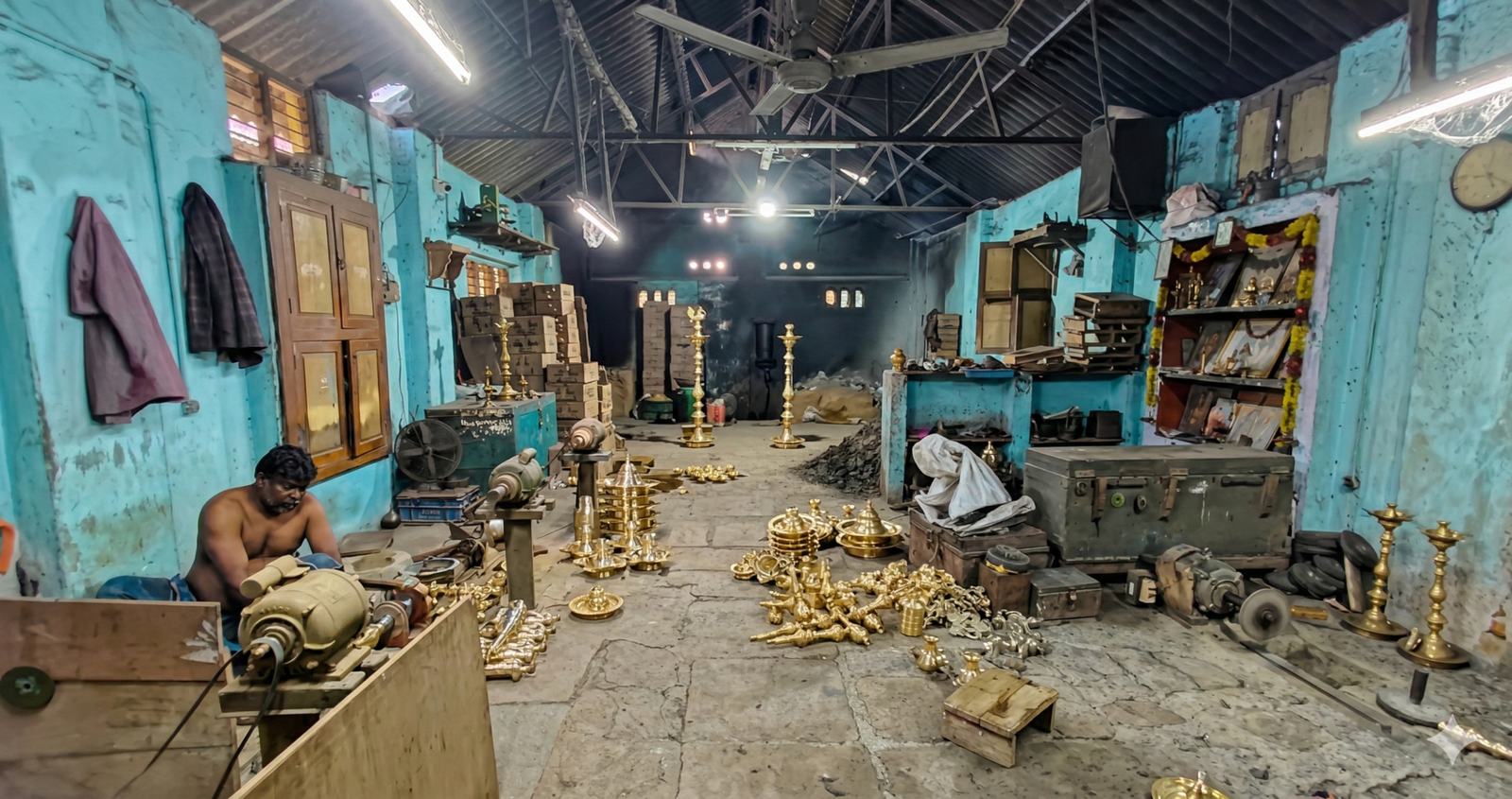
After the separate parts are cast, the raw brass pieces undergo a rigorous finishing process. They are secured to a கடைசல் (lathe) machine and meticulously turned, filed, and shaved until the metal yields a lustrous, golden-hue polish. The final stage of assembly showcases the pure, inherited skill of the craftsmen: they hand-carve screw threads directly into the components. Without using modern measuring instruments, these artisans rely solely on generational knowledge and sensory precision to ensure that the hand-crafted male and female threads fit together perfectly.
The cultural weight of this object in Tamil tradition is immense. The Nachiarkoil lamp is mandatory for all significant auspicious events, from private weddings and housewarmings to major public temple consecrations, where they serve as essential symbols of good fortune and divine presence. This enduring significance is cemented in classic Tamil literature, explicitly mentioned in sacred texts like Andal’s Thiruppavai.
In recognition of this unique heritage and to protect the traditional methods of the Pathar community, the Indian government granted the Nachiarkoil lamp a Geographical Indication (GI) Tag in 2010. This legal recognition ensures that only lamps meeting these specific traditional standards and produced in the Nachiarkoil region can bear the prestigious name, offering vital protection to the artisan clusters from cheap, machine-made imitations that cannot replicate the history or quality of the original, hand-cast masterpieces.