
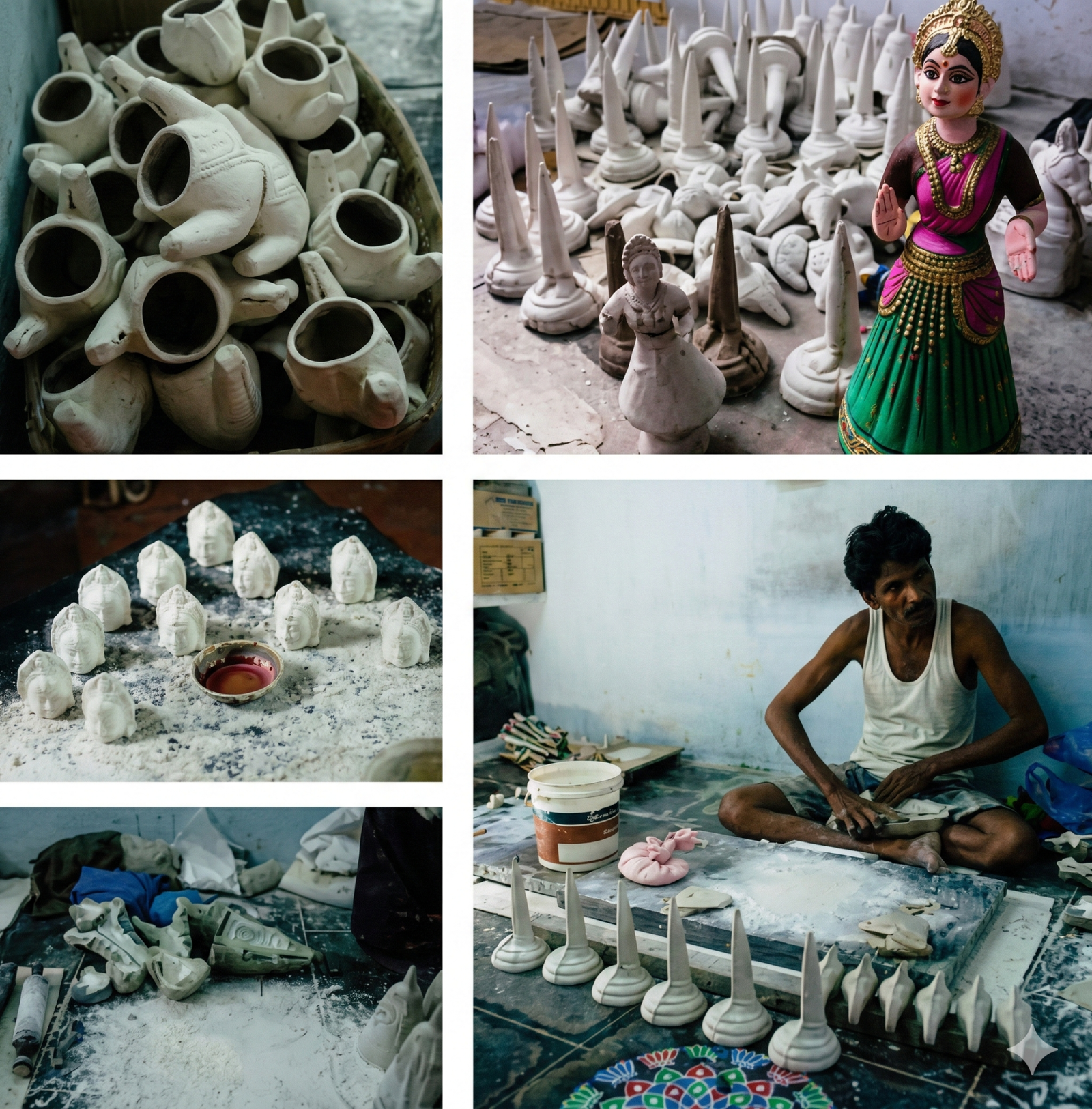
Thanjavur Doll
In the culturally fertile heartland of Tamil Nadu, where the majestic stone towers of the Brihadisvara Temple pierce the South Indian sky, a much smaller, yet equally captivating marvel of human ingenuity has been quietly dancing for centuries. Walk into any bustling artisanal market in Thanjavur, and your eyes will immediately be drawn to a fleet of brightly painted, smiling terracotta figures. With the slightest brush of the wind or a gentle tap of a finger, these figures spring to life, their heads bobbing in a rhythmic, hypnotic trance, and their bodies swaying in an elegant, unbroken oscillation. This is the famed Thanjavur Thalaiyatti Bommai—the Thanjavur dancing doll—a mesmerizing blend of ancient Indian artistry, profound philosophical symbolism, and an intuitive mastery of physics.
Far more than a mere child’s plaything, the Thanjavur doll is a living ambassador of Tamil heritage. Its history is a rich tapestry woven with the threads of royal patronage, scientific brilliance, and generational craftsmanship. As we peel back the layers of its brightly painted exterior, we uncover a story that traverses the golden eras of South Indian dynasties, battles the harsh tides of modern industrialization, and ultimately triumphs through the sheer resilience of the human spirit—much like the doll itself, which, no matter how hard it is pushed down, always rises back to its feet.
The Cradle of Cholas and the Maratha Renaissance
To truly understand the genesis of the Thanjavur doll, one must first understand the soil from which it springs. Thanjavur, historically known as Tanjore, is often celebrated as the “Rice Bowl of South India” due to the fertile delta forged by the sacred Cauvery River. But it was not just agriculture that flourished here; Thanjavur was the undisputed cultural capital of the South, serving as the nucleus of the mighty Chola dynasty. However, the specific origins of the Thanjavur doll trace their roots to a later period, specifically the 17th to the early 19th centuries, during the twilight of the Nayak rulers and the golden dawn of the Maratha kings.
While early forms of terracotta toys existed in the region for millennia, the sophisticated, gravity-defying dolls we recognize today were institutionalized under the patronage of King Serfoji II, a visionary Maratha ruler who reigned over Thanjavur in the early 19th century. King Serfoji II was an extraordinary polymath—a patron of the arts, a pioneer in medicine, and a connoisseur of the sciences. His royal court was a melting pot of Tamil, Telugu, and Maratha artistic traditions. It was within this vibrant crucible of innovation that local artisans were commissioned to create decorative items for the royal palace. Combining the local availability of rich riverbank clay with an advanced understanding of balance and motion, these craftsmen birthed the Thanjavur Bommai. Initially reserved exclusively for the visual delight of the royal courts and aristocratic households, these dolls gradually transcended the palace walls, capturing the imaginations and adorning the homes of the common people.
An Intuitive Mastery of Physics: The Science of the Sway
What makes the Thanjavur doll a masterpiece is not merely its aesthetic appeal, but its profound engineering. Centuries before modern physics was taught in formal classrooms across India, the humble artisans of the Cauvery delta had intimately decoded the secrets of gravity, equilibrium, and the center of mass. In fact, historical records from the Geographical Indication (GI) registry playfully boast that the makers of these dolls demonstrated an enlightened understanding of gravitational forces that rivaled, and perhaps predated, the widespread dissemination of Sir Isaac Newton’s theories.
The Thanjavur doll traditionally manifests in two distinct mechanical variations. The first is the Uruttu Bommai, a roly-poly tilting doll. These dolls, often depicting a regal Raja and Rani (King and Queen), are constructed with a hemispherical base. The genius of the Uruttu Bommai lies in the deliberate concentration of its total weight at the very bottom of this curved base. The upper torso is left entirely hollow and lightweight. As a result, when external force is applied to push the doll to the ground, the low center of gravity acts as an invisible anchor, swiftly pulling the doll back to a stable, upright position in a series of slow, damping oscillations.
The second variation is the Thalaiyatti Bommai, the iconic bobble-head dancing girl. This intricate masterpiece is usually crafted in four separate, loosely interlocking components: the heavy pedestal base (often depicting legs), the lower torso, the upper torso, and the head. Each piece is delicately balanced on top of the other, linked only by thin metal wires acting as rudimentary hinges. Because the head is proportionally larger than the neck connection but exquisitely hollowed out, the slightest vibration sends the head and the various body parts moving independently. The resulting motion mimics the graceful, fluid neck and torso movements of a classical Bharatanatyam or Kathakali dancer, creating a perpetual, dance-like continuous movement that is visually calming and spiritually uplifting.
Forged from the Earth: The Labor of the Artisans
The creation of a Thanjavur doll is an arduous, deeply organic process that vehemently rejects the cold efficiency of modern machinery. It is a labor of love, requiring the bare hands of skilled artisans who have inherited this craft through generations. Traditionally, the lifeblood of the doll is the sacred soil of Thanjavur. Artisans source vandal man (fine silt deposited by rushing streams) and kali man (clayey riverbed mud) directly from the banks of the Cauvery River.
However, as the weight of pure terracotta made the dolls prone to breakage and difficult to transport, artisans creatively evolved their materials. Today, a specialized dough called Bommai maavu is utilized. This eco-friendly mixture is a careful amalgamation of papier-mâché (wood pulp, waste paper), tapioca starch, and plaster of Paris, with copper sulphate occasionally added as a natural fungicide. The heavy pedestal base is still fortified with pure river clay or small stones to ensure the crucial gravitational pull.
The crafting process begins with the creation of the doll’s outer shell using meticulously carved cement or plaster molds. The dough is pressed into these molds to form the front and back halves of the figure. Once dried in the warm Tamil Nadu sun, the hollow halves are fused together using natural adhesives derived from tapioca flour. Any seams or imperfections are painstakingly smoothed out using sandpaper, transforming the rough papier-mâché into a seamless canvas.
Then begins the soul-infusing work of the painter. Sitting cross-legged in their humble workshops, artisans wield fine brushes to bring the dolls to life. Vibrant oil and water-based paints in hues of gold, crimson, emerald, and sapphire are applied. The faces are painted with a distinct stylistic flair—wide, expressive, kohl-rimmed eyes, gentle smiles, and intricate representations of traditional temple jewelry and classical dance costumes. Because every single doll is painted entirely by hand, no two Thanjavur dolls are ever exactly alike; each possesses its own subtle quirks, its own unique expression, and its own silent narrative.
A Symbol of Resilience and Divine Celebration
Beyond their physical construction, Thanjavur dolls hold a sacred space in the cultural and spiritual landscape of South India. They are not merely decorative items but are heavily imbued with philosophical significance. The self-righting mechanism of the Uruttu Bommai has long been interpreted as a powerful metaphor for human resilience. Local folklore dictates that the doll represents the inevitable ups and downs of human existence. No matter how violently the winds of adversity may strike, or how hard life pushes you down, one must possess the inner fortitude to bounce back, stand tall, and smile once more.
This deep cultural reverence culminates annually during the grand festival of Navaratri. Across Tamil Nadu, homes are transformed into spectacular, multi-tiered exhibitions known as Golu or Kolu. Families arrange dozens of dolls on stepped platforms to honor the divine feminine and celebrate the victory of good over evil. The Thanjavur dancing doll is the undisputed crown jewel of the Navaratri Golu. Placed prominently on the divine steps, the bobbing heads and swaying bodies of the Raja-Rani pairs and the dancing girls breathe an interactive, joyous life into the static displays, enchanting children and adults alike.
The Modern Crossroads: E-Commerce, Plastics, and the Fight for Survival
Despite the glorious heritage that shadows the Thanjavur doll, the dawn of the 21st century brought dark clouds over the traditional artisans. The rapid globalization of the toy market introduced a flood of cheap, mass-produced plastic toys and battery-operated gadgets that easily captured the fleeting attention spans of modern consumers. Consequently, the painstaking, time-consuming art of handcrafted papier-mâché toys struggled to compete economically.
Furthermore, environmental regulations, such as stringent bans on river sand mining, severely disrupted the supply of the crucial Cauvery riverbed clay required for the dolls’ heavy bases. Faced with dwindling incomes, a severe labor crunch, and a lack of successors willing to inherit the arduous, low-paying family trade, the artisan population in Thanjavur began a sharp decline. The once-thriving craft teetered on the precipice of becoming a forgotten tale.
However, recognizing the cultural tragedy that the loss of this craft would entail, significant efforts have been mobilized to save the Thanjavur doll. In a monumental victory for the artisans, the Government of India awarded the Thanjavur doll the prestigious Geographical Indication (GI) tag in the year 2008-2009. Registered under the Thanjavur Chamber of Commerce, this intellectual property right legally protects the traditional craft from cheap, counterfeit imitations and officially recognizes its unique geographic and historical origins.
A Shaking Legacy Revived
The GI tag was just the beginning of a larger renaissance. In recent years, local governments and non-profit organizations have aggressively championed the craft. The empowerment of women through Self Help Groups (SHGs) has breathed new life into the industry. Women are now at the forefront of crafting, painting, and marketing these dolls. In 2022, the establishment of dedicated handicrafts kiosks by the Thanjavur administration to help SHGs directly market their products caught the attention of the entire nation. Prime Minister Narendra Modi, during his widely broadcasted Mann Ki Baat radio program, specifically highlighted the exquisite, GI-tagged Thanjavur doll gifted to him by a local SHG. He praised the vibrant creativity of the women artisans and urged citizens nationwide to patronize these indigenous, handmade crafts, sparking a renewed, nationwide interest in the toys.
Today, while the struggle against modern mechanization continues, the Thanjavur doll stands as a defiant survivor. It has successfully transitioned from a child’s plaything to a highly sought-after cultural souvenir for global tourists and a cherished collector’s item for art enthusiasts. It serves as an educational model in schools, demonstrating the basic principles of physics, and remains an irreplaceable emblem of Tamil Nadu’s artistic zenith.
In an era defined by fleeting digital experiences and disposable plastics, the Thanjavur doll offers a tangible connection to our ancestral past. As long as there is a breeze in the Cauvery delta, and as long as skilled hands are willing to mold the river’s earth, the Thanjavur doll will continue its eternal, hypnotic dance. It will continue to bob its head in silent testimony to the genius of the Maratha kings, the resilience of the Tamil artisans, and the timeless beauty of a craft that gracefully balances the laws of science with the soul of art.
Thanjavur doll, Tanjore Bommai, Thalaiyatti Bommai, Thanjavur dancing doll, Tamil Nadu handicrafts, traditional Indian toys, terracotta toys India, Geographical Indication tag India, GI tag Thanjavur, King Serfoji II, Indian cultural heritage, Navaratri Golu dolls, papier-mache crafts India, roly-poly doll history.
History of the Thanjavur dancing doll, How Thanjavur dolls are made by artisans, Science and physics behind Thanjavur dolls, Thanjavur doll GI tag significance, Traditional Navaratri Golu decoration ideas, Buy authentic Tanjore Thalaiyatti Bommai, Cultural importance of Tamil Nadu handicrafts, Impact of plastic toys on traditional Indian artisans, King Serfoji II contribution to Tanjore art.
#ThanjavurDoll #TanjoreBommai #ThalaiyattiBommai #TamilNaduHeritage #IndianHandicrafts #IncredibleIndia #NavaratriGolu #TraditionalArt #GITagIndia #ArtAndPhysics #CulturalHeritage #SupportLocalArtisans #HandmadeInIndia #HistoryUncovered #HistoricalToys