
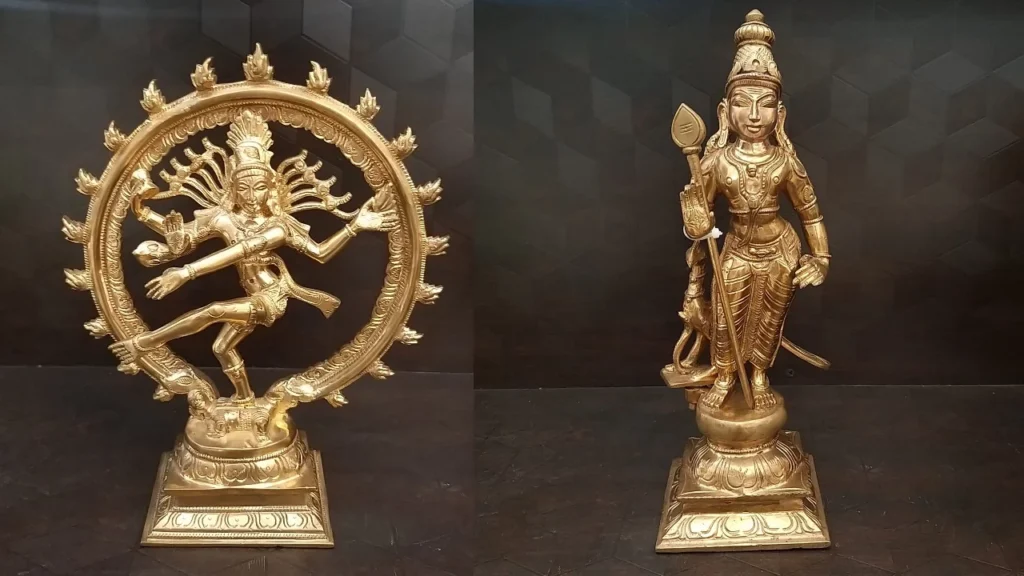
Swamimalai Bronze Icons
In the sun-drenched town of Swamimalai, nestled on the banks of the sacred Kaveri River, time does not move in seconds or minutes. Instead, it flows like molten metal, measured by the rhythmic tap-tap of a chisel against bronze and the quiet recitation of ancient Sanskrit verses. Here, for over a thousand years, a lineage of master sculptors known as Sthapathis has guarded the secrets of the world’s most sophisticated metal-casting tradition. This is the story of the Swamimalai Bronze Icons—a craft born of royal ambition, sustained by spiritual devotion, and perfected by a soil so unique it can capture the clarity of a fingerprint.
Of Kings and Architects: The Chola Genesis
The history of Swamimalai bronzes is inextricably linked to the Imperial Cholas (9th–13th century CE), arguably the greatest patrons of art in Indian history. When the visionary Emperor Raja Raja Chola I commissioned the Brihadiswara Temple in Thanjavur—a granite colossus that still flummoxes modern engineers—he summoned the finest craftsmen from across his empire. Among them were the ancestors of today’s Sthapathis, who trace their spiritual lineage to Vishwakarma, the divine architect of the universe.
As the great stone temples rose, a need emerged for Utsava Murtis—processional deities that could be carried through the streets so that even those barred from the inner sanctum could receive a blessing. These icons needed to be portable yet majestic, durable yet delicate. Legend says that while searching for the perfect medium, the Sthapathis discovered the alluvial soil (Vandal Mann) on the banks of the Kaveri near Swamimalai. This clay was a miracle of nature: fine, naturally filtered, and remarkably resistant to cracking when fired. Recognizing its potential, the Sthapathis settled in Swamimalai, transforming a quiet pilgrimage site into the global capital of bronze iconography.
Cire Perdue: The “Lost” Art of Perfection
At the heart of Swamimalai’s fame is the Lost-Wax process, or Cire Perdue. It is a misnomer to call it “lost”; it is a technique of transformation where the physical model is sacrificed to give birth to a divine form. Unlike mass-produced statues made from reusable molds, every Swamimalai icon is a one-of-a-kind masterpiece. The mold is shattered to reveal the statue, meaning no two idols—even of the same deity—are ever identical.
The process begins with the Wax Model. Artisans mix beeswax with dammar resin and groundnut oil to create a malleable dough. With hands toughened by heat, they shape this wax into the likeness of a god. This isn’t mere artistic whim; every proportion, every tilt of the head, and every mudra (hand gesture) must adhere to the Shilpa Shastras, the ancient canonical texts of iconography.
Once the wax figure is perfected, it is “invested”—encased in multiple layers of that fabled Kaveri clay mixed with cow dung. When the sun-dried mold is fired, the wax inside melts and drains away (the “lost” wax), leaving a hollow, negative impression of the deity. Into this fiery void, the Sthapathis pour Panchaloha—the sacred “five-metal” alloy of copper, tin, zinc, and traditionally, small amounts of gold and silver.
The Breath of the Icon: From Metal to Divinity
The most poignant moment in the workshop occurs after the metal has cooled and the clay mold is ceremoniously broken. What emerges is a rough, blackened casting. It takes weeks, sometimes months, of painstaking chiseling and filing to reveal the grace hidden beneath the surface. Using tools that have changed little since the 11th century—engraving needles, spatulas, and polishing stones—the Sthapathis carve the intricate jewelry, the delicate folds of the silk garments, and the enigmatic “Chola smile.”
The process concludes with the Nayanammeelanam, or the “Opening of the Eyes.” For the Sthapathy, the icon is a work of art until this final stroke. Once the eyes are carved, the metal becomes a deity. As master craftsman Swaminathan Sthapathy once remarked, “Until the eyes are opened, they are just pieces of art; then, they are Gods to us.”
A Global Heritage Shielded by Law
In a modern world flooded with cheap, machine-made imitations, the authenticity of Swamimalai was finally given legal protection. In 2008, the Swamimalai Bronze Icons were granted the Geographical Indication (GI) Tag. This ensures that only icons produced in Swamimalai using the traditional lost-wax method can bear the name.
Today, these icons are not just found in the temples of South India. They grace the halls of the British Museum, the Victoria and Albert Museum, and private collections from New York to Singapore. Whether it is the rhythmic movement of Nataraja (the Dancing Shiva) or the serene generosity of Varada Ganesha, the Swamimalai bronze remains the gold standard of metal sculpture—a fusion of spiritual discipline and metallurgical science.
Swamimalai Bronze Icons, Chola Bronze Statues, Lost-Wax Casting Process, Panchaloha Idols, Sthapathy Community Swamimalai.
History of Swamimalai bronze casting, Shilpa Shastra bronze icon rules, GI Tag Swamimalai bronze statues, traditional Chola lost wax technique, where to buy authentic Swamimalai bronzes.
#SwamimalaiBronze #CholaArt #IndianHeritage #LostWaxCasting #Sthapathy #Panchaloha #TraditionalCrafts #TamilNaduTourism #AncientSkills #HinduIconography