
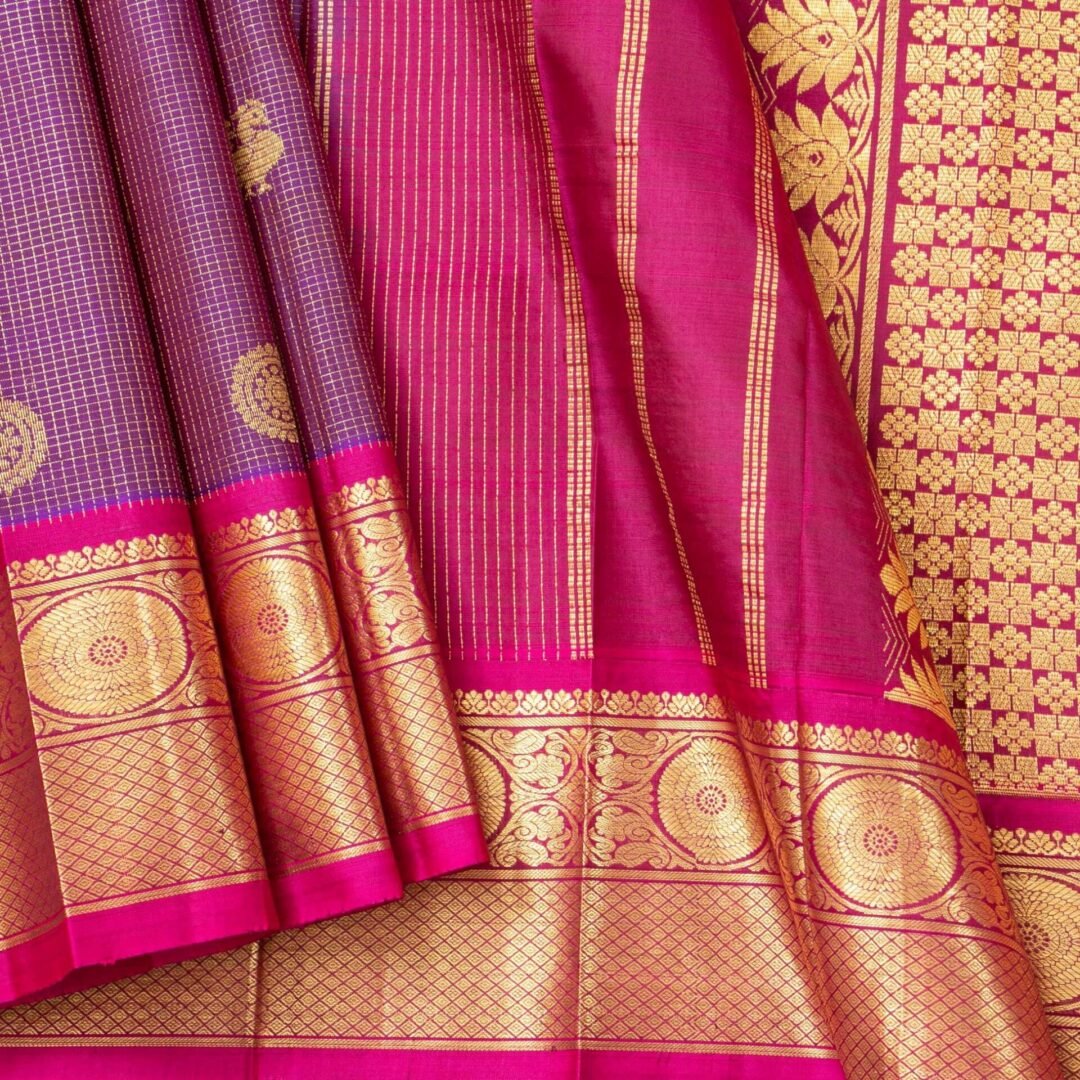
Kanchipuram Silk Sari
In the golden corridors of Tamil Nadu’s “City of a Thousand Temples,” there exists a rhythmic clatter that has served as the heartbeat of the region for over four centuries. It is the sound of the throw-shuttle moving across heavy rosewood looms, weaving together mulberry silk and silver-gold threads into what is arguably the most prestigious garment in the Indian subcontinent: the Kanchipuram Silk Sari. To the world, it is a luxury textile; to the people of South India, it is an heirloom, a piece of temple architecture draped in six yards of grace, and a sacred link to a divine lineage of weavers.
The Divine Ancestry: From Sages to Shuttles
The history of the Kanchipuram sari is inextricably linked to Hindu mythology. According to local lore and the Kanchi Puranam, the weavers of this city are the descendants of Sage Markanda, the master weaver of the Gods. Legend tells that Markanda wove tissue from lotus petals for Lord Vishnu and white silk for Lord Shiva. When his descendants settled in the town of Kanchipuram, they brought with them a celestial mandate: to clothe the earthly representations of the divine.
Historically, the industry flourished during the reign of the Pallava Dynasty, but it reached its zenith under the Vijayanagara Empire. King Krishna Deva Raya, a great patron of the arts, invited two weaving communities—the Devangas and the Saligars—from Andhra Pradesh to settle in Kanchipuram. These master craftsmen merged their superior weaving techniques with the local artistic sensibilities, creating a hybrid style that prioritized weight, durability, and intricate “temple” motifs. By the 15th and 16th centuries, Kanchipuram had established itself as the premier silk-weaving hub of the South, a status it has defended for 500 years.
The Architecture of a Masterpiece: The Double-Warp Secret
What distinguishes a genuine Kanchipuram sari from any other silk in the world is its structural integrity. Known as a “double-warp” or “three-ply” silk, the sari is woven using three individual silk threads twisted together. This makes the fabric significantly heavier and more durable than the lighter silks of the North.
The most fascinating aspect of its construction is the Korvai technique. In a traditional Kanchipuram sari, the border and the body are woven separately and then joined together. This joint is so strong that even if the sari tears after decades of use, the border will not detach. Look closely at the junction where the colorful body meets the heavy border; you will often see a jagged, serrated pattern known as the Thazhampoo Rekku (the temple petal). This isn’t just a design; it is the physical manifestation of the interlocking of two different sets of warp threads, a feat of manual engineering that modern power looms struggle to replicate.
The Alchemy of Gold: Zarikas and Mulberry
The raw materials of a Kanchipuram sari are a geography lesson in themselves. The silk comes from the mulberry silkworms of Karnataka, while the Zari (the gold and silver thread) was traditionally sourced from Surat in Gujarat. However, a true Kanchipuram Zari is a masterpiece of metallurgy. It is made by winding a flattened silver wire around a silk core, which is then electroplated with pure gold.
To be classified as an authentic Kanchipuram silk under the Geographical Indication (GI) tag granted in 2005, the Zari must contain at least 57% silver and 0.6% gold. This high precious metal content is why these saris feel heavy in the hand—often weighing between 750 grams to a kilogram—and why they serve as a financial investment for many families. They do not merely shimmer; they glow with a deep, metallic luster that matures into a beautiful patina over generations.
Motifs from the Stone: Temple Walls on Silk
If the silk is the canvas, the motifs are the poetry. A Kanchipuram weaver does not look at fashion magazines for inspiration; they look at the stone carvings of the Varadharaja Perumal Temple and the Kailasanathar Temple. Every design carries a name and a meaning.
The Malli Moggu (Jasmine bud) represents purity, while the Gopuram (Temple tower) connects the wearer to the divine. You might see the Yali, a mythical creature that is part lion and part elephant, symbolizing power and protection. Other popular motifs include the Kamalam (Lotus), the Mayilkan (Peacock eye), and the Rudraksham (Sacred beads). These patterns are not printed; they are painstakingly “lifted” using a complex system of harnesses called the Adai, where the weaver must memorize thousands of thread movements to bring the stone-cold myths of the temple walls into the fluid world of silk.
The Great Partition: The Paluvai and the Body
A Kanchipuram sari is traditionally divided into three distinct parts: the Udal (Body), the Karai (Border), and the Mundhi or Pallu (the highly decorative end-piece). In a “contrast” Kanchipuram, the Mundhi and Border are often of a different color than the body. Joining the Mundhi to the body requires a second specialized technique called Petni. This involves twisting the threads of the body warp into the threads of the Mundhi warp, creating a seamless transition of colors that appears as if the two shades have magically melted into one another. This labor-intensive process is why a single sari can take anywhere from three weeks to several months to complete, depending on the complexity of the design.
The GI Tag and the Battle Against the Machine
In the late 20th century, the Kanchipuram industry faced a grave threat from cheap power-loom imitations and synthetic “art silk.” To protect the legacy of the 60,000 weavers remaining in the city, the Geographical Indication (GI) status was secured in 2005. This legal protection ensures that only saris woven in the Kanchipuram district, using the specific double-warp and Zari standards, can bear the name.
Today, in 2026, technology has become a dual-edged sword. While CAD (Computer-Aided Design) helps weavers visualize new patterns, the “Silk Mark” and “Handloom Mark” certifications have become essential tools for consumers to verify authenticity. The modern Kanchipuram weaver is a guardian of a dying art, balancing the pressures of a fast-fashion world with the slow, meditative pace of the pit loom.
A Living Heritage
The Kanchipuram silk sari is more than just a garment; it is a repository of South Indian culture. It is the sari a mother passes to her daughter on her wedding day; it is the fabric used to drape the deities during temple processions; it is a symbol of the enduring power of the human hand over the machine.
When you touch a Kanchipuram sari, you are touching the red earth of Tamil Nadu, the silver of Gujarat, and the silk of Karnataka. You are touching five centuries of history. As long as there are stories to be told in gold and silk, the looms of Kanchipuram will continue to sing their ancient song, weaving together the divine and the mortal in a shimmering embrace.
Kanchipuram silk sari, Kanchipuram sari history, authentic Kanchipuram silk, handloom silk weaving India, Kanchipuram GI tag silk.
Difference between Kanchipuram and Dharmavaram silk, how to identify real gold Zari Kanchipuram, temple motifs in Kanchipuram saris, history of silk weavers in Kanchipuram, Kanchipuram wedding silk sari price factors.
#KanchipuramSilk #QueenOfSilks #IndianHandloom #SariHeritage #KanchipuramSaree #TraditionalWeaves #SilkSareeLove #IndianWeddings #HandmadeIndia #TextileHistory #GITagIndia