
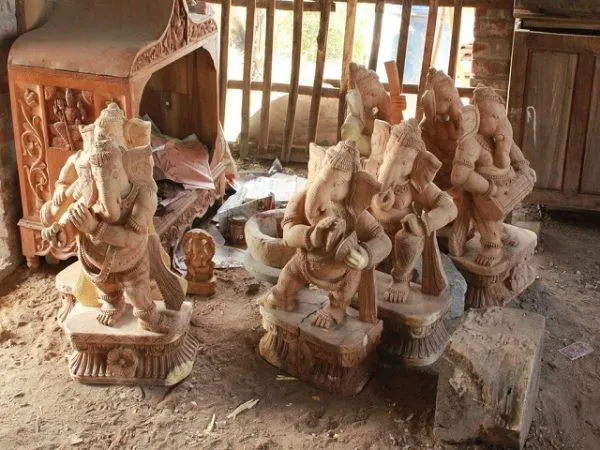
Arumbavur Wood Carvers
In the shadow of the Pachamalai Hills, where the air is often thick with the scent of seasoned timber and the rhythmic clink-clink of iron meeting wood, lies a town that has breathed life into logs for centuries. Arumbavur, a quiet Town Panchayat in the Perambalur district of Tamil Nadu, is not merely a geographical location; it is a living museum of the Shilpa Shastra. Here, the wood does not just serve a purpose—it tells a story of migration, devotion, and the architectural grandeur of a civilization that refuses to let its heritage wither.
For the historical writer, Arumbavur offers a narrative that is as layered as the carvings on a temple chariot. It is a story that begins in the bustling courts of Madurai, travels along dusty roads as a nomadic quest, and eventually drops its roots in the fertile plains of the Veppanthattai taluk. Today, Arumbavur stands as the undisputed capital of wood carving in South India, a status cemented by its 2020 Geographical Indication (GI) tag and a legacy of over 400 temple chariots that traverse the streets of India.
The Nomadic Architects: From Madurai to the Veppanthattai Plains
The history of Arumbavur’s artisans is a testament to the fluid nature of traditional Indian craftsmanship. About 250 to 300 years ago, the forefathers of the current artisan community—predominantly from the Boyar community—were nomadic Sthapathis (architect-sculptors) based in Madurai. These were the men who built the foundations of faith, traveling across the Tamil landscape wherever a new temple chariot (Ratham) or a sacred Vahana (vehicle) was needed.
A single temple chariot could take up to four years to complete. During this time, the families of the Sthapathis would settle in the temple precincts, their lives revolving around the massive wooden structure taking shape under their chisels. They were the architects of the “moving temple,” bringing the divine out of the sanctum sanctorum and into the streets for the common people to witness.
Legend suggests that a group of these nomadic artisans found the region around Arumbavur particularly alluring. Nestled between the Pachamalai and Kolli Hills, the area provided an abundant supply of the high-quality hardwoods required for their craft. More importantly, it offered a strategic midpoint between the major religious centers of Tiruchirappalli, Salem, and Thanjavur. Around 250 years ago, the wanderers decided to drop their anchors. They established a permanent settlement in Arumbavur, transforming a nomadic tradition into a flourishing cottage industry that would eventually become the town’s global identity.
The Sacred Alchemy: Selecting the Timber of the Gods
In Arumbavur, a wood carving is not born on the workbench; it begins in the forest. The artisans follow the strict tenets of the Shilpa Shastra, ancient Sanskrit texts that dictate everything from the proportions of a deity to the specific types of wood suitable for sacred work. The choice of timber is a spiritual decision, as much as a structural one.
For the grand temple chariots, the preferred wood is often Vengai (Malabar Kino) or Athi (Fig tree). Vengai is prized for its immense strength and its ability to weather the harsh tropical sun and monsoon rains without warping or cracking. Athi, on the other hand, is considered spiritually auspicious, often used for the main idols and the internal structures of the chariot.
Other local varieties play their roles: Mavilangam (Indian Cork tree) is used for its fine grain, allowing for microscopic detailing on smaller statues. Siridam (Indian Siris) and Mamaram (Mango wood) are frequently used for the base structures and utilitarian products. In recent decades, Teak and Rosewood have been introduced for premium furniture and decorative panels, but for the sacred temple works, the traditional “woods of the soil” remain the gold standard.
The seasoning process is an exercise in patience. Freshly felled logs are never carved immediately; they are left to breathe and dry naturally, sometimes for years, until the moisture content is exactly right. An artisan can tell if a log is ready simply by tapping it with a mallet and listening to the resonance—a “musical” log is a stable one.
The Master’s Hand: The Unyielding Rule of the Single Block
Perhaps the most awe-inspiring aspect of Arumbavur wood carving is the “Single Block” technique. Unlike modern carpentry, which relies on joints, glue, and screws, a traditional Arumbavur statue is carved entirely from a single, solid piece of wood. This requires a level of spatial visualization that borders on the superhuman. One wrong stroke of the chisel, one hidden knot in the wood, or one moment of lapsed concentration, and weeks of labor are rendered useless. There is no “undo” button in wood carving.
The process is a rhythmic progression of tools. It begins with the Kodari (axe) and large chisels to “rough out” the basic shape, following a chalk outline drawn directly on the wood. As the form emerges, the tools become smaller and more specialized. The Sittar Uli (small chisel) and Aakkur (fine-point tools) are used to carve the delicate features of the face, the intricate folds of a silk dhoti, or the scales of a mythical Yali.
The artisans are famous for their “High Relief” work, where figures seem to leap out from the background panel. This depth is achieved by meticulously hollowing out the negative space around the figures, a task that requires both physical strength and a jeweler’s precision. Finally, the piece is smoothed with varying grades of sandpaper and polished with natural waxes or oils to bring out the deep luster of the grain.
The Moving Temple: Anatomy of a Temple Chariot
While Arumbavur produces everything from five-inch miniatures to twelve-foot temple doors, its crowning glory remains the Temple Ratha. To the people of Tamil Nadu, a chariot is not a vehicle; it is a Chala-Alaya—a moving temple. The construction of these giants is the pinnacle of the Arumbavur Sthapathis’ skill.
A chariot is traditionally divided into three horizontal tiers, representing the cosmic hierarchy of the universe:
The Earthly Realm (Bhuloka): The lowest base of the chariot depicts life as we know it. It is adorned with carvings of kings, queens, dancing girls, musicians, and even erotic scenes, symbolizing the multifaceted nature of human existence.
The Celestial Realm (Antariksha): Above the earthly tier, the carvings transition to Devatas, Gandharvas (celestial musicians), and mythical creatures like the Hamsa (swan) and the Kamadhenu (the wish-fulfilling cow).
The Divine Realm (Devaloka): The uppermost tier features the primary deities—Shiva, Vishnu, Ganesha, and the Mother Goddess—surrounded by their various avatars and legends.
At the very base of the chariot, artisans often carve the Adi Shesha (the primordial serpent) and massive turtles, echoing the Hindu mythology where the world is supported on the back of these cosmic beings. The sheer scale of these works is staggering; a large chariot can feature over 400 individual carved images, all meticulously scaled according to the geometric proportions of the Shilpa Shastras.
The GI Tag: A Global Shield for a Local Heritage
For many years, the artisans of Arumbavur operated as an unsung workforce, their masterpieces scattered across the temples of the world but their town remaining a footnote in tourism brochures. This changed in May 2020, when the Arumbavur Wood Carvings were officially granted the Geographical Indication (GI) Tag.
This was more than just a bureaucratic certificate; it was a legal and economic shield. The GI tag ensures that only wood carvings produced within the Arumbavur region using traditional methods can carry the name. This protection has been vital in a market increasingly flooded with machine-made replicas and cheap imitations from other regions.
The GI tag acted as a catalyst for a renaissance. It opened doors to international markets—specifically in Malaysia, Singapore, Canada, and the United States, where the Tamil diaspora seeks a connection to their roots through these sacred carvings. It also brought a renewed sense of pride to the younger generation of artisans, who now see a viable, prestigious career in a craft that their fathers once feared might die with them.
From Temple Cars to Modern Mantapas: The Art of Adaptation
As the 21st century progressed, the Arumbavur artisans proved themselves to be masters of adaptation. While the demand for temple chariots remains steady—Arumbavur Sthapathis have crafted over 400 chariots and 5,000 Vahanas to date—they have successfully pivoted to meet the needs of the modern home.
Today, Arumbavur is a hub for Pooja Mandapas (home altars), intricately carved main doors, and massive wall panels. A “Chettinad Pillar” or a “Dasavatara Panel” from Arumbavur has become a status symbol in contemporary Indian interior design. These pieces often blend the traditional iconography of the temples with a modern aesthetic, using polished rosewood or teak to fit into sleek, urban apartments.
Even utilitarian products like wooden utensils, chairs, and tables are crafted with the same attention to detail. The artisans have also begun to embrace e-commerce, with workshops like Udaya Wood Carvings and various cooperatives reaching global customers through digital storefronts. This transition from “God’s architect” to “global décor provider” has ensured the survival of the community’s skill set in a rapidly changing world.
The Future in the Grain: Challenges and Preservation
Despite its successes, the road ahead for Arumbavur is not without its hurdles. The most pressing challenge is the scarcity of raw materials. Deforestation and stricter environmental regulations have made it increasingly difficult to source mature Vengai and Athi logs. The artisans are now looking toward sustainable plantation-grown timber, though some purists argue that the “soul” of the wood is only found in old-growth forests.
Another challenge is the labor-intensive nature of the work. A large statue can take months of grueling physical labor, and in a world of instant gratification, the apprenticeship of a wood carver—which can last a decade—is a hard sell for the youth. However, the establishment of the Arumbavur Wood Carvers’ Handicrafts Industrial Cooperative Society has provided a structured platform for training and fair wages, helping to bridge the generational gap.
The Eternal Echo of the Mallet
As the sun sets over the Pachamalai Hills, the clink of the chisels in Arumbavur slowly fades, replaced by the evening prayers from the town’s temples. But the work remains—immortalized in the grain of the wood. Arumbavur is a reminder that in the age of 3D printing and AI-generated design, there is something irreplaceable about the human touch.
Every curve on an Arumbavur Ganesha, every scale on a temple Yali, and every wheel on a massive Ratham carries the DNA of those nomadic Sthapathis from Madurai. It is an art form that has survived three centuries of political upheaval, colonial rule, and industrial revolution. Today, as Arumbavur carvings adorn homes and temples from London to Sydney, the town remains a testament to the fact that when a craft is rooted in faith and perfected by time, it becomes truly timeless.
To look at an Arumbavur carving is to look at the heart of Tamil Nadu—strong, resilient, and deeply, beautifully intricate.