
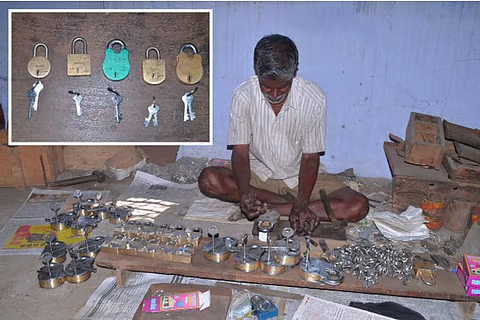
Dindigul lock
In the heart of Tamil Nadu, nestled under the watchful gaze of a massive, pillow-shaped granite hill, lies a city whose name has become a synonym for an unbreakable promise. To the world, it is Dindigul—a name derived from Thindu (pillow) and Kal (rock). But to the generations of merchants, kings, and commoners who sought to protect their most prized possessions, it is simply the “Lock City.” Here, the air doesn’t just carry the scent of the famous Seeraga Samba biryani; it resonates with the rhythmic, metallic clink-clink-clink of hammers meeting iron—a sound that has defined the region’s identity for over three hundred years.
The story of the Dindigul lock is not merely an account of industrial manufacturing. It is a chronicle of survival, an architectural marvel on a miniature scale, and a testament to the sheer mechanical genius of the human hand. As a historical writer looking back from the year 2026, one can see how these iron sentinels have guarded the treasuries of empires and the humble doors of huts, remaining as unrelenting as the granite fort that looms over the town.
The Fortress and the First Bolt: Origins in the 17th Century
The genesis of this industry is inseparable from the Dindigul Malai Kottai (Hill Fort). Built in 1605 by the Madurai Nayak king, Muthu Krishnappa Nayak, the fort served as a vital strategic outpost. However, it was during the 18th century, under the reign of Hyder Ali and his son Tipu Sultan, that Dindigul truly transformed into a military nerve center. History tells us that Tipu Sultan, ever the innovator, found the local iron ore deposits to be of exceptional quality. He commissioned local blacksmiths to create robust, intricate locking systems for the fort’s massive gates and ammunition cellars.
The earliest Dindigul locks were massive affairs, forged from raw iron and designed to withstand the battering of war elephants and the prying eyes of spies. The local abundance of iron ore, combined with a persistent lack of water for agriculture in the rain-shadow region, forced the local populace to turn their creative energies toward the furnace. If the earth would not yield grain, it would yield steel. These early locksmiths weren’t just making tools; they were engineers of security, creating mechanisms where each key was a unique “secret code” that only the owner and the creator knew.
The Sankaralingachari Legacy: The Commercial Awakening
While the military provided the initial spark, the transformation of lock-making from a fortress necessity into a world-renowned cottage industry happened in the late 19th and early 20th centuries. The name Sankaralingachari echoes through the narrow lanes of Nagal Nagar even today. Legend has it that Sankaralingachari, a master craftsman, married into a family of locksmiths from the port town of Thoothukudi. He brought back advanced techniques and, along with his brothers, began to refine the lock’s internal mechanism, moving away from simple bolts to complex, multi-lever systems.
By the 1930s, the industry had hit its stride. Craftsmen like Parattai Achari became local legends, creating locks that were as much art as they were utility. During this period, the Dindigul lock became the preferred choice for the British East India Company’s treasuries and the massive mansions of the Chettinad region. A Chettiar trader might travel halfway across the world to Burma or Ceylon, but he would sleep soundly knowing his gold in Karaikudi was secured by a ten-pound iron lock forged in the workshops of Dindigul.
The Alchemy of the Workshop: A Masterclass in Manual Precision
To understand why a Dindigul lock is superior to a modern, factory-made alternative, one must step into a pattarai (workshop). Unlike the mass-produced locks of Aligarh or the molded versions from China, an authentic Dindigul lock is handcrafted from scrap metal, brass, and steel. There are no automated assembly lines here; there is only the practiced eye and the calloused thumb of the artisan.
The process begins with the “outer casing,” often shaped like a mango or a square, hand-cut from thick iron or brass sheets. But the true genius lies within—the lever mechanism. While a standard modern lock might have two or three levers, a premium Dindigul lock boasts anywhere from seven to fifteen. Each lever is hand-filed to a specific, unique depth. This means that out of ten thousand locks produced, no two keys are alike. The “shackle” (the U-shaped bar) is made of hardened steel, designed to be “crowbar-proof.” It is said that in the mid-20th century, the quality control was so rigorous that a master would throw a finished lock against a granite stone; if it chipped or the mechanism jammed, it was melted back down.
A Catalog of Curiosities: From Mangoes to Magic Bells
The variety of designs developed over the centuries is a testament to the locksmiths’ sense of play and paranoia. The most iconic is the Maanga Poottu (Mango Lock), named for its distinctive, fruit-like shape. But the ingenuity went far beyond aesthetics. There is the Bell Lock, a marvel of mechanical acoustic engineering; when the key is turned, a hidden internal hammer strikes the casing, creating a melodious chime that alerts the owner that the door is being opened.
Then there are the Trick Locks, the “riddles” of the iron world. Some have hidden keyholes covered by a sliding plate that can only be moved if a secret button is pressed. Others, like the Vichitra Lock, utilize a hierarchical security system: it requires two or even three different keys held by different people to open a single door. The most feared by thieves was the Kolaigaran Puttu (Killer Lock); folklore suggests that early versions of these locks were designed to eject a small, sharp blade if a foreign object or the wrong key was inserted with force. While perhaps more myth than reality in modern times, the reputation alone was enough to keep burglars at bay for decades.
The Great Decline: The Shadow of Aligarh and Automation
By the 1970s and 80s, the “Lock City” began to feel the pressure of a changing world. The rise of Aligarh as a massive manufacturing hub in North India introduced cheaper, lighter, and mass-produced locks to the market. While a Dindigul artisan spent three days making one lock, a factory in Aligarh could churn out hundreds. The price difference was staggering—a handmade Dindigul lock might cost fifty rupees, while an Aligarh equivalent was sold for five.
The younger generation, seeing the back-breaking labor and meager returns of their fathers, began to migrate toward the city’s burgeoning tannery and textile industries. The number of active locksmiths dwindled from nearly 2,000 in the peak years to barely a hundred by the early 21st century. The “Iron Guardians” were being replaced by “Zinc Impostors,” and for a while, it seemed as though the rhythmic clanging in Nagal Nagar would fall silent forever.
The 21st Century Renaissance: GI Tags and the Return to Quality
History, however, has a way of coming full circle. In August 2019, the Dindigul lock was officially granted the Geographical Indication (GI) Tag. This was more than just a certificate; it was a global acknowledgment that the skill inherent in these locks could not be replicated elsewhere. It provided a legal shield against counterfeits and sparked a renewed interest among heritage enthusiasts and high-security institutions.
In 2026, the industry is witnessing a small but significant revival. High-security prisons, temple treasuries like the one at Tiruchendur, and government vaults have returned to their roots, commissioning massive brass and iron locks that weigh upwards of 10 kilograms. There is a growing “Slow Craft” movement where modern homeowners are opting for these “lifetime purchases” over disposable digital locks that can be hacked or broken with a simple bypass. The Dindigul Lock Workers’ Industrial Co-operative Society has become a hub for training a new, albeit smaller, group of artisans who see the value in preserving this mechanical heritage
The Unbreakable Spirit of Dindigul
As we look at the Dindigul lock today, we see more than just a piece of hardware. We see a legacy of trust. In an era of digital vulnerabilities and planned obsolescence, the Dindigul lock stands as a defiant reminder that some things are meant to last a lifetime—and beyond. It is a story of a town that took the raw iron of its hills and forged it into a reputation for integrity.
The “Lock City” remains a place where time slows down to the pace of a file against steel. The hill fort still stands, the biryani is still hot, and the locks are still unbreakable. To hold a Dindigul key in your hand is to hold a heavy, cold piece of history—a key that doesn’t just open a door, but unlocks a story of 400 years of human ingenuity.