
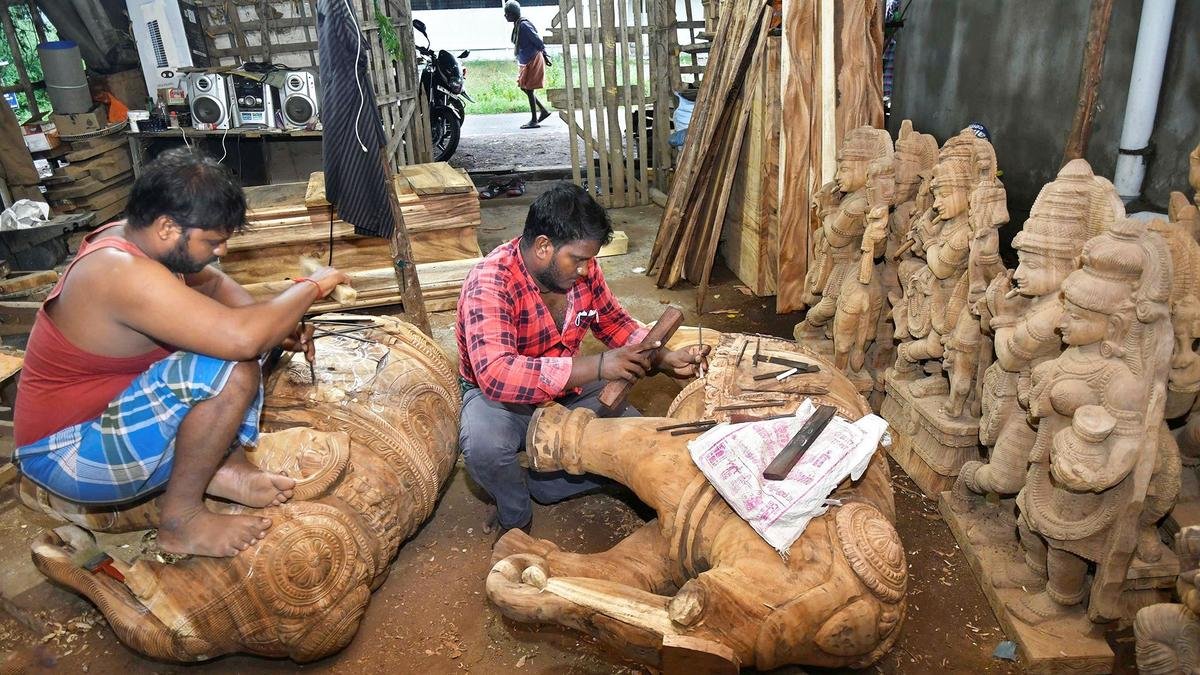
Kallakurichi Wood Carving
In the sun-baked districts of north-central Tamil Nadu, specifically in the towns of Kallakurichi and Chinnasalem, the air often carries a distinctive, earthy perfume. It is the scent of freshly shaven Vaagai wood and the sharp, metallic tang of iron chisels meeting seasoned timber. To a passerby, it is merely the sound of labor, but to the artisans of this region, it is the heartbeat of a 300-year-old tradition. Kallakurichi wood carving is not just an industry; it is a spiritual dialogue between the craftsman and the wood, a process where dead timber is coaxed into becoming a living deity, an intricate panel, or a majestic temple chariot. This is a story of migration, devotion, and the recent global recognition of a craft that nearly faded into the shadows of history.
The Great Migration: From the Vaigai to the Southern Pennar
The origins of Kallakurichi wood carving are as much about people as they are about art. While the craft is now synonymous with the Kallakurichi district, its roots lie far to the south, in the majestic city of Madurai. During the 17th and 18th centuries, under the patronage of the Madurai Nayaka rulers, art and architecture reached a zenith in the Tamil country. Sculptors, painters, and ivory carvers were the rock stars of the era, commissioned to decorate the soaring gopurams and sprawling mandapams of the Meenakshi Amman Temple. However, as political landscapes shifted and monarchical regimes waned, several families of skilled artisans began a long migration northward in search of new patronage and raw materials.
Legend has it that these craftsmen were drawn to the Kallakurichi region because of its proximity to the Kalrayan Hills and the dense forests that offered a consistent supply of specific hardwoods. They settled in a cluster of villages—Kallakurichi, Chinnasalem, and Tirukoilur—bringing with them the sophisticated “Madurai style” of carving. This style, characterized by its deep relief and fluid, lifelike movements, merged with the local folk traditions of the region. Over three centuries, this fusion evolved into the distinct Kallakurichi school of wood carving, an art form that adheres strictly to the Shilpa Shastras—the ancient Hindu texts on iconography—yet possesses a rustic vitality unique to its new home.
The Alchemy of Wood: Choosing the Sacred Canvas
For a Kallakurichi artisan, the process of creation begins not in the workshop, but in the grove. The choice of wood is the most critical decision, as each variety possesses a “spirit” suited for a particular purpose. The most revered material in this region is the Vaagai (Rain Tree or Albizia lebbeck). Valued for its durability and relatively soft grain, Vaagai allows for the incredibly fine detailing that Kallakurichi is known for. It is the preferred choice for idols of Lakshmi, Saraswati, and Ganesha, intended for home shrines.
For more specialized tasks, the artisans turn to other species. Atthi (Fig wood) is traditionally used for sacred puja items, believed to possess auspicious spiritual vibrations. When the task involves building the massive Rathams (temple chariots) that must bear the weight of gods and the strain of thousands of devotees, the craftsmen choose the incredibly hard Illupai wood. On rare occasions, for premium collectors, they might work with the fragrant Sandalwood or the deep-hued Rosewood. Each block of wood is treated with reverence; before the first chisel mark is made, a small prayer is often whispered to the timber, asking for its permission to be transformed into a higher form.
The Master’s Hand: Tools and Techniques
What sets Kallakurichi carving apart from other South Indian styles is the mastery of “Embossed Carving.” Unlike the flat, two-dimensional work seen elsewhere, Kallakurichi artisans specialize in creating high-relief sculptures from a single block of wood. A visitor to a workshop in Chinnasalem would see an artisan surrounded by an array of nearly a hundred different tools. There are broad-bladed chisels for the initial “roughing out,” curved gouges for shaping the musculature of a deity, and needle-thin files used to carve the individual strands of hair on a celestial maiden or the microscopic petals of a lotus.
The process is entirely manual and painstakingly slow. It begins with a hand-drawn sketch on paper, which is then transferred onto the wood using carbon or chalk. Then, the “wastage” is slowly chipped away. There is no room for error; one slip of the mallet can ruin a month’s work. The artisans speak of “listening” to the wood—knowing by the sound of the chisel whether the grain is about to split or if there is a hidden knot within. After the carving is complete, the piece is smoothed using sandpaper and polished with natural waxes. In some traditional pieces, non-toxic paints made from vegetable dyes are used to breathe color into the divine figures, a technique that mirrors the Kalamkari traditions of the region.
The Pantheon in Timber: Symbols and Motifs
The visual vocabulary of Kallakurichi wood carving is deeply rooted in the Puranas and the Epics. The most common subjects are the gods of the Indian pantheon, usually measuring between one and five feet in height. Each figure is a study in precise iconography—Goddess Saraswati must hold her Veena at a specific angle, and Lord Krishna’s flute must be positioned just so to convey the right rasa (emotion).
Beyond the deities, the carvings are adorned with a rich tapestry of motifs. The Annapakshi (a mythical swan) is a signature element, often found gracing the corners of panels or the tops of lamp stands. Floral garlands, intricate Yali figures (mythical lion-elephant hybrids), and scrolling vines called Kodival create a frame of lush complexity around the central figures. These motifs are not merely decorative; they are symbolic of the abundance of nature and the interconnectedness of all living things. In Kallakurichi, every lotus petal carved into a door frame is a silent prayer for prosperity and peace.
Chariots of Fire and Faith: The Pinnacle of the Craft
While individual idols are the bread and butter of the craftsmen, the true test of a master artisan is the construction of a temple chariot. These mobile cathedrals are the architectural wonders of the rural South. Building a Ratham can take several years and requires a team of dozens of carvers. Every square inch of the chariot’s base is covered in carvings depicting scenes from the Ramayana, the Mahabharata, or the local Sthala Purana (temple history).
These chariots are designed to be “read” like a book as they move through the streets during festivals. The lower levels often depict the earthly realm—elephants, soldiers, and everyday life—while the higher levels transition into the celestial realm of the gods. The durability of the Kallakurichi work is such that many of the chariots still in use today were built by the grandfathers of the current generation of artisans. When the chariot rolls through the dust of a village festival, accompanied by the roar of the crowd, it is the ultimate validation of the artisan’s skill—a piece of wood has become a vehicle for the divine.
A New Dawn: The GI Tag and Global Recognition
For much of the 20th century, the artisans of Kallakurichi operated in relative obscurity, competing with factory-made plastic and resin substitutes. The younger generation began to look toward the cities for steadier, less physically demanding work. However, the year 2021 marked a historic turning point. Recognizing the unique cultural and historical value of the craft, the Government of India granted the Geographical Indication (GI) Tag to Kallakurichi Wood Carving.
This “seal of authenticity” changed everything. It provided legal protection against cheap imitations and gave the artisans a powerful brand to use in international markets. Suddenly, the “Madurai-Kallakurichi” style was no longer just a local secret; it was a certified heritage product. Organizations like the Tamil Nadu Handicrafts Development Corporation (Poompuhar) and NABARD stepped in to provide training, loans, and better marketing platforms. Today, a piece carved in a small shed in Kallakurichi might find its way to a luxury hotel in Dubai, a museum in London, or a corporate boardroom in New York, carrying with it the 300-year-old story of its makers.
The Keepers of the Flame: Challenges and the Path Ahead
Despite the newfound fame, the life of a Kallakurichi artisan remains one of humble devotion. Master craftsmen like Kuppu Swamy, who has spent over five decades at the bench, still worry about the future. The supply of seasoned Vaagai wood is becoming increasingly scarce due to climate change and forest regulations. Furthermore, the sheer physical toll of carving by hand for ten hours a day is immense.
Yet, there is a renewed sense of hope. In recent years, small cooperative societies have been formed to ensure fair wages and to stockpile quality timber for the community. Some artisans are even embracing modern technology—using CNC machines for the initial rough cuts of furniture while reserving the sacred idols for pure hand-carving. This hybrid approach allows them to stay competitive while preserving the “soul” of the craft. As long as there are people who value the touch of a human hand over the cold precision of a machine, the chisels of Kallakurichi will continue to sing.
The story of Kallakurichi wood carving is a testament to the resilience of Indian heritage. It is a reminder that in our fast-paced, digital world, there is still a place for the slow, meditative rhythm of the chisel. Each sculpture that leaves this district is a bridge—between the ancient Nayaka courts and the modern home, between the silent forest and the vibrant festival, and between a block of wood and the infinite divine.