
Kovilpatti Kadalai Mittai
As you step into the bustling streets of Kovilpatti, a town nestled in the rain-shadow region of Tamil Nadu’s Thoothukudi district, your senses are immediately greeted by a symphony of scents. It is a warm, nutty aroma that hangs heavy in the air—the scent of thousands of groundnuts being slow-roasted to a golden crisp. This is the olfactory signature of a town that has, for over a century, turned the humble peanut into a global culinary icon. To the uninitiated, it is simply a peanut brittle; to the connoisseur, it is the Kovilpatti Kadalai Mittai, a confection that carries within its amber depths the history of a people, the chemistry of a river, and the spirit of an entrepreneur who dared to change the shape of tradition.
As a historical chronicler of South Indian culture, one finds that few snacks have achieved the legendary status of this rectangular candy. In an era dominated by mass-produced, foil-wrapped chocolates, the Kadalai Mittai remains a steadfast sentinel of purity. In 2020, it was formally draped in the mantle of the Geographical Indication (GI) Tag, and as we look at it from the vantage point of 2026, its journey from a small-town grocery store to a global commodity is nothing short of a gastronomic epic.
The Architect of the Rectangle: Ponnambala Nadar’s Vision
The story of Kovilpatti Kadalai Mittai does not begin in a high-tech factory, but in a modest grocery store in the 1940s. Before this period, peanut candy was a rustic, homemade affair. It was typically found at village festivals, where palm jaggery (Karupatti) was melted down to bind roasted groundnuts into spherical balls. While tasty, these Urundais (balls) were inconsistent in texture and difficult to store for long periods.
Enter Ponnambala Nadar, a resourceful grocery store owner in Kovilpatti. Nadar noticed two things: the abundant harvest of groundnuts from the nearby black soil tracts and the rising availability of sugarcane jaggery (Gur). In a moment of culinary brilliance that would redefine the regional economy, he decided to switch the binding agent from the darker, earthy palm jaggery to the golden, glistening sugarcane variety.
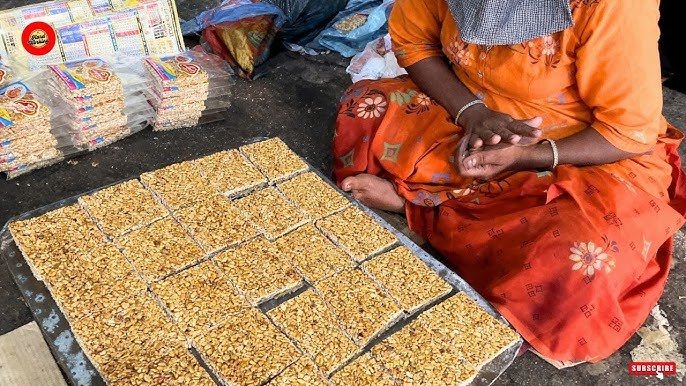
But his most significant innovation was geometric. To make the candy easier to package and transport, Nadar poured the molten mixture onto flat wooden slabs and, before it could fully set, used a sharp knife to cut it into neat, rectangular chunks. This “bar” format was revolutionary. It allowed for a uniform crunch and a professional presentation that made it an instant hit with travelers passing through the Kovilpatti railway station. From that single shop in the bazaar, a cottage industry was born, one that would eventually sustain over 150 manufacturers in the region.
The Terroir of the Black Soil
To understand why a peanut candy made in Kovilpatti tastes vastly different from one made anywhere else in the world, one must look at the “Terroir”—the unique environmental factors that influence the crop. The groundnuts used for this candy are primarily sourced from the native black soil (Karisal Mann) in and around Kovilpatti and Aruppukottai. This soil is rich in minerals and possesses a unique moisture-retention capacity that results in peanuts with a high oil content and an inherent sweetness.
The peanuts are not just ingredients; they are the stars of the show. They are carefully shelled and dry-roasted in a way that enhances their natural oils without burning the skin. It is this specific variety of groundnut that provides the “snap” that the candy is famous for. When you bite into a Kovilpatti Kadalai Mittai, the peanut doesn’t just crumble; it shatters with a nutty resonance that is the hallmark of the region’s produce.
The Chemistry of the Thamirabarani
While the peanuts provide the crunch, the jaggery provides the soul. The artisans of Kovilpatti are notoriously picky about their sweetener. They typically source organic jaggery from specific locations like Theni and Salem, favoring blocks that are pale, soft, and triangular. This jaggery is chosen for its low salt content and high purity, ensuring that the final syrup is a bright, glistening amber rather than a muddy brown.
However, the “secret ingredient” that often escapes the casual observer is the water. To melt the jaggery into a syrup, the manufacturers use water from the Thamirabarani River. This river, which flows through the Tirunelveli and Thoothukudi districts, is believed to have a unique mineral profile. Much like how the water of the Hudson River is often credited with the texture of New York bagels, the Thamirabarani water reacts with the jaggery to create a syrup with a specific tensile strength. This allows the candy to hold its shape without becoming “gummy” or sticking to the teeth—a common flaw in imitation brands.
The Veragu Aduppu: The Ritual of the Fire
The preparation of Kovilpatti Kadalai Mittai is an exercise in heat management. Even in 2026, despite the availability of modern gas burners, the most authentic manufacturers insist on using the Veragu Aduppu—the traditional wood fire. The choice of wood is deliberate, often using tamarind or neem wood, which provides a steady, high heat.
The jaggery is boiled in massive iron vats (Karai) until it reaches the “Hard Ball” stage. The master craftsman, usually a veteran with decades of experience, performs the “water test.” He drops a small bit of the bubbling syrup into a bowl of cold water. If it forms a hard, brittle ball that “clinks” when dropped against the side of the bowl, the syrup is ready.
It is at this precise micro-second that the roasted peanuts are introduced. The mixture is stirred with a long wooden oar, a process that requires immense physical strength to ensure that every single peanut is perfectly enveloped in a thin, translucent coat of syrup. There is no room for excess; the goal is a “dry” candy where the peanuts are the dominant volume, held together by a skeletal framework of sugar.
A Tapestry of Color: The Grated Coconut
If you look closely at a piece of Kovilpatti Kadalai Mittai, you will often see delicate wisps of color on its surface. This is perhaps the most charming aesthetic tradition of the craft. Before the mixture is rolled out and cut, it is topped with wisps of freshly grated coconut that have been dyed in vibrant hues of pink, green, and yellow.
While originally intended to add a hint of tropical aroma and a splash of color for village festivals, these coconut shavings have become the “visual ID” of the Kovilpatti brand. To the local people, these colors represent joy and celebration. Some modern health-conscious manufacturers have moved toward using natural beet or turmeric dyes, but the tradition of the colorful topping remains a cherished signature of the town.
The Cultural Significance: Of Weddings and Wisdom
Beyond being a snack, the Kadalai Mittai is woven into the social fabric of Tamil Nadu. There is a humorous cultural concept known as the “Kadalai Mittai Kalyanam” (Peanut Candy Wedding). In Tamil families, this often refers to the wedding of the last person in a generation to get married. Just as the Kadalai Mittai is the “final sweet treat” often enjoyed at the end of a meal or a long day, this wedding represents the sweet conclusion of a generational line of marriages.
In the villages surrounding Kovilpatti, the candy is an inclusive treat. Because it is made of jaggery rather than refined sugar, and peanuts rather than expensive nuts like cashews or almonds, it has historically been the “common man’s protein bar.” It was the snack carried by farmers into the fields and by students to their schools. Its long shelf life—up to three months without preservatives—made it the perfect companion for the long-distance travelers of the 20th century.
The Road to the GI Tag: A Battle for Authenticity
For decades, the artisans of Kovilpatti watched as “Kadalai Mittai” became a generic term, with imitators across the country producing sticky, inferior versions under the same name. In 2014, the Kovilpatti Regional Kadalaimittai Manufacturers and Retailers Association decided to take action. Led by passionate local leaders and supported by the then-sub-collector, they began the arduous process of applying for a Geographical Indication (GI) Tag.
They had to prove that the specific soil, water, and traditional wood-fire processing methods created a product that could not be replicated elsewhere. After a five-year legal and scientific journey, the tag was finally granted in April 2020. This was a watershed moment. It meant that only candies produced in the Kovilpatti region, following the strict traditional protocols, could legally use the name. For the small-scale manufacturers, this wasn’t just about pride; it was about economic survival in a globalized world.
The Global Renaissance
As of 2026, the Kovilpatti Kadalai Mittai has completed its transition from a regional secret to a global health-food darling. With the world moving toward “clean label” products—snacks with minimal, recognizable ingredients—the Kadalai Mittai fits the bill perfectly. It contains no artificial preservatives, no refined sugar, and no palm oil.
Exports have surged to the United Arab Emirates, the United States, Singapore, and Europe. In the international market, it is marketed as a “Superfood Bar,” prized for its high protein content and the iron-rich benefits of jaggery. Yet, back home in Kovilpatti, the heart of the industry remains in the cottage units. The “Broken Pieces”—the leftover bits after the rectangular bars are cut—have developed their own cult following. These bits, often crunchier and more syrup-laden, are sold in small packets and are the favorite of the locals, proving that in Kovilpatti, even the “mistakes” are delicious.
The Eternal Crunch
The story of Kovilpatti Kadalai Mittai is ultimately a story of resilience. It is the story of how a small town used its black soil and its river to create something that the world couldn’t ignore. Every time a consumer in Chicago or Chennai snaps a bar of this candy, they are participating in a century-old ritual. They are tasting the wood-smoke of the Veragu Aduppu, the mineral salts of the Thamirabarani, and the entrepreneurial spirit of Ponnambala Nadar.
The Kovilpatti Kadalai Mittai is a reminder that heritage isn’t just found in temples and monuments; it is found in the simple, honest work of the hands. As long as the peanuts grow in the black soil and the river flows through the plains, the golden crunch of Kovilpatti will continue to be the sweetest song of the South.