
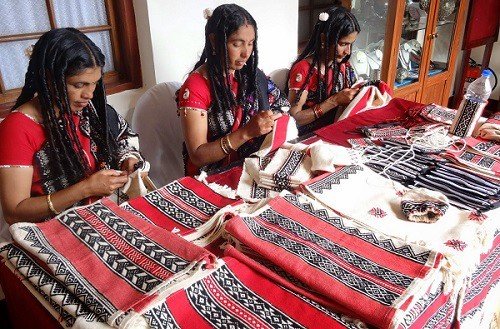
Nilgiri Toda Embroidery
The misty peaks of the Nilgiri Hills in Southern India hold many secrets, but none are as visually arresting as the stark, geometric patterns draped over the shoulders of the Toda people. Known as Pukhoor in the Toda language, Toda Embroidery is not merely a craft; it is a cultural lexicon stitched into fabric. To the uninitiated, it looks like a complex weave, but to the historian and the art lover, it is a testament to an ancient pastoral tribe’s relationship with nature, their sacred buffaloes, and the rugged landscape they call home.
The Genesis of the ‘Pukhoor’: A Gift from the Hills
The origin of Toda embroidery is as shrouded in mist as the Ooty valleys. The Toda tribe, one of the most ancient and unique indigenous communities of India, believes their culture was ordained by the goddess Teikirshy. Unlike many other tribal arts that migrated through trade, Toda embroidery is strictly endemic to the Nilgiri plateau. For centuries, Toda women have sat outside their rainbow-shaped silver-thatched huts, known as munds, capturing the world around them with a simple needle and thread.
Historically, this embroidery was never a commercial venture. It was a rite of passage and a labor of love. Every Toda woman was expected to master the art of Pukhoor to provide for her family’s ritual needs. The embroidery was traditionally done on a coarse white cotton cloth, which provided the perfect canvas for the bold red and black woolenchest threads that define the craft. This color palette is not accidental; white symbolizes purity, red represents the Earth and life-force, and black signifies the transition to the afterlife or the shadows of the deep shola forests.
The Reverse-Stitch Revolution: A Technical Marvel
What sets Toda embroidery apart in the global map of textiles is its mind-bending technique. While most embroidery is done by looking at the “right” side of the fabric, Toda women work from the reverse side. They do not use frames, stencils, or traced patterns. Instead, they rely on a technique known as “counted thread work.” By counting the warp and weft of the base fabric, they insert the needle with such mathematical precision that the resulting pattern on the front appears as if it were woven into the structure of the cloth itself.
The texture is another point of fascination. Because they use thick woolen threads on a cotton base, the patterns have a raised, embossed quality. When you run your fingers over a traditional Toda shawl, or Pootkhuly, you feel the ridges of a history that refused to be flattened. This “embossed” effect is so distinct that in 2013, the craft was granted Geographical Indication (GI) Tag status, ensuring that only the Toda artisans of the Nilgiris can claim the name for their work.
Symbology: The Language of Buffaloes and Blooms
To “read” a Toda embroidery piece is to understand the tribe’s worldview. The patterns are almost exclusively geometric—triangles, zig-zags, and diamonds—but each carries a specific natural meaning. The most sacred motif is the Buffalo Horn. The Toda life revolves around their sacred dairy temples and buffaloes; hence, the stylized horns are a recurring theme, symbolizing strength and divinity.
Other motifs include the Kebu (the scales of a python), the Modj (the undulating clouds of the Nilgiris), and the Powor (the wild flowers that bloom after the monsoon). There is a specific pattern called ‘the heart of a honeybee’ and another representing the ‘ripples in a lake.’ By wearing these patterns, the Toda people literally wrap themselves in the ecosystem they inhabit. It is a form of environmental storytelling that predates modern conservation movements by millennia.
The Pootkhuly: A Fabric for Life and Death
The most significant application of this embroidery is the Pootkhuly, a large, heavy mantle worn by both men and women. The Pootkhuly is not just clothing; it is a social and spiritual anchor. In the life of a Toda, the shawl appears at every critical juncture. When a child is named, they are wrapped in a small version of the embroidered cloth. At weddings, it is exchanged as a symbol of union.
Perhaps most poignantly, the embroidery plays a vital role in funeral rites. When a Toda passes away, their body is wrapped in a brand-new, intricately embroidered Pootkhuly. The community believes that the ancestors in the “other world” recognize their kin by the patterns on their shawls. To die without a Pootkhuly is to be a stranger in the afterlife. This deep spiritual connection ensured the craft’s survival even when modern, cheaper clothing became available; you can buy a t-shirt for daily chores, but you cannot meet your ancestors in anything less than a Pukhoor.
Colonial Curiosity and the Path to the Global Stage
The isolation of the Nilgiris was broken in the 19th century when British officials and missionaries discovered the “Queen of Hill Stations.” They were immediately fascinated by the Toda people, whom they often described as having “Grecian” or “Roman” features. The embroidery caught the eye of Victorian travelers, and for the first time, small pieces of Toda work began to find their way into European museums and private collections.
However, the transition from a ritual craft to a commercial one was fraught with challenges. As the Toda population dwindled in the mid-20th century, the art form faced the threat of extinction. It was the intervention of social workers and the establishment of the Toda Nalivazhvu Sangam that helped pivot the craft toward the modern market. Today, the embroidery is no longer confined to shawls; it appears on contemporary products like mobile pouches, cushion covers, table runners, and high-fashion garments, providing a sustainable income for Toda women while keeping their heritage alive.
The Future: Preserving the Needle in a Digital Age
In the modern era, Toda embroidery faces a double-edged sword. On one hand, international designers have begun incorporating these tribal patterns into “Boho-chic” collections, bringing global visibility. On the other hand, the market is flooded with cheap, screen-printed imitations that mimic the geometric look but lack the soul and texture of the hand-stitched original.
Preserving this craft requires more than just buying a shawl; it requires an appreciation for the time involved. A full-sized Pootkhuly can take a woman up to three months to complete. In 2026, as we move deeper into a world of AI and automation, the Toda embroidery stands as a stubborn, beautiful reminder of what human patience can achieve. It is a slow art for a fast world, a red and black line connecting a modern wearer to the ancient spirits of the Nilgiri hills.