
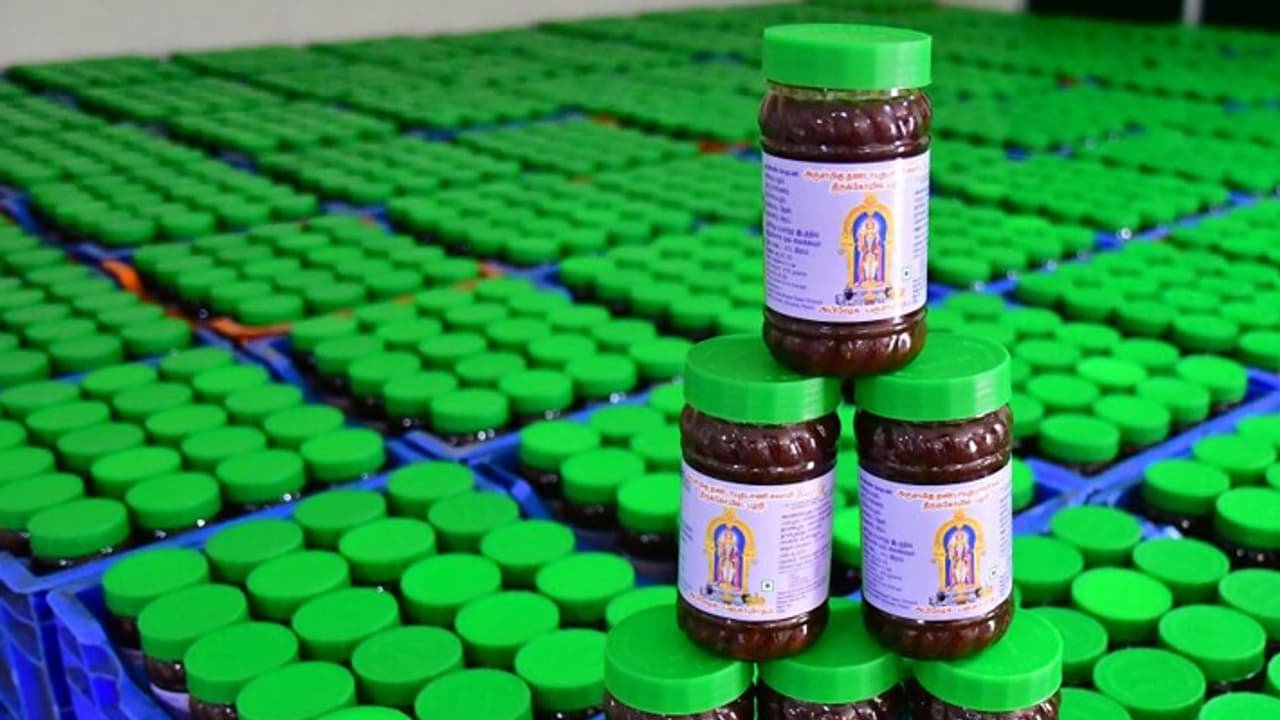
Palani Panchamirtham
In the shimmering heat of the Dindigul plains, where the Western Ghats begin their dramatic ascent, the town of Palani stands as a beacon of faith. But long before you see the golden Vimana of the Arulmigu Dhandayuthapani Swamy Temple atop the hill, you encounter its soul in another form—the aroma of caramelized jaggery, mountain honey, and ripened bananas. This is the scent of Palani Panchamirtham, a divine concoction that has transitioned from a mystic’s medicinal elixir to the world’s first temple prasadam to be honored with a Geographical Indication (GI) tag.
To the millions of pilgrims who climb the 689 stone steps, the Panchamirtham is more than a sweet; it is a spiritual necessity. It is the tangible grace of Lord Murugan, a legacy of the Siddhas, and a marvel of natural food preservation that defies the modern laws of shelf life.
The Alchemist’s Blueprint: Bogar and the Navapashanam
The story of the Panchamirtham begins not in a kitchen, but in an alchemist’s cave over three millennia ago. According to ancient Tamil tradition and the Siddha scrolls, the presiding deity of Palani was not carved from stone or cast in metal. It was created by the legendary Siddhar Bogar, one of the 18 great sages of South India.
Bogar, a master of medicine and alchemy, envisioned an idol that would act as a perpetual source of healing for humanity. He meticulously blended nine poisonous substances—known as Navapashanam—which, through a secret process of purification and transmutation, became a single, solid medicinal masterwork. The genius of Bogar lay in the Abhishekam (ritual anointing). He designed the idol such that when substances like milk or Panchamirtham were poured over the Navapashanam deity, they would absorb its molecular medicinal properties.
When a devotee consumes the Panchamirtham, they aren’t just tasting a dessert; they are partaking in a biological intervention. Historical texts and local lore suggest that this “divine nectar” was specifically formulated to balance the three doshas of the human body—Vata, Pitta, and Kapha—making it one of the oldest recorded “functional foods” in history.
The Anatomy of the Five Nectars
The name “Panchamirtham” is derived from the Sanskrit words Pancha (five) and Amrutam (nectar of immortality). While variations of panchamrit exist across India, the Palani version is unique because of its strict adherence to a specific regional ingredient list and the total absence of water.
The five primary ingredients are Banana, Jaggery, Cow Ghee, Forest Honey, and Cardamom. However, the secret to its legendary status lies in the specific variety of fruit used: the Virupakshi Hill Banana. Grown only in the high altitudes of the Palani Hills, these bananas are smaller, firmer, and have a significantly lower moisture content than common varieties. This low moisture is the “biological anchor” of the Panchamirtham; it prevents the growth of fungi and bacteria, allowing the sweet to remain fresh for months without a single artificial preservative.
To this base, Khandsari sugar (natural unrefined sugar from the Kangeyam region) or high-quality jaggery is added, which acts as a natural humectant. The addition of dates and sugar candy (kalkandu) provides texture, while the forest honey and cow ghee (now exclusively sourced from Aavin to ensure purity) act as natural sealing agents, coating the fruit fibers and preventing oxidation.
The Royal Patronage: Inscriptions and the Pandyan Era
While the spiritual origin is tied to the Siddhas, the historical documentation of Panchamirtham as a formal temple offering dates back centuries. Temple inscriptions from the 14th century (roughly 1300 AD) mention the great Pandyan King, Jatavarman Sundara Pandian, who arranged for special evening poojas where Panchamirtham was a central offering.
Later, the Nagarathar community—a powerful mercantile guild of South India—played a pivotal role in standardizing the production and distribution of the prasadam. They recognized that as Palani grew as a pilgrimage hub, the demand for the holy offering would skyrocket. They introduced systematic ways of sourcing the Virupakshi bananas and refining the jaggery, ensuring that every pilgrim, regardless of their status, could carry a piece of the temple’s grace back home.
From Mud Pots to Automated Vats
For centuries, the preparation of Panchamirtham was a labor-intensive ritual. Master cooks, known as Madapalli priests, would hand-crush the Virupakshi bananas in large wooden or stone vats, slowly folding in the honey and ghee. The heat of the hands and the rhythm of the wooden oars were thought to infuse the mixture with a specific energy.
However, as Palani became one of the most visited shrines in the world—second only to Tirupati in some years—the temple administration faced a challenge: how to maintain purity at a scale of 20,000 to 50,000 kilograms a day. Today, the process is a fascinating blend of tradition and high-tech engineering. The temple’s production facility is a sterile, fully automated plant overseen by the Central Food Technological Research Institute (CFTRI) in Mysore.
Giant stainless steel vats now handle the mashing and mixing, ensuring that not a single drop of water enters the production line. Automated canning machines seal the jars in a vacuum, ensuring that the prasadam reaches devotees in London, Singapore, or New York with the same freshness it had the moment it left the Palani hills.
The 2019 GI Tag: A Global Shield
In 2019, Palani Panchamirtham made history by becoming the first temple prasadam in Tamil Nadu to receive a Geographical Indication (GI) tag. This was a critical victory for the heritage of the region. The GI tag legally dictates that for a product to be called “Palani Panchamirtham,” it must be produced in the Palani region and must use the specific ingredients—notably the Virupakshi banana—that define its character.
This move was prompted by an influx of “fake” panchamirthams made with cheap, water-heavy bananas and artificial flavorings. The GI tag ensures that the centuries-old “Bogar formula” remains protected from commercial dilution. It also transformed the sweet from a local religious item into an internationally recognized luxury food product.
Modern News and the “Purity” Discourse
Even in the modern era, the Panchamirtham remains at the center of public discourse. In 2024 and early 2025, following controversies regarding the purity of ingredients in other major Indian temples, the Tamil Nadu Hindu Religious and Charitable Endowments (HR&CE) Department stepped in to reassure devotees.
Concerns were raised about the source of the ghee used in the Panchamirtham. The temple administration clarified that every batch of ghee is sourced from the state-run Aavin, undergoing rigorous lab testing before it enters the temple vats. Furthermore, the temple recently introduced a digital tracking system where devotees can scan a QR code on the jar to see the batch number and the date of preparation—a marriage of 9th-century faith and 21st-century transparency.
Interesting Facts You Might Not Know
The “Zero Waste” Sweet: Every part of the Panchamirtham process is natural. Even the discarded peels of the Virupakshi bananas are used as organic fertilizer for the temple gardens.
The Healing Bath: Only a small portion of the Panchamirtham produced is used for the Abhishekam of the main idol. This “anointed” portion is then mixed into the larger vats, essentially “blessing” the entire day’s production.
No Refrigeration: Due to its low water activity, the Panchamirtham has a natural shelf life of about 30 days at room temperature, but if kept in airtight containers, it is known to last much longer, darkening into a rich, deep mahogany color as the sugars age.
A Spoonful of Eternity
To taste Palani Panchamirtham is to taste the history of Tamil Nadu itself. It is a flavor that encompasses the ruggedness of the Western Ghats, the wisdom of the Siddhas, and the unwavering faith of millions. As you stand at the foot of the Palani hill, watching the sun set over the emerald groves of Virupakshi, the Panchamirtham reminds us that some traditions don’t just survive time—they grow sweeter because of it.
It remains a testament to the fact that when nature, science, and spirit converge in a single jar, the result is nothing short of an immortal delicacy.