
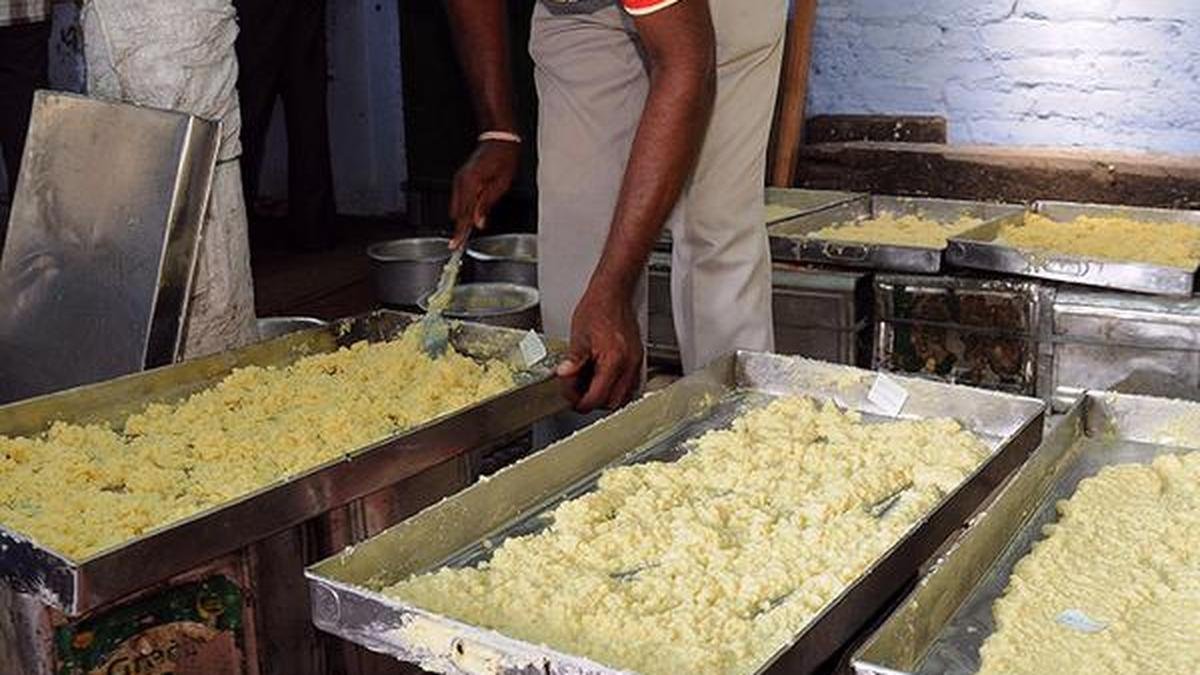
Srivilliputtur Palkova
The Pastoral Cradle: A Land of Milk and Honey
To understand the Palkova, one must first understand the land. Srivilliputtur, nestled at the foothills of the Western Ghats in the Virudhunagar district, has historically benefited from a unique microclimate. The red loam and black soil of the region, nurtured by seasonal rains, provide a lush grazing ground for livestock. Local folklore suggests that the cows of Srivilliputtur graze on a specific variety of local grass and crops that imbue their milk with an unusually high fat content—often exceeding 7%—and a natural, subtle sweetness.
Historically, this abundance of milk posed a logistical challenge. In the early 20th century, before the advent of modern refrigeration, farmers often found themselves with a massive surplus of unconsumed milk. The birth of Palkova was, in many ways, an act of preservation born of necessity. By boiling the milk down to its solids, the villagers created a product that could last for weeks, unlike raw milk which would spoil in hours.
The Rajput Legacy: From the North to the Temple Gates
While the milk was local, the spark of genius that turned it into a commercial phenomenon came from afar. In 1921, a Rajput named Dev Singh migrated from North India to this southern temple town. Drawing on the North Indian tradition of making Khoa (milk solids), Singh recognized that the local milk was far superior to what he had known back home.
He established a small sweet stall called Lala Sweets (later renamed Sri Venkateswara Vilas) right in the shadow of the Andal Temple. Singh’s innovation was simple but revolutionary: he married the North Indian technique of slow-reducing milk with the fat-rich local cow’s milk and a precise measure of sugar. Unlike the plain Khoa used as a base for other sweets in the North, this was a standalone delicacy—grainy, decadent, and deeply caramelized.
The proximity to the temple was no accident. Pilgrims visiting the birthplace of Goddess Andal began to purchase this “milk-gold” as a souvenir. It wasn’t long before the Palkova became inextricably linked with the temple itself.
Divine Confections: The Andal Connection
In the Vaishnavite tradition, the relationship between the devotee and the divine is often expressed through food. Goddess Andal, the only female among the twelve Alvar saints, is celebrated for her intense, bridal devotion to Lord Vishnu. In her verses, the Tiruppavai, she often references “rich milk” and “sweets that drip with ghee.”
It is a common belief among locals that the creamy Palkova is the modern manifestation of the Prasadam (divine offering) that Andal herself might have favored. Today, no visit to the Andal Temple is considered complete without an offering of Palkova. The sweet has moved from being a commercial snack to a sacred bridge between the physical and the spiritual, often referred to as the “Queen of Milk Sweets.”
The Alchemy of the Wood Fire: A Masterclass in Patience
What separates a generic milk sweet from an authentic Srivilliputtur Palkova is the grueling, artisanal process of its creation. Modernity has attempted to introduce steam jackets and gas burners, but the purists of Srivilliputtur still swear by the traditional wood-fire kiln.
The process begins in the early hours of the morning, around 7:00 AM, when farmers deliver fresh, unpasteurized milk to the local cooperative societies and private manufacturers. The quality is strictly monitored; if the fat content isn’t high enough, the milk is diverted to other uses.
The Cauldron: A wide-mouthed, shallow iron pan called a kadai is placed over a mud stove.
The Fuel: Traditionally, dried tamarind wood or cashew nutshells are used as fuel. The intense, consistent heat of the tamarind wood is said to contribute to the Palkova’s specific smoky undertone.
The Reduction: For every 10 liters of milk, a master craftsman begins a rhythmic, back-breaking process of stirring. As the water evaporates, the milk proteins and sugars undergo the Maillard reaction, turning the liquid into a thick, pale-yellow slurry.
The Sweetening: Only when the milk has reduced to nearly a third of its volume is the sugar added—approximately 1.25 to 1.5 kg for every 10 liters. The sugar further caramelizes the mixture, giving it its signature light-brown hue.
The Texture: The “grain” is everything. A skilled maker knows exactly when to pull the pan off the fire. Too early, and it’s a liquid paste; too late, and it becomes a hard candy. The perfect Srivilliputtur Palkova is semi-solid, moist, and features fine, uniform granules that dissolve the moment they hit the tongue.
The White Revolution and the Cooperative Movement
If Dev Singh provided the spark, the Srivilliputtur Milk Producers Co-operative Society, established in 1945, provided the fuel for the Palkova’s global journey. Following the “White Revolution” of the 1970s, milk production in the region skyrocketed. The cooperative society became a pioneer in mass-producing the sweet while maintaining artisanal standards.
Today, the society remains one of the largest and most trusted producers. Their shop at the Srivilliputtur bus stand is a landmark in its own right, where travelers from across the state scramble to buy fresh packets during brief bus halts. This cooperative model ensured that the wealth generated by the Palkova stayed within the local community, supporting thousands of dairy farmers and artisans.
The GI Tag: Protecting a Geographical Legacy
In 2019, the Srivilliputtur Palkova was officially granted the Geographical Indication (GI) tag. This was a landmark moment for the town, as it legally recognized that the specific quality and taste of the sweet are inseparable from the geography of Srivilliputtur.
The GI status protects the local producers from “fly-by-night” imitators who use milk powder, condensed milk, or artificial thickeners. An authentic Srivilliputtur Palkova must, by definition, be made within the specified region using local cow’s milk and the traditional slow-reduction method. It is a victory for the “slow food” movement in a world dominated by instant gratification.
Interesting Historical Tidbits & Trivia
The “Tamarind Tree” Shop: One of the most famous outlets, Puliyamarathadi Palkova, gets its name because the original shop was situated under a massive tamarind tree. This shop, started by Krishna Singh (another Rajput) in the 1960s, is credited with popularizing the “grainy” texture that is now the industry standard.
No Refrigeration Needed: Due to its high sugar content and the intensive boiling process which eliminates most moisture, Palkova has a remarkable shelf life. It can stay fresh for up to two weeks at room temperature, making it the perfect gift for travelers.
Yield Ratios: It takes roughly 3 to 3.5 liters of high-fat milk to produce just 1 kilogram of Palkova. This concentration of nutrients is why it was historically given to children and convalescents as a source of energy.
The Color Spectrum: You will find Palkova ranging from creamy white to dark tan. The darker the color, the longer the milk has been caramelized—a preference that varies from one local shop to another.
A Taste of History
As you peel back the butter-paper wrapping of a fresh block of Palkova, you aren’t just looking at a dessert. You are looking at the culmination of a century of history. You are tasting the resilience of Rajput migrants, the devotion of Tamil saints, and the bounty of the Southern pastures.
Srivilliputtur Palkova remains a testament to the idea that the best things in life require only two ingredients: purity and patience. It is a story told in the language of simmering milk and glowing embers—a story that continues to be written, one delicious spoonful at a time.