
Swamimalai Bronze Icons
The Alchemist’s Prayer: The Eternal Bronze of Swamimalai
In the heart of the Kaveri delta, a millennium-old lineage of Sthapathis breathes life into metal, preserving the radiant legacy of the Chola Empire. To step into a bronze-casting workshop in Swamimalai is to step into a sensory landscape where time itself seems to have liquefied. The air is thick with the scent of smoldering charcoal and the sweet, heavy aroma of melting beeswax and dammar resin. Here, amidst the heat of the furnace and the rhythmic clink-clink of chisels against bronze, an ancient alchemy is performed every single day. This is not mere manufacturing; it is a ritualistic birth where the four elements—earth, air, fire, and water—conspire under the guidance of a master artisan to create a divinity.
The Shadow of the Cholas: A Royal Genesis
The story of the Swamimalai bronze icons is inseparable from the zenith of the Chola Empire between the 9th and 13th centuries CE. While metal casting was known in India for millennia, it was the Chola monarchs—specifically Raja Raja I and his son Rajendra Chola—who elevated it to a state of sublime perfection. These emperors were not just conquerors; they were enlightened patrons of the arts who sought to immortalize their piety in stone and metal. When the Great Brihadisvara Temple was being built in Thanjavur, Raja Raja I summoned a group of master sculptors known as Sthapathis from Gingee, near Vellore.
These artisans were tasked with creating the Utsava Murtis—the processional deities that would leave the inner sanctum of the stone temples to be carried through the streets, allowing the common people to experience the Darshan of the divine. After the construction of the great temples at Thanjavur and Gangaikonda Cholapuram, a branch of these artisans migrated to Swamimalai. They were drawn to this specific town for a geological secret: the silt on the banks of the River Kaveri. The clay here was found to be exceptionally fine, malleable, and heat-resistant, making it the perfect medium for creating the intricate molds required for bronze casting. For over a thousand years, their descendants—belonging to the Vishwakarma community—have lived and worked in Swamimalai, considering themselves the inheritors of a sacred architectural mandate.
The Soul that Dies for Art: The Lost-Wax Method
At the core of Swamimalai’s fame is the Cire Perdue or “Lost-Wax” process, known in Sanskrit as Madhuchishta Vidhana. Unlike modern mass-produced items, every Swamimalai bronze is a “one-of-a-kind” masterpiece because the mold is broken to reveal the statue. The process begins not with metal, but with wax—a specific mixture of beeswax, dammar resin, and groundnut oil. The Sthapathi carves the entire deity in this malleable wax with the precision of a jeweler. Every fold of the garment, every intricate jewel on the crown, and every subtle smile must be captured in the wax, for the final bronze will be a perfect replica of this model.
Once the wax model is complete, it is encased in three layers of Kaveri clay. The first layer, Kaliman, is a fine silt that captures the minute details. The subsequent layers are coarser, providing the structural strength to withstand the pressure of molten metal. This clay-covered model is then sun-dried and eventually heated in a furnace. This is the moment of sacrifice: the wax melts and flows out through small vents, leaving behind a hollow, negative impression of the deity within the clay. The wax “soul” is lost so that the bronze form can be born. Molten metal—an alloy heated to nearly 1100°C—is then poured into this void.
Panchaloha: The Spiritual Science of Five Metals
The metal poured into these molds is traditionally Panchaloha, an alloy of five sacred metals: copper, gold, silver, brass, and lead (or tin/zinc depending on the tradition). In the spiritual science of the Sthapathis, these five metals are not chosen randomly; they represent the Pancha Bhootas or the five elements of the universe: Earth, Water, Fire, Air, and Ether. Gold represents the sun and spiritual growth, silver the moon and emotional balance, and copper acts as a conductor of divine energy.
While economic pressures have made the inclusion of significant amounts of gold and silver rare today—often replaced by a higher percentage of copper (about 82%), brass (15%), and lead (3%)—many devotees still bring their own family gold or silver ornaments to be melted into the alloy during the casting of their personal deity. The resulting icon is believed to be a “living” conductor. When a priest performs the Prana Pratistha (consecration ritual) on a Swamimalai Panchaloha idol, it is believed that the specific metallurgical properties of the alloy help retain and radiate the spiritual vibrations generated by the mantras and rituals.
The Mathematics of Divinity: Tala Mana
The beauty of a Swamimalai icon is not subjective; it is governed by the rigorous mathematical laws of the Shilpa Shastra. The Sthapathis use a basic unit of measurement called the Tala, which is roughly the distance between the hairline and the tip of the chin. A specific system called Navatala (nine-part measurement) is used to ensure that the proportions of the head, torso, and limbs are perfectly balanced.
A male figure is traditionally divided into 124 parts, while a female figure is divided into 120 parts on the odiolai—a traditional measuring strip made from a coconut palm frond that does not shrink or expand. Every mudra (hand gesture), whether it is the Abhaya Mudra (gesture of fearlessness) or the Varada Mudra (gesture of boon-giving), must be chiseled to exact specifications. This fusion of art and geometry is what gives the Chola bronzes their “classic grace”—a sense of movement frozen in time, where the heavy metal appears light, and the rigid bronze seems as soft as human skin.
Nataraja: The Pinnacle of the Tandava
If one were to pick a single image that defines the Swamimalai legacy, it is the Nataraja—Shiva as the Lord of the Dance. The Chola Nataraja is considered by art historians worldwide as one of the most perfect representations of the cosmic cycle ever created. Within a circle of fire (the Thiruvasi), Shiva performs the Ananda Tandava, his four arms representing the five activities of the deity: creation, preservation, destruction, illusion, and grace.
The fame of the Swamimalai Nataraja transcends religion and art. A massive 2-meter bronze Nataraja, cast in Swamimalai, stands proudly at the entrance of CERN (European Organization for Nuclear Research) in Geneva. It was a gift from India to acknowledge the profound parallel between the “dance of the subatomic particles” observed by modern physicists and the “cosmic dance of Shiva” described in ancient Tamil scriptures. To see a master Sthapathi in Swamimalai detailing the flaming aura of a Nataraja is to witness a direct link between ancient metaphysics and modern science.
The Artisan’s Life: Guardians of a Fading Fire
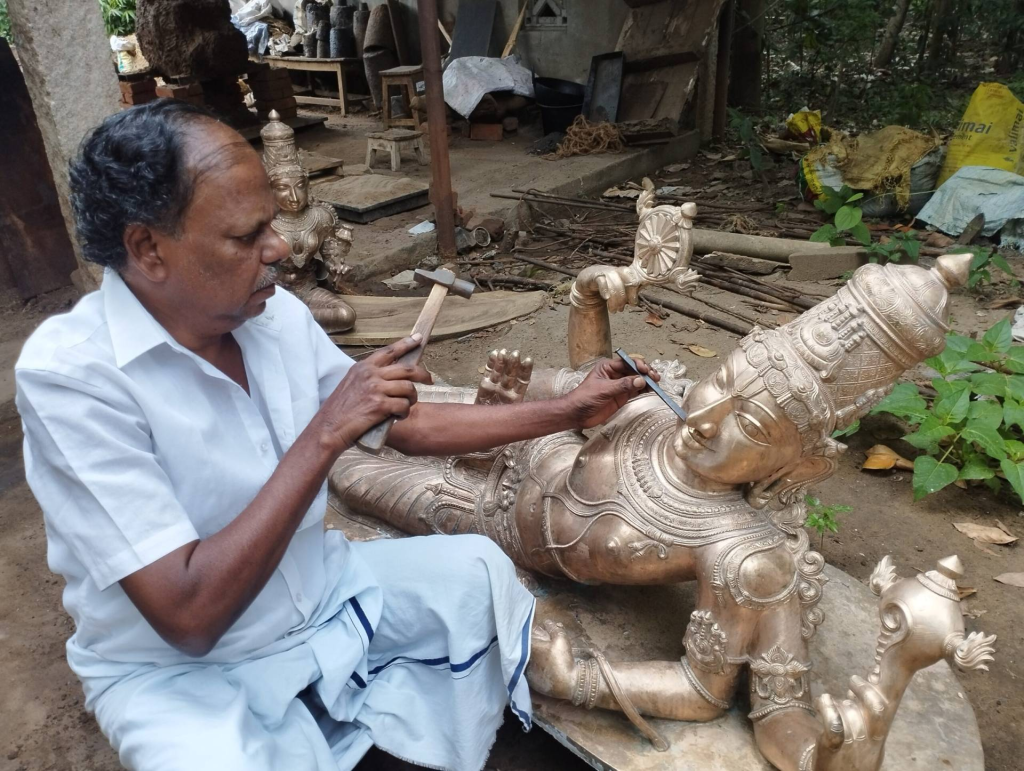
Today, nearly 500 to 600 Sthapathi families continue this tradition in Swamimalai. Their lives are ones of quiet dedication, working eight hours a day in soot-stained workshops. The craft is physically demanding and requires immense patience; a medium-sized icon can take anywhere from four to six months to complete. After the clay mold is broken, the “unfinished” bronze that emerges is rough and dull. It is the final stage—the chiseling, filing, and polishing—that truly reveals the deity. The “opening of the eyes” (Nayanamelanam) is the most sacred moment, usually performed on an auspicious day, when the Sthapathi carves the pupils of the eyes, symbolically bringing the icon to life.
In recent years, the craft has faced modern challenges. The availability of high-quality Kaveri silt has become a concern due to river regulations and environmental changes. Furthermore, the rise of mass-produced, hollow brass statues made using modern industrial molds provides a cheaper but aesthetically inferior alternative for the casual market. However, for serious temples and art collectors, there is no substitute for the solid, hand-carved Swamimalai bronze. The 2008 GI tag has provided a vital shield, ensuring that only icons produced in this region using the traditional lost-wax method can carry the prestigious name.
A Global Legacy: From the Temple to the World
The Swamimalai bronze icons have moved beyond the temple walls into the global art market. While a significant portion of their work is still commissioned for temples in the US, UK, Australia, and Malaysia, these icons are increasingly sought after by interior decorators and art connoisseurs for their sheer aesthetic power. Whether it is a tiny six-inch Ganesha or a massive 12-foot processional deity, each piece carries the weight of a thousand years of history.
In the quiet lanes of Swamimalai, as the sun sets over the palm trees, the furnaces continue to glow orange. The Sthapathis know that they are not just making statues; they are holding the thread of a civilization that refuses to snap. As long as the Kaveri flows and the human spirit seeks a tangible form for the divine, the alchemists of Swamimalai will continue to turn molten metal into the poetry of the gods.