
Temple Jewellery of Nagercoil
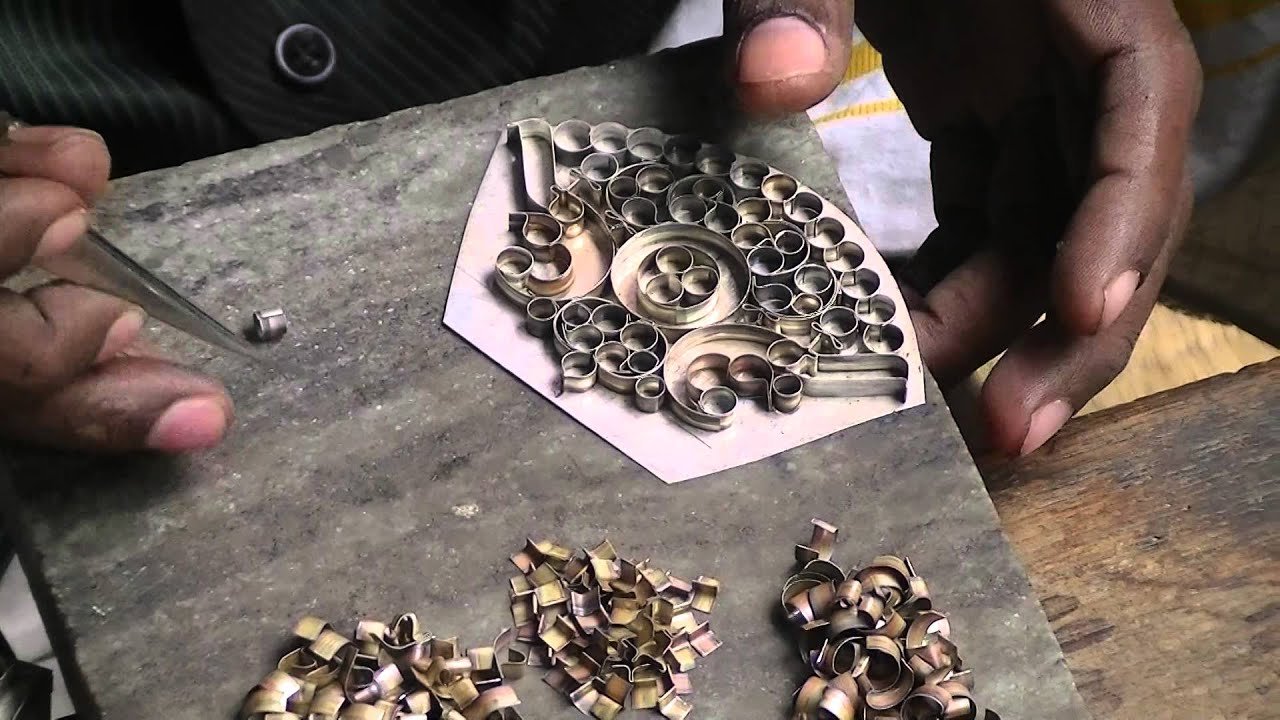
As the morning mist clings to the towering gopurams of the Suchindram Thanumalayan Temple, a few kilometers away in the narrow, winding lanes of Vadasery, a different kind of devotion begins. It is not found in the chanting of hymns or the ringing of bells, but in the rhythmic, metallic tink-tink of a small hammer hitting a silver wire. Here, in this humble hamlet within the city of Nagercoil, the air is thick with the smell of melting wax and the quiet intensity of artisans who have, for centuries, been the personal jewelers to the Gods. This is the birthplace of the legendary Temple Jewellery of Nagercoil, a craft that serves as a bridge between the celestial and the terrestrial, a golden thread that has survived the rise and fall of empires.
The Genesis: When Kings Worshipped through Art
To understand the origin of this jewellery is to travel back to the 9th century, into the heart of the Chola and Pandya dynasties. In the ancient Tamil landscape, a temple was not merely a place of worship; it was the political, social, and cultural hub of the kingdom. The presiding deity was treated as a living monarch—the Chakravarthi of the universe. Just as an emperor required regalia to signify his power, the idols required Abharanam (ornaments) to signify their divinity.
Historical accounts and temple inscriptions suggest that the earliest pieces were forged from pure gold, donated by kings as a form of “booty” from successful military campaigns. Every gemstone—the deep red rubies from the mines of Burma and the soothing green emeralds—was an offering of the highest order. The artisans, known as Acharis, were often settled near the temple precincts, given lands and titles by the royalty to ensure they could focus entirely on their “divine service”. For these craftsmen, the process was a form of tapas (penance); every curve of a necklace had to mirror the proportions of the Shilpa Shastras, the ancient scriptures of iconography.
The Vadasery Hub: A Village of Alchemists
While temple jewellery exists in various forms across South India, the variety from Vadasery in Nagercoil is the only one protected by the Geographical Indication (GI) tag. Why this specific village? The secret lies in a transition that occurred nearly three hundred years ago. As the price of gold skyrocketed and the absolute power of local chieftains waned, the artisans of Vadasery innovated. They pioneered a unique technique: a base of pure silver covered with a thick, lustrous gold leaf, or dipped in gold through a rigorous electroplating process that allowed the jewellery to remain affordable for the common man without losing its “regal” aura.
Today, Vadasery remains an artisanal cluster where time seems to have paused. Approximately 52 families, comprising around 300 to 350 master craftsmen, carry forward the lineage. Walking through their pattarais (workshops), one sees three generations working side-by-side. The elders, with their fading eyesight but unerring muscle memory, guide the youth in the delicate art of curling silver strips into intricate floral designs. This is a craft where machines have little room; apart from the initial rolling of silver into thin sheets, every single step—from the soldering to the stone-setting—is done by human hand.
The Alchemy of the Kemp: Of Red Stones and Wax
The most defining feature of Nagercoil temple jewellery is the use of the Kemp stone (traditionally called Kuchu kal). In its original form, these were uncut cabochon rubies and emeralds, prized for their deep, opaque color rather than their clarity. In the modern Vadasery method, these have been replaced by high-quality synthetic stones that retain the signature dark reddish-maroon and emerald-green hues.
The manufacturing process is a masterclass in ancient engineering. It begins with a silver frame, handcrafted to the desired motif. Instead of using modern mechanical settings, the artisan fills the hollow silver frame with a specialized natural lacquer or wax. The stones are then painstakingly pressed into this softened wax. To give the stones their characteristic “fire,” a sliver of colored foil is often placed beneath them to reflect light. The piece is then baked, causing the wax to harden and permanently lock the stones in place. This “wax-setting” ensures that the gems do not rattle or fall out, a necessity for jewellery that must withstand the vigorous movements of a dancer or the heavy washing rituals of a deity.
Royal Patronage: The Travancore Connection
The survival of the Nagercoil tradition owes much to the Kingdom of Travancore and the chieftains of the Chettinad region. Nagercoil, being part of the erstwhile Travancore state, benefited directly from the patronage of the Maharajas, who were staunch devotees of Lord Padmanabhaswamy. The royals believed that their wealth belonged to the deity, and they commissioned the Vadasery artisans to create massive Prabhavalis (halos), Kireetams (crowns), and Kasu Malas (coin necklaces) for the temples of their realm.
It is said that in the 17th and 18th centuries, the wealthy Chettiars of Ramanathapuram would travel for days specifically to Nagercoil to commission “real” diamond-studded gold jewellery. They valued the Vadasery craftsmen not just for their technical skill, but for their “ritual purity.” The artisans were expected to follow strict codes—maintaining a calm temperament and total concentration—as they were working on objects that would eventually reside within the Garbhagriha (sanctum sanctorum). This association with royalty and the divine gave the Nagercoil jewellery a status that commercial gold could never match.
The Stage as a Temple: Bharatanatyam and the Aharya
As the 20th century dawned, temple jewellery transitioned from the static idols to the living, breathing “temple dancers” or Devadasis. In the world of classical dance, the costume is known as Aharya Abhinaya—the expression through dress and adornment. For a Bharatanatyam or Kuchipudi dancer, the Nagercoil temple jewellery set is an absolute necessity.
The brilliance of this jewellery lies in how it frames the dancer’s body and highlights their movements. The Nethi Chutti (headpiece) highlights the forehead as the dancer tells stories with their eyes. The Jimikki (bell-shaped earrings) and their connecting Mattal chains define the face. The Vanki (armlet), often shaped like a coiled serpent or a lotus vine, symbolizes strength, while the Oddiyanam (waist belt) keeps the heavy silk saree in place while emphasizing the rhythmic movements of the hips. Because original Nagercoil jewellery is made of silver and then plated in gold, it is lighter than pure gold sets, allowing dancers to perform for hours without being weighed down by their own finery.
A Language of Motifs: The Sacred Flora and Fauna
Every piece of Nagercoil temple jewellery is a visual dictionary of South Indian mythology. The motifs are never chosen at random; they are deeply symbolic.
The Peacock and Parrot: Often found in the Manga Malai (mango necklace), the peacock represents grace and victory, while the parrot is the companion of Meenakshi, the goddess of wisdom.
The Lotus: The most ubiquitous motif, symbolizing purity as it rises from the mud to reach for the sun.
The Yali: A mythical creature that is part-lion, part-elephant, and part-horse. Often found on heavy pendants, the Yali is a protector, meant to ward off evil and guard the wearer.
Goddess Lakshmi: The goddess of wealth is frequently depicted seated on a lotus, bestowing blessings and prosperity upon the wearer.
These designs are “bold yet balanced,” ensuring that they do not overpower the person wearing them but rather enhance their presence. Even today, modern brides in Tamil Nadu consider their wedding collection incomplete without at least one authentic Nagercoil Addigai (choker) or Haram, seeing it as a symbol of cultural continuity.
The Struggle and the Shield: The GI Tag Era
In 2007, the Geographical Indication (GI) Tag was granted to the Temple Jewellery of Nagercoil, providing it with much-needed legal protection. Before this, the market was flooded with cheap brass imitations that lacked the ritual purity and durability of the silver-based Vadasery pieces. The GI tag ensures that only jewellery made in the Vadasery cluster using traditional methods can carry the prestigious name.
However, the craft faces modern challenges. The rise in material costs and the labor-intensive nature of the work—a single set can take anywhere from a few weeks to several months to complete—makes it a difficult profession for the younger generation. Many artisans suffer from poor eyesight due to the intricate nature of the work, and the competition from “instant” machine-made jewellery is fierce. Yet, the global demand from the Indian diaspora and dance schools across the US, UK, and Singapore keeps the kilns burning. Organizations like the Development Commissioner for Handicrafts have stepped in to provide welfare schemes, ensuring that the Acharis of Vadasery do not have to battle the dark alone.
The Immortal Gold
The Temple Jewellery of Nagercoil is more than just an accessory; it is “history, devotion, and artistry cast in gold”. It is a reminder of an era when human hands were seen as an extension of the divine will. Whether it is adorning a six-foot granite idol in a cavernous temple or a young girl taking her first steps on a dance stage, these ornaments carry a “regal glow” that time cannot tarnish.
As the sun sets over the Kanyakumari coast, the clink-clink of the chisels in Vadasery slowly quietens. But the spirit of the craft remains—vibrant, red like a Kemp ruby, and as enduring as the legends of the Palani Hills. To wear a piece of Nagercoil temple jewellery is to wear a fragment of the past, a blessing from the royalty of old, and a silent prayer for the future.