
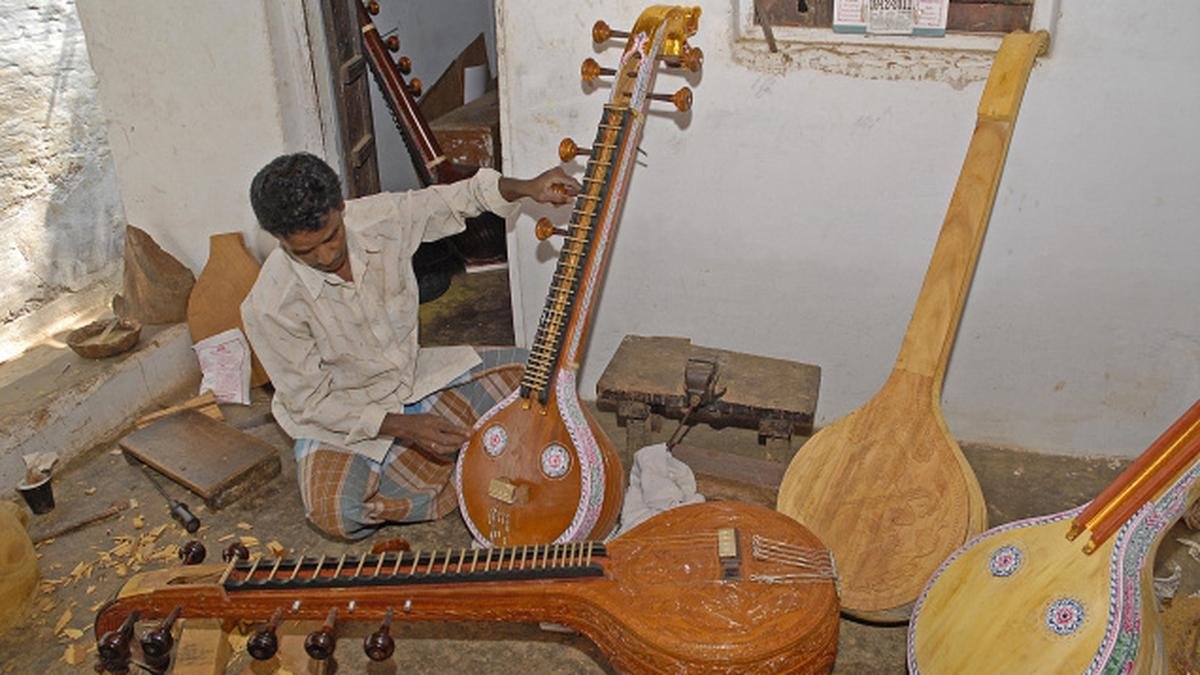
Thanjavur Veena
The history of Thanjavur is often told through its towering granite temples and the scent of its fertile paddy fields. Yet, there is a more delicate sound that echoes through the corridors of time in this ancient city—the deep, resonant, and almost human-like voice of the Thanjavur Veena. Known as the Saraswati Veena, this instrument is more than a tool for music; it is a manifestation of divine symmetry, a triumph of medieval engineering, and the very soul of South Indian classical music.
The Royal Refinement: From Raghunatha to Saraswati
While stringed instruments resembling the Veena have been mentioned in the Rigveda and Natya Shastra for over three millennia, the specific form we celebrate today—the Thanjavur Veena—is a product of the 17th-century golden age of the Nayak dynasty. The story of its origin is inseparable from the brilliance of King Raghunatha Nayak (reigned 1600–1634).
Raghunatha was not merely a ruler; he was a polymath and a master vainika (veena player). Before his era, the veena was a simpler instrument with movable frets that required constant adjustment for different ragas. Legend says the King, along with his visionary minister and musicologist Govinda Dikshitar, sought to perfect the instrument. Together, they fixed the number of frets at 24, strategically placed to encompass two full octaves. This innovation was revolutionary; it allowed for the seamless transition between ragas and laid the foundational structure for the 72 Melakarta raga system of Carnatic music. To this day, the instrument is sometimes reverently called the Raghunatha Mela Veena.
The Alchemy of Jackwood: A Craft of Patience
To build a Thanjavur Veena is to engage in a slow, meditative dialogue with nature. The journey begins with the Jackfruit tree (Artocarpus heterophyllus). Artisans do not use just any wood; they seek out matured jackwood, often sourced from the Panruti region, known for its density and acoustic resonance. The choice of jackwood is scientific as much as it is traditional; it is resistant to changes in weather and possesses a unique “tonal memory” that improves as the instrument ages.
The construction is divided into two prestigious categories:
Ekantha Veena: The most coveted form, where the entire instrument—the Kudam (resonator), the Dandi (neck), and the Yali (dragon-head)—is painstakingly carved from a single, solid block of wood. It is a rare feat of craftsmanship that ensures a pure, unbroken vibration.
Sada Veena: A more common but equally beautiful version where the three parts are carved separately and joined with such precision that the seams are invisible to the ear.
An artisan spends nearly 20 to 30 days on a single piece, hollowing out the wood until the walls are thin enough to vibrate but strong enough to withstand the tension of seven steel strings.
The Architecture of Sound: 24 Frets and a Mythical Beast
The most striking visual feature of the Thanjavur Veena is the Yali, a mythical creature with the features of a lion and an elephant, carved into the neck’s end. This is not mere ornamentation; the Yali represents the protection of the arts and serves as a counterbalance to the heavy resonator.
The “soul” of the music, however, lies in the 24 brass frets. These are set into a bed of scalloped black wax, a secret concoction of beeswax and coal powder. Setting these frets is the most difficult stage of the process, requiring a “tuner’s ear” and a “surgeon’s hand.” If a fret is off by even a millimeter, the entire instrument loses its sanctity.
At the other end, the Kudurai (bridge) sits atop the resonator. Unlike a guitar, the bridge of a Veena is slightly curved, allowing the strings to graze the surface. This creates the signature jawari—a rich, buzzing harmonic overtones that give the Veena its distinctive, vocal-like quality. This unique construction even caught the attention of Nobel laureate Sir C.V. Raman, who published a scientific paper in 1921 analyzing the geometric significance of the Veena’s bridge on sound radiation.
The Human Connection: Spirituality and Anatomy
In the cultural imagination of Tamil Nadu, the Veena is often described as a mirror of the human body. The Kudam represents the skull, the Dandi (neck) corresponds to the spinal column, and the 24 frets are equated to the 24 vertebrae. The seven strings are the seven dhatus (tissues) of the body. Playing the Veena is thus seen as a yogic act, a way to harmonize the internal vibrations of the self with the external sounds of the universe.
This spiritual weight is why the Thanjavur Veena is the chosen instrument of Goddess Saraswati. In every traditional home in Thanjavur, the Veena is treated not as a possession but as a deity. Before a concert, the artist performs a puja to the instrument, acknowledging that the music flowing through it is a gift from a higher plane.
A Legacy Protected: The GI Tag and Modernity
In 2013, the Thanjavur Veena became the first musical instrument in India to receive the Geographical Indication (GI) Tag. This was a pivotal moment for the nearly 100 families of the Vishwakarma community who live in the narrow lanes of Thanjavur, keeping this craft alive through generations. The GI tag ensures that “Thanjavur Veena” remains a mark of quality, protecting the artisans from mass-produced, inferior imitations.
Despite the rise of electronic keyboards and digital music, the demand for an authentic Thanjavur Veena remains high among serious students and global maestros like Jayanthi Kumaresh and the legendary S. Balachander. These artists have taken the sound of Thanjavur from temple courtyards to the world’s most prestigious concert halls, proving that the 400-year-old design of Raghunatha Nayak is as relevant today as it was in the 17th century.
The Fading Echo?
As the sun sets over the Vadavaru river in Thanjavur, the sound of chisels hitting jackwood still fills the air in small workshops. However, the craft faces a precarious future. The painstaking nature of the work, combined with the low profit margins for the artisans, means that fewer young people are taking up the chisel.
The Thanjavur Veena is more than a relic; it is a living, breathing testament to the intellectual and artistic height of Tamil civilization. To listen to a Veena is to hear the heartbeat of Thanjavur—a city that refuses to let its melodies die. As long as there are ears to hear and hearts to feel, the “Queen of Instruments” will continue to sing its golden song.