
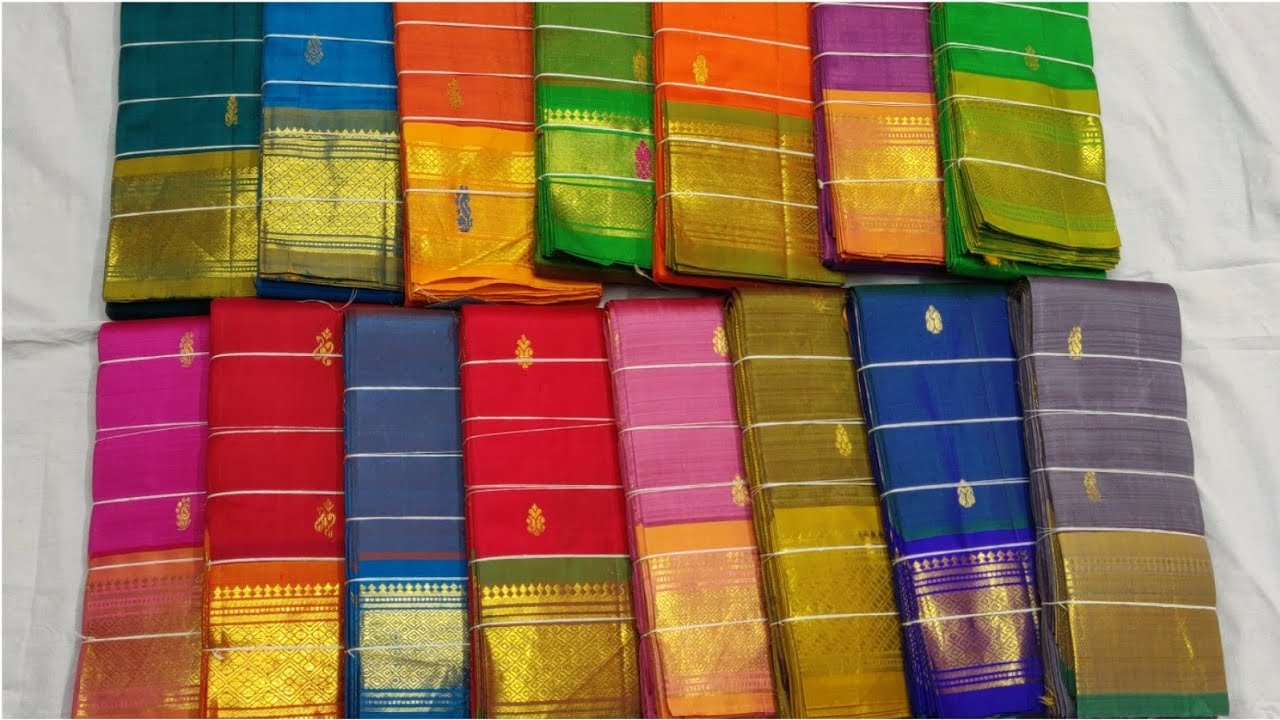
Thirubuvanam Silk Saree
In the sun-drenched landscape of the Thanjavur district, where the Cauvery River carves a path of emerald green through the heart of Tamil Nadu, lies a town that sounds like a benediction: Thirubuvanam. While the world outside hums with the digital rush of 2026, here, the air is thick with a different kind of music—the rhythmic, mechanical thwack-clack of thousands of handlooms. This is the birthplace of the Thirubuvanam Silk Saree, a garment that many connoisseurs consider the “crown jewel” of South Indian textiles, even outshining the more famous Kanchipuram in technical purity and structural integrity.
To wear a Thirubuvanam is to wrap oneself in a thousand years of history. It is a story of royal obsession, migratory genius, and a cooperative movement that saved an entire community from the brink of extinction.
The Chola Genesis and the Sovereign’s Dream
The story begins in the 12th century, during the twilight of the Great Chola Empire. King Kulothunga Chola III, a monarch who styled himself “Thirubuvanam Chakravarti” (Emperor of the Three Worlds), envisioned a town that would reflect his divine mandate. He built the magnificent Kambahareswarar Temple, but he knew that a temple alone does not make a civilization. He needed artisans.
History records that a group of master weavers, primarily from the Saurashtra community, migrated from the western coast of India under royal invitation. These weavers brought with them a secret vocabulary of silk that was distinct from the local traditions. Under Chola patronage, and later the Nayaks and Marathas, Thirubuvanam became a protected enclave for “Temple Silk”—fabrics woven exclusively for the deities and the royal household. This legacy of “royalty only” is why even today, a Thirubuvanam saree feels heavier and more substantial than almost any other; it was never originally intended for the common market.
The Architecture of the Loom: Why Thirubuvanam is Different
In the hierarchy of South Indian silks, the Kanchipuram saree is famous for its Korvai technique—where the body and the border are woven separately and joined with a “mulberry-link.” However, the Thirubuvanam saree possesses a unique technical DNA. It is woven on a Single Warp.
This means that the entire saree—body, border, and the elaborate pallu—is woven as one continuous, seamless unit of fabric. There are no joints. From a structural standpoint, this makes the Thirubuvanam virtually tear-proof at the borders. While a joint in a Kanchipuram saree might weaken after fifty years of storage, a Thirubuvanam remains an indestructible monolith of silk.
Furthermore, while most luxury sarees use 2-ply silk, Thirubuvanam weavers insist on strictly 3-ply filature silk for both the warp and the weft. This results in a “mirror-like” luster. When you move in a Thirubuvanam saree, the light doesn’t just hit the fabric; it reflects off it with a prismatic intensity that defines the “Thirubuvanam Glow.”
The Language of Motifs: Jewelry in Silk
If Kanchipuram draws its inspiration from the towering Gopurams (temple gateways), Thirubuvanam draws its soul from the Temple Jewelry of the Chola queens. When you look closely at the zari borders of an authentic Thirubuvanam, you aren’t just seeing patterns; you are seeing a catalog of traditional Tamil ornaments:
The Neli: A wavy line representing the traditional toe-ring given to a bride.
The Vanki: An inverted ‘V’ pattern that mimics the ornate armlets worn by dancers and royalty.
The Kalasam: The sacred pot that signifies auspicious beginnings.
The Pavun: The gold coin motif, representing prosperity.
These designs are woven with pure zari—silk thread wound with silver wire and dipped in 22-carat gold. Because the weavers use a higher volume of zari per square inch than almost any other cluster, a genuine Thirubuvanam saree can weigh anywhere from 450 grams to a staggering 1.25 kilograms. It is quite literally a “heavyweight” of the textile world.
The “Visirimadippu”: The Art of the Fan-Fold
One of the most interesting historical facts about these sarees is how they are presented. If you walk into a traditional silk shop, most sarees are folded into neat squares. But a Thirubuvanam is always presented in Visirimadippu (Fan-Fold).
This is a long, thin, rectangular fold that looks like a folded palm-leaf fan or a tall scale. This isn’t just for show. Because the 3-ply silk and heavy zari are so dense, folding them into small squares would create sharp horizontal creases that could eventually “crack” the metallic zari threads. The long Visirimadippu fold allows the heavy border to stay straight and the silk to retain its smooth, unblemished surface for generations.
THICO: The Cooperative Revolution
By the mid-20th century, the master-weaver system had become exploitative, leaving individual artisans in poverty. In 1955, a group of weavers broke free and formed the Thirubuvanam Silk Handloom Weavers Co-operative Production and Sale Society (THICO).
Today, THICO is the largest cooperative society in Tamil Nadu and arguably the most successful in India. It operates with the precision of a luxury brand, maintaining its own dye houses and quality control labs. This cooperative movement didn’t just save the craft; it turned the weavers into stakeholders of their own destiny. It is a rare success story where ancient art and modern socialism combined to create a multi-million-dollar industry that benefits the person at the loom.
The GI Tag and the Global Stage
In 2019, the Thirubuvanam Silk Saree was officially granted the Geographical Indication (GI) Tag. This was a landmark moment, legally recognizing that a “Thirubuvanam” can only be born from the looms of this specific town. It protected the weavers from power-loom imitations and cemented the saree’s status as a premium global heritage product.
The saree’s fame has reached far beyond the borders of Tamil Nadu. Legend has it that Queen Elizabeth II was so impressed by a Thirubuvanam weave during a visit to India that she remarked on its extraordinary shine. Similarly, Soviet leaders and global dignitaries have often been presented with Thirubuvanam shawls as the ultimate symbol of Indian craftsmanship.
A Legacy for the Next Millennium
As we look at the shimmering folds of a Thirubuvanam saree in 2026, we see more than just a beautiful garment. we see the resilience of the Saurashtra weavers who found a home in the shadow of Chola temples. We see the heavy, honest weight of gold and silver that refuses to diminish with age.
A Thirubuvanam is not a “fast fashion” item to be worn once and forgotten. It is an investment, a piece of “wearable architecture,” and a sacred heirloom meant to be passed from mother to daughter for a hundred years. In a world of digital ephemera, the Thirubuvanam Silk Saree remains a solid, glowing truth—woven one thread at a time, with a patience that the modern world is only just beginning to rediscover.