
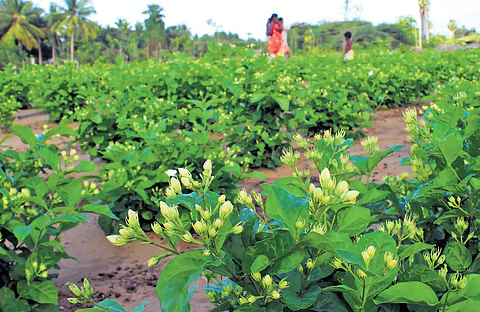
Madurai Malli
Long before the sun dares to breach the horizon, while the rest of the world is still wrapped in the quiet embrace of sleep, the ancient city of Madurai is already awake, humming to a rhythm set centuries ago. In the dim, indigo light of the pre-dawn hours, a fragrance begins to rise, cutting through the damp air and the earthy scent of the Vaigai river. It is a scent so mysterious, so profoundly intoxicating, that it has inspired kings to lay down their chariots, poets to write epics, and modern perfume empires to cross oceans in search of its essence. This is the realm of the Madurai Malli, the Jasmine Sambac. To understand this delicate white bud is to understand the soul of Thoonga Nagaram—the city that never sleeps. It is a story not just of agriculture, but of devotion, artistry, and an unbroken cultural lineage that links the modern Tamil woman adorning her hair to the legendary queens of the Sangam era.
Roots in Antiquity: The Echoes of Sangam Literature
To trace the origins of the Madurai Malli, one must look far beyond modern horticultural records and delve deep into the rich, poetic tapestry of Sangam literature, written between 300 BCE and 300 CE. In the Tamil imagination, flowers have never been mere botanical specimens; they are a profound language of love, war, and landscape. The jasmine, known locally as Mullai or Malligai, is the reigning monarch of this floral vocabulary. The ancient texts brim with references to this flower, firmly establishing that the relationship between the Tamil land and the jasmine is older than many recorded civilizations.
Perhaps the most poignant historical anecdote is the legend of King Pari, one of the Kadai Ezhu Vallalgal (the seven great philanthropic patrons of ancient Tamil Nadu). According to classical poetry, King Pari was once riding his magnificent golden chariot through the dense forest when he noticed a fragile, young mullai (jasmine) creeper struggling on the hard, unforgiving forest floor, seeking support to climb. Overwhelmed by a sudden surge of empathy for the delicate plant, the great king stepped down, abandoned his royal chariot, and offered it to the jasmine vine so it could twine itself around the spokes and rest comfortably. This singular act of poetic compassion immortalized the flower in Tamil ethos, symbolizing purity and the ultimate receipt of unconditional love.
The literary journey of the Madurai Malli does not stop there. In the epic Silappatikaram, penned in the post-Sangam era, there is a mesmerizing sequence where the protagonist Kovalan and his wife Kannagi are traveling towards Madurai. As they approach the outskirts, guided by folk singers known as Paanars, Kovalan asks how far the city is. The singers reply that they do not need a map; the gentle breeze carrying the unmistakable, heady scent of the jasmine announces that they have arrived at the gates of Madurai. Similarly, the Maduraikanchi vividly describes the Malligaa Maalai—garlands of jasmine worn by lovers and maidens playing along the banks of the Vaigai river. These ancient verses prove that for over two millennia, the identity of Madurai has been woven entirely out of this fragrant white thread.
The Mythological Canvas: Gods, Kings, and the Fish-Eyed Goddess
Beyond the realm of literature, the Madurai Malli is deeply rooted in the spiritual and mythological soil of India. In Hindu tradition, flowers are categorized by their spiritual purity, and the jasmine is considered supremely auspicious and divine. A popular mythological tale speaks of Parthan, a King of Ayodhya, who journeyed to the south and fervently worshipped Lord Shiva in a dense, untamed forest of jasmine vines. So pleased was the Lord with this fragrant devotion that he manifested there, earning the name Malleeswaran (the Lord of the Jasmine).
However, the truest guardian of the Madurai Malli is Goddess Meenakshi, the presiding deity of the magnificent Meenakshi Sundareswarar Temple that anchors the city. Meenakshi, the fish-eyed warrior goddess, is a manifestation of Parvati, and her connection to the local jasmine is absolute and intimate. Every evening, in a sacred ritual that prepares the Goddess for her union with her divine consort, Lord Sundareswarar, she is adorned with copious amounts of the freshest, most fragrant Madurai Malligai. It is a widely held local belief that the very reason this specific geography produces the finest jasmine in the world is because the Goddess herself demands it. During the grand Chithirai festival in spring, the entire city transforms into a floral wonderland. From the magnificent palanquins to the temple corridors, everything is blanketed in millions of jasmine buds, proving that in Madurai, devotion is not just spoken; it is inhaled.
The Alchemy of Earth: Why Madurai?
What makes the Madurai Malli so vastly superior to jasmines grown in other parts of the world? The answer lies in a miraculous convergence of geography, climate, and soil chemistry. The region surrounding Madurai—including Nilakottai, Melur, Uthappanaickanur, and Thirumangalam—boasts a very specific type of red, lateritic soil. Local farmers affectionately refer to this as the “red carpet” laid out by nature. This soil is extraordinarily rich in sulphur, which acts as a crucial precursor to the development of two specific aromatic alkaloids: jasmone and alpha-terpineol. It is these chemical compounds that grant the Madurai Malli its devastatingly deep, seductive, and long-lasting fragrance.
Furthermore, the physical architecture of the flower is unique. Compared to other varieties, the Madurai Malli possesses noticeably thicker petals and a lengthier petiole (the stalk joining the leaf to the stem). These thick petals are an evolutionary marvel; they act as tiny reservoirs, retaining moisture long after the flower has been plucked. This delayed withering means that a bud harvested in the cool darkness of the early morning will slowly, tantalizingly unfold its petals by dusk, releasing a sweet, floral scent that actually intensifies as the night deepens.
The cultivation process itself is a labor of immense love and tradition. Interestingly, the journey of the Madurai Malli often begins far away on the coastal island of Rameswaram, in a village called Thangachimadam. Here, the salt-kissed coastal air proves perfect for nurturing the initial saplings. Once these shoots are strong enough, they are transported to the sulphur-rich plains of Madurai. Farmers speak of tending to these plants with the same fierce devotion they would offer their own children. They meticulously manage the water from the Vaigai river, knowing that even a slight imbalance in hydration can alter the delicate bell-curve of the flowering season. Plucking the flowers is a race against the sun; it must be done when the bud is oblong, tightly closed, and harboring its maximum fragrant potential before the heat of the day forces it open.
The Art of the Weavers: A Symphony of Threads
If the farmers are the composers of this fragrant symphony, the flower weavers of Madurai are its master conductors. By mid-morning, the Madurai flower market is a chaotic, vibrant, and deafening theater of commerce. Amidst the shouting auctioneers and the sea of green leaves, women sit cross-legged in the shade, executing an art form passed down through countless generations.
Stringing the Madurai Malli is not a menial task; it is an intricate, highly specialized craft. Because of the flower’s thick petals and firm structure, the weavers can manipulate the buds into astonishingly complex architectural forms. There is no single way to tie a garland here. The weavers employ distinct, traditional styles that read like a poetic glossary:
Uruttu Kattu: A tightly rolled, cylindrical weave that resembles a thick, white spring or rope.
Pattai Katti: A flat, ribbon-like weave often used for temple adornments, resembling a floral metal strip.
Kadhambam: A vibrant mixture where jasmine is interlaced with colorful marigolds, roses, and foliage.
Maalai: The grand, heavy ceremonial garland used for weddings and deity adornment.
Thirumbippaar: Literally translating to “turn and look,” a weave so intricately beautiful it demands a second glance from anyone who passes by.
Using the humble fiber of the banana tree or sturdy cotton thread, the hands of these artisans move in a blur. They intuitively know the exact pressure required—too tight, and the bud is bruised; too loose, and the structural integrity of the garland fails. As they weave, their fingers become permanently stained with the green of the stems and the sweet, waxy oil of the petals. It is their silent, unseen labor that ultimately rests upon the crowns of deities, the necks of dignitaries, and the oiled, braided hair of brides across the country.
A Crown of Recognition: The GI Tag and Global Perfumery
For centuries, the brilliance of the Madurai Malli was a somewhat localized secret, celebrated primarily within the boundaries of the Indian subcontinent. However, the twenty-first century brought a new era of recognition. In January 2013, a historic milestone was achieved when the Madurai Malli was awarded the Geographical Indication (GI) tag by the Government of India, spearheaded by local farmers’ associations and the DHAN Foundation. It was a momentous occasion—the very first flower in the state of Tamil Nadu to receive this prestigious legal protection. This tag officially acknowledged what the Sangam poets had known all along: the unique size, shape, thick petals, and mesmerizing fragrance of this flower are inextricably linked to the specific geographical and human environment of Madurai.
Today, the journey of the Madurai Malli extends far beyond the temple corridors of South India. The flowers that are gently plucked by calloused hands in the rural hinterlands of Tamil Nadu are rushed to airports, flying out to cities like Dubai, Singapore, and New York within hours of being harvested. Yet, perhaps the most fascinating destination for these humble buds is the glamorous, secretive world of Parisian haute perfumery.
The thick petals and potent alkaloid profile of the Madurai jasmine make it one of the most highly sought-after raw materials in the global fragrance industry. Giant luxury perfume houses—names like Christian Dior, Guerlain, Bulgari, and Tom Ford—rely heavily on the jasmine extracts sourced from Madurai. The extraction process is painstaking; it takes millions of hand-picked blossoms to yield just one kilogram of the precious jasmine absolute, a golden, viscous liquid that is worth its weight in diamonds. For instance, Dior’s iconic J’adore prominently features the Jasminum sambac from Madurai as a core note. It is a stunning juxtaposition: the same flower that a rural Tamil woman tucks casually behind her ear for a few rupees is the very heart of a thousand-dollar crystal perfume bottle sitting in a boutique on the Champs-Élysées. The scent of Madurai has truly conquered the world.
The Eternal Bloom: A Cultural Identity
Despite its global commercial triumph, the true essence of the Madurai Malli remains deeply personal and cultural. In Tamil Nadu, the lifecycle of a human being is inextricably mirrored by the presence of this flower. It is there to bless the cradle of a newborn; it is woven into heavy, magnificent crowns for the bride and groom, its aphrodisiacal scent blessing the union; it is offered to the gods in daily supplication; and finally, it is draped over the departed, a fragrant farewell to the earthly realm.
To witness a woman walking down the streets of Madurai with a thick strand of malli woven into her dark hair is to witness a living, breathing tradition. The distinctive aroma, especially when it mingles with the subtle scent of coconut hair oil and the warm tropical evening air, is not just a cosmetic choice. It is an assertion of identity. It is a quiet, powerful declaration of belonging to an ancient land.
The Madurai Malli is much more than an agricultural commodity or an ingredient in a luxury perfume. It is the living memory of King Pari’s compassion; it is the silent witness to Goddess Meenakshi’s grace; it is the lifeblood of the farmers and the artistic canvas of the weavers. Long after the empires of the Sangam era have faded into dust, and long after modern trends have shifted, the jasmine vines of Madurai will continue to bloom in the dark. They will continue to draw from the waters of the Vaigai, the sulphur of the red earth, and the unwavering spirit of the Tamil people, releasing their immortal fragrance into the night, ensuring that the legacy of Thoonga Nagaram never truly sleeps.