
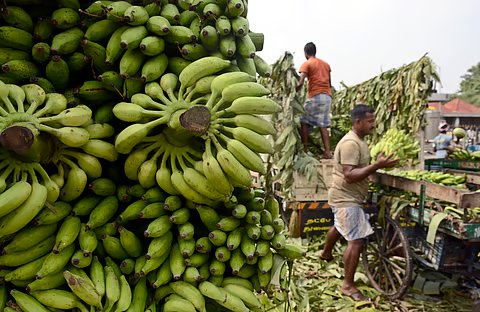
Sirumalai Hill Banana
In the mist-shrouded peaks of the Eastern Ghats, where the air grows thin and the soil turns a rich, loamy red, lives a fruit that is as much a legend as it is a crop. This is the story of the Sirumalai Hill Banana—locally revered as the Sirumalai Malai Vazhai—a fruit so steeped in history and flavor that it has survived the passage of centuries, the threat of extinction, and the shifting whims of global agriculture. To step into the orchards of Sirumalai is to step back in time, into a world where nature and tradition have forged a bond that tastes of honey, tang, and the very spirit of the mountains.
A Gift of the Ancients: The Puranic Origins
Long before modern botanists classified it as a member of the AAB pome genome, the Sirumalai banana was the food of sages and kings. Local folklore, whispered by the hill tribes who have called these slopes home for generations, suggests the fruit was a gift from the great Saint Agasthiyar. Legend has it that the saint sanctified these hills—Vellimalai, the Silver Hill—transforming them from gold to stone to protect their riches from human greed. In the process, he is said to have blessed the flora, giving rise to a banana that would never truly spoil.
The first written whispers of this emerald treasure appear in the Silappathikaram, the 2,200-year-old Tamil epic. Referred to as Thennavan Sirumalai, the text describes a land bursting with trenches of plantains, areca nuts, and coconut trees. For two millennia, this variety has been the soul of the region, earning its place as one of the Mukkanigal—the three royal fruits of Tamil Nadu (Mango, Jackfruit, and Banana)—that define the culinary and spiritual identity of the South.
The Crucible of Flavor: Terroir and Cultivation
What makes the Sirumalai Hill Banana so distinct that it was granted a Geographical Indication (GI) tag in 2008? The answer lies in the “terroir”—that magical intersection of geography and climate. These bananas refuse to thrive in the lowlands. They demand the specific embrace of altitudes between 2,500 and 3,000 feet.
In the Sirumalai hills, the soil is a well-drained loam with a delicate pH balance, nourished by an annual rainfall of 1,500 mm. The farmers here do not use the intensive, chemical-heavy methods seen in industrial plantations. Instead, the Sirumalai banana is a perennial, rain-fed crop. It is often grown as a “shade plant,” intercropped with young coffee trees and pepper vines. This multi-tier system creates a micro-ecosystem where the banana plants, growing up to ten feet tall, act as protectors of the forest floor. The result is a fruit with a sugar content of up to 23° Brix—a sweetness so concentrated it feels like a confection direct from the branch.
The Fruit That Defies Time: Unique Characteristics
To the uninitiated, a Sirumalai banana might look modest. It is medium-sized, often with five distinct angular ridges and a thick, yellowish-green skin. But the true magic happens inside. Unlike the watery, soft pulp of commercial varieties like the Cavendish, the Sirumalai banana is mealy and dense, with significantly less moisture.
This low moisture content is its superpower. It grants the fruit an incredible shelf life of up to 10 days at room temperature. In fact, locals claim the taste only improves as the skin darkens. While a regular banana becomes a bruised mess when overripe, the Sirumalai variety remains firm and sweet even when the peel turns black. This unique “dry-sweet” profile is why it is the indispensable ingredient in the Palani Panchamirtham, the sacred offering at the Dhandayuthapani Swamy Temple. Without the Sirumalai banana, the offering loses its signature aroma and its ability to stay fresh for months without preservatives.
A Battle for Survival: The Bunchy Top Crisis
The story of the Sirumalai banana is not without its tragedies. For decades, a shadow hung over the hills in the form of the Banana Bunchy Top Virus (BBTV). This devastating disease, spread by aphids, almost wiped the variety off the map. At its lowest point, the “Queen of Hill Bananas” was on the verge of extinction, and many farmers began abandoning their ancestral lands for more resilient, albeit less flavorful, crops.
However, the resilience of the Sirumalai people matched that of their fruit. Through a Herculean effort by the National Research Centre for Banana (NRCB) and the Tamil Nadu Department of Horticulture, a rejuvenation plan was set in motion. By introducing virus-free tissue culture plantlets and biological controls like Beauveria bassiana to fight corm weevils, the groves of Sirumalai began to turn green once more. Today, the formation of Farmer Producer Organizations (FPOs) has ensured that the “Sirumalai” name is protected and that the farmers receive a premium price for their labor.
Healing in Every Bite: The Medicinal Marvel
Beyond the palate, the Sirumalai Hill Banana is a cornerstone of Siddha medicine. Ancient practitioners recognized its high potassium content long before modern science linked it to heart health and nervous system regulation. It is famously prescribed for digestive health, acting as a natural remedy for bowel disorders. Because it is nutrient-dense and low in fat, it has earned the reputation of a “superfruit” among the health-conscious in 2026. For the tribes of the Western Ghats, the plant is a pharmacy in itself—even the corm extract is utilized in traditional treatments for jaundice.
The Future of the Hill Banana
As we look toward the future, the Sirumalai Hill Banana stands as a symbol of sustainable agriculture. In an era of climate change and genetic homogenization, this variety represents the importance of biodiversity. It is a crop that works with the mountain, not against it.
The next time you peel back the thick skin of a Sirumalai banana, remember that you are holding more than just a snack. You are holding a piece of Tamil history, a relic of ancient poetry, and a survivor of a biological war. It is a reminder that the best things in life—the sweetest, most enduring things—often grow on the steepest slopes, nurtured by the mist and the memories of the hills.
Sirumalai Hill Banana, Sirumalai Malai Vazhai, GI Tagged Bananas India, Tamil Nadu Hill Bananas, Dindigul Sirumalai history.
Unique characteristics of Sirumalai banana, medicinal benefits of hill bananas, Sirumalai banana for Palani Panchamirtham, sustainable banana cultivation in Western Ghats, history of Sirumalai banana in Silappathikaram.
#SirumalaiBanana #HillBanana #GITagIndia #TamilNaduHeritage #SustainableFarming #Superfoods #AncientGrainsAndFruits #DindigulDiaries #SirumalaiHills #IndianAgriculture