
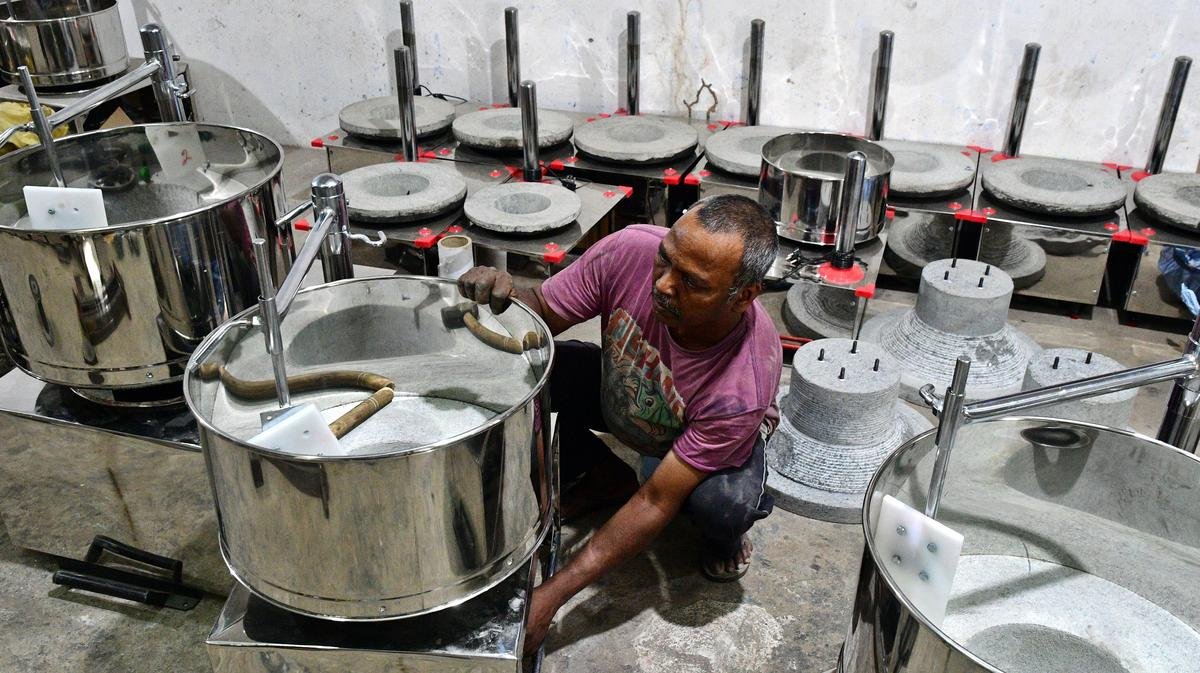
Coimbatore Wet Grinder
In the bustling industrial landscape of Coimbatore, where the clatter of textile looms once defined the air, a different kind of revolution was born in the mid-1950s. It didn’t arrive with the fanfare of a global patent or the backing of a multinational giant; rather, it began as a quiet act of love. This is the story of the Coimbatore Wet Grinder—a mechanical marvel that liberated millions from the backbreaking toil of manual stone grinding and forever changed the culinary map of South India. Today, recognized with a Geographical Indication (GI) tag, this appliance is the “silent matriarch” of the Indian kitchen, a testament to how local engineering can solve deep-seated domestic challenges.
The Wedding Gift That Changed History
The year was 1955. In a small house near Town Hall in Coimbatore, a high-school dropout and apprentice named P. Sabapathy watched his wife, Indrani, spend hours hunched over a heavy granite mortar (aattukal), manually rotating a stone pestle to grind soaked rice and lentils for the next day’s idlis. Driven by the desire to save his wife from this grueling labor, Sabapathy utilized his experience with motors and engines to conceive the first mechanical wet grinder.
Legend has it that Sabapathy presented the prototype to his wife as a wedding gift. It was a revolutionary machine—a belt-driven contraption that used an electric motor to rotate granite stones within a drum. The neighbors were so fascinated that they began bringing their own grains to Indrani’s kitchen. Realizing the commercial potential, Sabapathy started Electron Electricals and Mechanical Engineers, evolving over 32 different models. While Sabapathy moved on to other ventures later in life, he had already sparked an industrial fire that would turn Coimbatore into the world’s wet grinder capital.
The Geology of Taste: Why Coimbatore?
One might wonder why the wet grinder industry became so rooted in this specific city. The answer lies in the very earth beneath it. Coimbatore is surrounded by the Palani Hills and regions like Uthukuli, which yield a specific type of high-quality black granite. This stone is unique; it is hard enough to withstand years of grinding without eroding or chipping—ensuring that the batter remains pure and grit-free—yet it possesses a naturally rough texture that is ideal for crushing fibers.
Beyond the raw material, Coimbatore was already a hub for motor and pump manufacturing. The presence of skilled casting foundries, lathe workshops, and motor winding units provided the perfect ecosystem. By the 1960s, entrepreneurs like P. B. Krishnamurthy of Lakshmi Grinders took the concept to the masses, turning a niche invention into a household necessity across the South Indian diaspora.
The Evolution of the Sway: From Floor to Table
For decades, the “conventional” wet grinder was a heavy, floor-mounted behemoth. It required significant space and a strong arm to lift the heavy stones out of the drum for cleaning. However, the 1970s and 80s saw a wave of innovation that made the appliance “feminist” in its design—shrinking to fit the changing lives of modern women.
In 1975, R. Doraiswamy introduced the tilting wet grinder, which allowed users to tilt the entire drum to pour out the batter, eliminating the need to lift the 15-kilogram stones. But the most significant leap came in the 1990s when L. G. Varadaraj introduced the tabletop wet grinder under the brand ELGI Ultra. By replacing heavy, belt-driven systems with compact, direct-drive motors and lighter stones, the grinder finally moved from the back porch to the kitchen counter. This miniaturization allowed the “Coimbatore Wet Grinder” to travel in the suitcases of students and families migrating to the US, Europe, and the Middle East, ensuring the scent of fresh dosa batter followed the Tamil spirit wherever it went.
A Shield of Quality: The Geographical Indication (GI) Tag
As the popularity of the product soared, imitators began to flood the market with inferior stones and weak motors. To protect the integrity of the original craft, the Government of Tamil Nadu applied for a Geographical Indication (GI) tag, which was officially granted in 2005–06. This recognition legally binds the name “Coimbatore Wet Grinder” to products manufactured within the district using specific traditional methods and local granite.
The GI status was more than just a certificate; it was an acknowledgment of the city’s 700+ manufacturers who contribute to roughly 75% of India’s wet grinder output. The industry, which saw a massive boom between 2011 and 2015 due to state welfare schemes distributing free grinders to millions of households, has become a multi-thousand-crore sector, supporting over 70,000 families directly and indirectly.
The Cultural Soul in the Machine
In 2026, even in the age of instant pre-packaged batters and high-speed blenders, the Coimbatore wet grinder remains indispensable. Why? Because of thermal integrity. High-speed mixer grinders generate heat that partially cooks the batter during the grinding process, killing the beneficial bacteria needed for fermentation. The slow, stone-on-stone friction of the Coimbatore grinder keeps the batter cool, ensuring that the idlis remain fluffy and the dosas perfectly fermented.
The story of the Coimbatore Wet Grinder is a story of Frugal Innovation (Jugaad) at its finest. It reminds us that sometimes the most world-changing inventions don’t come from Silicon Valley laboratories, but from the simple, empathetic desire of a husband to make his wife’s morning just a little bit easier. It is a machine with a stone heart, but its rhythm is the very heartbeat of the South Indian home.
Coimbatore Wet Grinder, P. Sabapathy invention, history of wet grinders, GI tag Coimbatore, South Indian kitchen appliances.
How was the wet grinder invented, benefits of stone grinding idli batter, tilting vs tabletop wet grinders, Coimbatore industrial history wet grinder cluster, Coimbatore wet grinder GI status year.
#CoimbatoreWetGrinder #IndustrialHeritage #InnovationStory #TamilNaduHistory #KitchenTech #IdliDosa #EngineeringExcellence #GITagIndia #MadeInCoimbatore #SabapathyInvention