
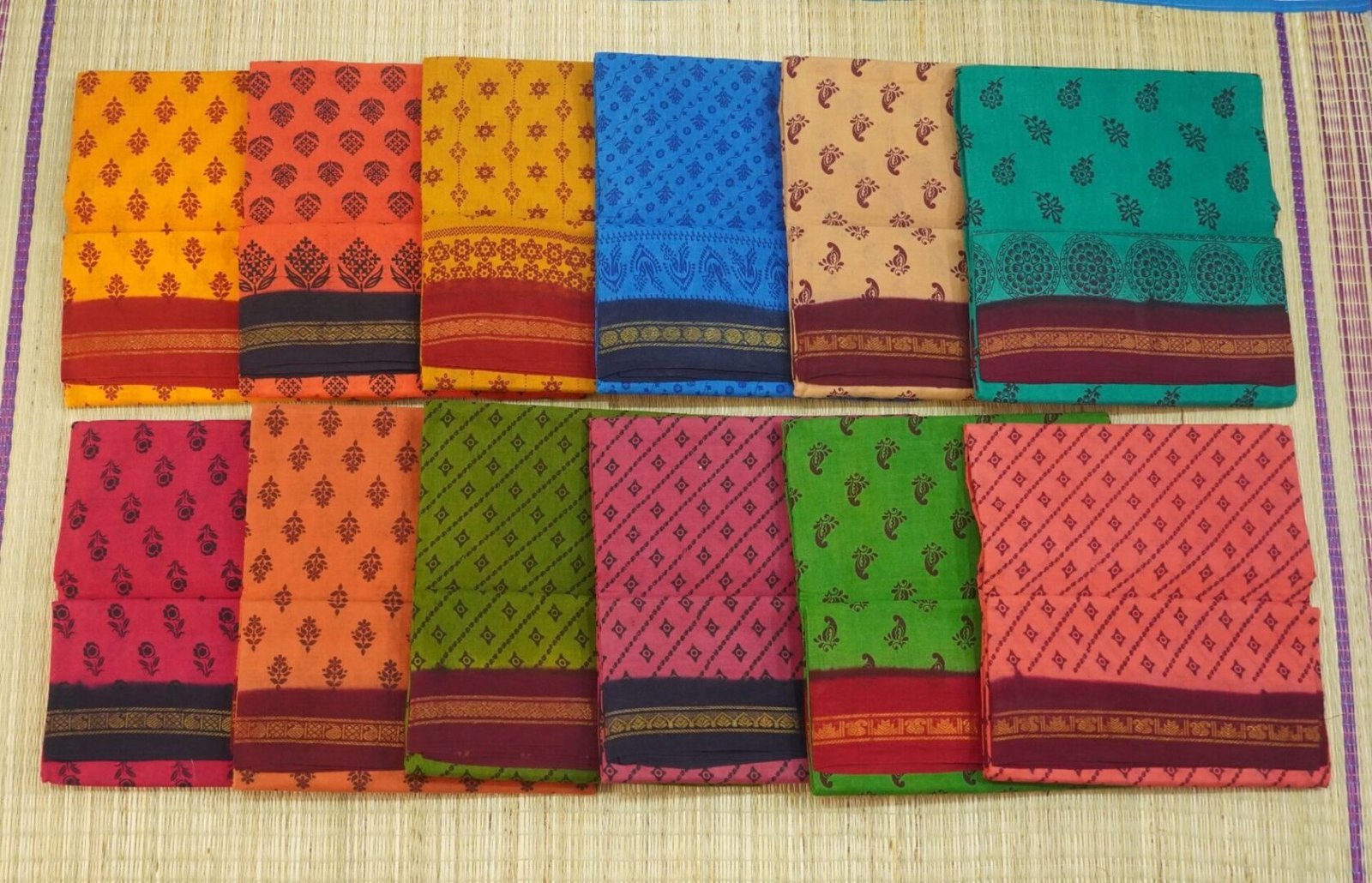
Madurai Sungudi
The story of Madurai Sungudi does not begin in the Tamil-speaking lands of the south, but rather in the arid, salt-flecked plains of Saurashtra, in present-day Gujarat. Over a thousand years ago, facing the pressures of frequent invasions and looking for more stable patronage, a community of highly skilled weavers began a monumental southern migration. They carried with them a secret—the art of Bandhani, a complex tie-and-dye technique that involved pinching tiny portions of fabric and binding them with thread before immersion in dye baths.
Their journey was not a direct one. Historical records and oral traditions suggest they moved through the Deccan plateau, settling briefly in parts of Maharashtra and Andhra Pradesh, absorbing local aesthetics while refining their own. By the 16th and 17th centuries, during the golden age of the Vijayanagara Empire and later the Madurai Nayakar dynasty, these craftsmen found their final home. King Thirumalai Nayak, a legendary patron of the arts and architecture, invited these weavers to settle in Madurai. He sought a fabric that was light enough for the sweltering tropical heat but regal enough for the aristocratic women of his court. The Saurashtrians delivered exactly that, blending their northern tie-dye heritage with the fine, locally grown cotton of the south.
The Alchemy of the Sun: The Traditional Process
To understand why Madurai Sungudi is a “Historical Writer’s” delight, one must look at the etymology of the word itself. “Sungudi” is derived from the Sanskrit word Sunnam, meaning “round,” referring to the circular dots or “buttas” that characterize the fabric. But the process is far more than just dots. In its original, authentic form, a Sungudi saree is the product of a slow, meditative alchemy involving earth, water, and fire.
The traditional process begins with high-quality cotton, which is thoroughly bleached in the sun. The “Sungudikkaran” (the craftsman) then spends days performing the arduous task of “tying.” Using only their fingernails and thin thread, they pinch the fabric at thousands of precise points. This labor-intensive stage ensures that when the cloth is dipped into the dye, the tied portions remain white, creating the iconic “dotted” patterns.
Historically, the dyes were entirely organic. The deep reds came from the roots of the Aal tree (Indian Madder), and the vibrant yellows from turmeric and pomegranate rinds. The fabric would then be washed in the Vaigai River, whose mineral content was said to provide a unique brightness to the colors. Finally, the sarees were starched with rice water and dried under the scorching Madurai sun. This combination of natural minerals, organic dyes, and solar bleaching gave the Sungudi a longevity that allowed it to be passed down through generations—a “grandmother’s saree” that never lost its luster.
The Nayakar Legacy and the Royal Influence
During the reign of the Nayakars, Madurai Sungudi was a symbol of status. The weavers were granted special quarters near the Thirumalai Nayakkar Mahal, and the designs often mirrored the architectural grandeur of the city. The “Kuttu” (borders) of the sarees frequently featured motifs inspired by the intricate stone carvings of the Meenakshi Amman Temple—lotuses, peacocks, and temple towers (Gopurams).
An interesting historical footnote lies in the cultural fusion the fabric represents. While the body of the saree utilized the North Indian Bandhani technique, the borders and the “Pallu” (the ornate end of the saree) were often woven using the traditional South Indian gold-thread (Zari) techniques. This made the Sungudi a bridge between two worlds. It was the preferred gift for visiting royalty and a staple for the elite during the Chithirai Festival, the city’s largest cultural celebration.
A Fabric of Resilience: Surviving the Machine Age
The 20th century brought the greatest threat to the Sungudi: the power loom and chemical dyes. As the world demanded faster, cheaper clothing, the painstaking “tie-and-dye” method began to falter. Many weavers shifted to screen printing—producing sarees that looked like Sungudi but lacked the soul of the hand-tied knots. The authentic craft was pushed to the brink of extinction, preserved only by a few dedicated families in the narrow lanes of Madurai.
However, the tide began to turn in 2005. Recognizing that the Madurai Sungudi was a unique intellectual property of the region, the Indian government granted it the Geographical Indication (GI) Tag. This was a turning point. It legally protected the name “Madurai Sungudi,” ensuring that only sarees produced within the specified geographical area using traditional methods could carry the prestigious label. This recognition breathed new life into the looms. Today, there is a global resurgence of interest in sustainable, artisanal textiles, and the “Sungudikkaran” are once again finding their work featured on international runways.
Modern Innovations: Beyond the Saree
While the classic 5.5-meter saree remains the heart of the industry, the 21st century has seen a fascinating evolution of the craft. Modern designers, recognizing the breathability of the fabric and the charm of its patterns, have adapted Sungudi for contemporary wardrobes. We now see Sungudi-patterned stoles, scarves, men’s shirts, and even home decor like cushion covers and curtains.
The color palette has also expanded. While the traditional “Madurai Red” and “Pandi Yellow” are still beloved, one can now find Sungudis in pastel teals, lavender, and charcoal greys. Despite these changes, the essence remains the same: a commitment to the “butta” and the use of fine cotton that becomes softer with every wash, making it the perfect companion for the modern woman who values both comfort and heritage.
The Spiritual Connection: Meenakshi’s Blessing
In Madurai, the Sungudi is more than commerce; it is sacred. It is common practice for devotees to offer Sungudi sarees to the Goddess Meenakshi. The belief is that the Goddess, the ultimate patron of the city, watches over the weavers. For the Saurashtrian community, the craft is a form of worship—a “Dharma” that has sustained them through a millennium of migration. When you wear a Madurai Sungudi, you are wearing a piece of this spiritual devotion, a fabric that has been blessed by the sun and the history of a resilient people.
A Heritage to Hold
Madurai Sungudi is a testament to the fact that true beauty is timeless. It is a fabric that tells the story of India itself—a story of migration, adaptation, and the enduring power of the handmade. As we move further into a digital, mass-produced world, the “imperfections” of a hand-tied Sungudi—the slight variations in the dots, the earthy scent of the dye—become its greatest strengths. It is a heritage that must be held, worn, and passed on, ensuring that the tinkle of the weaver’s tools and the vibrant dots of the Vaigai never disappear from the tapestry of human history.
Madurai Sungudi Saree, History of Sungudi, Saurashtrian Weavers Madurai, Traditional Tie and Dye India, GI Tagged Saree Tamil Nadu, Handloom Cotton Sarees, Thirumalai Nayakar Weaving History, Bandhani vs Sungudi, Authentic Madurai Textiles.
The origin of Saurashtrian weavers in Madurai, how to identify an original Madurai Sungudi saree, the process of natural dyeing in Sungudi sarees, history of textile migration in South India, Madurai Sungudi Geographical Indication status.
#MaduraiSungudi #HandloomIndia #SareeStories #TextileHistory #SaurashtraToMadurai #VocalForLocal #GITag #SustainableFashion #IndianHeritage #MeenakshiAmmanCity #CottonSarees #TraditionalWeaves #IndianArtisans #WearHistory