
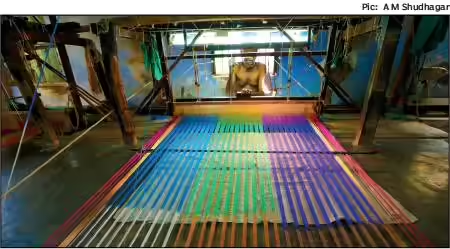
Salem Silk
In the bustling, sun-drenched corridors of Tamil Nadu, where the aroma of filter coffee mingles with the scent of jasmine, there exists a rhythmic symphony that has played uninterrupted for centuries. It is the steady, hypnotic clack-clack of the wooden handloom. Nestled amidst rolling hills and rich mineral landscapes, the district of Salem is globally renowned as the “Steel City” and the “Land of Sago.” Yet, beneath its industrial exterior lies a softer, far more opulent legacy. This is the birthplace of the legendary Salem Silk, affectionately and reverently known as Salem Venpattu—a fabric woven not just with silk threads, but with the very history, culture, and soul of South India.
To run your fingers over a pure Salem silk dhoti or saree is to touch a living artifact. It is a gossamer canvas that captures the brilliance of the Vijayanagara Empire, the esoteric alchemy of local waters, and the generational resilience of a dedicated weaving community. For the connoisseur of Indian textiles, Salem silk is an emblem of purity and technical mastery, a shining testament to an art form that refuses to fade into the shadows of mechanized modernity.
Echoes of Empires and the Saurashtra Odyssey
The story of Salem silk is inextricably tied to the royal courts of antiquity. Archaeological and historical records trace Salem’s roots back to the Stone Age, but it was during the reign of the Cheras, Cholas, and Pandyas that the region began to establish its cultural footprint. However, the golden era of Salem’s textile prominence blossomed under the patronage of the great Vijayanagara Empire and, subsequently, the Nayakas. The city’s strategic location along ancient trade routes transformed it into a bustling nucleus for the exchange of spices, minerals, and, most importantly, luxurious fabrics.
The true architects of the Salem Venpattu, however, are the members of the Saurashtra weaving community. Centuries ago, facing political upheavals and seeking royal patronage, these highly skilled artisans embarked on a massive migration from the western coast of India, journeying through the Deccan plateau before finally settling in the fertile plains of Tamil Nadu. They brought with them an intimate, almost spiritual understanding of sericulture and weaving. Establishing themselves in enclaves like Chinthamaniyur, Panchukalipatty, Semmandapatty, and the famed weaving census town of Kondalampatti, the Saurashtras transformed Salem into a textile powerhouse. The very word “Salem” is believed by some historians to have evolved from “Shailam” (hills), while others link the region’s textile fame to the ancient weavers known as “Salya.” Together, the land and the artisans forged an unbreakable bond.
The Alchemy of Water: The Magic of Venpattu
When one thinks of South Indian silk, the mind immediately conjures images of vibrant reds, deep emeralds, and brilliant mustards. Salem silk, however, carved its niche through a striking departure from this vivid palette. Its most celebrated creation is the Salem Venpattu, which translates to “White Silk.”
Woven from the finest pure mulberry silk, the chief attraction of Salem Venpattu is its otherworldly luster and pristine whiteness. But how do the weavers achieve this radiant glow without modern chemical bleaches? The answer lies in the region’s geography. It is a long-held belief among the master weavers that the ground and river water of the Salem region possesses unique mineral properties. When the raw silk is washed and processed in this local water, it acts as a natural alchemist, elevating the silk’s natural sheen to an extraordinary level of brilliance that cannot be replicated in any other geographical location.
Fascinatingly, the Salem Venpattu is a fabric that lives and matures with its wearer. At the time of manufacturing and purchase, the silk dhoti or saree is a brilliant, blinding white. However, as the fabric is worn and repeatedly washed over the years, it undergoes a beautiful metamorphosis. The pure white gradually transitions into a soft, light sandalwood hue, eventually maturing into a deep, rich golden yellow. This phenomenon is simply the fabric slowly returning to the natural, unbleached state of the original mulberry silk yarn. To the families who pass these garments down as heirlooms, this color change is not a flaw, but a cherished evolution of the garment’s life.
The Geometry of Grace: Looms, Weaves, and Motifs
The creation of a Salem silk garment is a masterclass in patience, mathematics, and extreme dexterity. Most of the Venpattu is still meticulously hand-woven on traditional pit looms or raised pit looms situated in the front rooms of the artisans’ homes. The hallmark of Salem silk lies in its incredible structural density paired with a buttery softness. In a genuine Kondalampatti or Salem saree, weavers cram an astonishing 60 to 65 silk threads into a single square inch of the warp. This high thread count guarantees remarkable durability, while the standard width of the saree is maintained at a majestic 51 inches.
While the body of the Venpattu remains an ocean of pure, lustrous white, the borders are where the weavers showcase their flamboyant artistry. Using a complex lattice dobby mechanism, the artisans weave intricate motifs into the borders and pallu using pure zari or half-fine (limitation) zari. The designs are deeply symbolic, drawn from nature and temple architecture. Traditional motifs include the Nagachattai (the protective hood of a serpent), Kammal (the intricate South Indian earring), Diamond with Roja (geometric diamonds interspersed with blooming roses), and Muthu with Gold Pettu (pearl-like dots framed by solid gold bands).
Despite its heavy thread count and rich zari borders, a standard Salem Venpattu dhoti maintains an average weight of just 250 grams, making it exceptionally comfortable in the humid tropical climate. It is no wonder that these garments are the quintessential attire for South Indian weddings, coming-of-age ceremonies, and temple festivals.
The Weavers’ Tale: Lives Bound by Threads
Behind every yard of Salem silk is a human story of resilience and passion. To step into a weaver’s home in Mettupatti or Kondalampatti is to step into a space where life revolves around the loom. Consider the story of artisans like Thangammal, a veteran weaver who has spent over four decades seated beside her beloved wooden loom. For her, and thousands like her, weaving is far more than a cottage industry; it is the heartbeat of their existence.
The process of creating a single Salem saree or dhoti demands four to eight days of intense labor. But the work begins long before the loom is engaged. The pre-loom activities—such as warping the vibrantly dyed yarns, crafting the delicate bamboo reeds, and the painstaking heald-making process where silk yarn is twisted into leases—are often communal or family activities. Weaving offers these artisans a sense of profound peace and financial independence. It is a craft that has educated their children, built their homes, and funded the weddings of their grandchildren. The survival of Salem silk is a direct result of this intergenerational transfer of knowledge, where children learn the rhythm of the loom by simply falling asleep to its lullaby.
Weathering the Storms of Modernity
The journey of Salem silk has not been without its perilous storms. During the pre-independence era, handloom weaving was the absolute bedrock of the local economy, second only to agriculture. However, the 1960s and 1980s brought the formidable rise of massive spinning mills and mechanized power looms. The towns surrounding Salem—Gugai, Ammapet, Rasipuram, and Elampillai—saw a massive boom in power loom societies and automated dye houses.
Simultaneously, the influx of cheap, machine-made synthetic fabrics and the aggressive dumping of raw and finished Chinese silk into the Indian market threatened to push traditional handlooms into extinction. Yet, the Salem Venpattu survived. It survived because the cultural mandate of Tamil Nadu demands absolute purity for its sacred rituals. A machine-made synthetic dhoti could never replace the spiritual sanctity and the regal drape of a handwoven Venpattu during a temple Kumbhabhishekam or a traditional wedding ceremony.
The Crown Jewel: Geographical Indication and Global Triumphs
In recognition of its unparalleled quality, unique manufacturing process, and deep historical roots, the Government of India awarded the prestigious Geographical Indication (GI) tag to Salem Silk (Salem Venpattu) in the year 2007-08. This intellectual property protection was a monumental victory for the local weaving communities. It served as a global certification that authentic Salem Venpattu could only be produced in this specific region, utilizing the traditional methods that have been safeguarded for centuries.
This recognition brought a fascinating industry secret out of the shadows. For decades, the majestic silk sarees and dhotis of Salem were of such exquisite quality that they were regularly procured by massive retail showrooms in neighboring Kanchipuram. Yes, many of the prized garments sold under the banner of other famous silk towns were, in fact, born on the pit looms of Salem. The GI tag finally gave Salem silk the independent aristocratic identity it so richly deserved.
A Woven Future
Today, as the world increasingly turns its back on fast fashion in search of sustainable, ethical, and culturally rich alternatives, Salem silk is experiencing a glorious renaissance. The district now boasts over 75,000 active handlooms, with an industry valuation running into thousands of crores. While modern designers are experimenting with contemporary aesthetics and lighter drapes, the soul of the craft remains untouched.
Salem Venpattu is not merely a relic relegated to museum glass cases or history textbooks. It is a living, breathing tapestry that continues to drape the modern Indian in elegance. Every thread of Salem silk carries the whisper of ancient kings, the magic of the mountain waters, and the unyielding spirit of the artisans. As long as there are weddings to be celebrated and gods to be adorned, the rhythmic clatter of the looms in Salem will continue to weave the fabric of India’s heritage.
Salem Silk, Salem Venpattu, Salem handloom silk, Geographical Indication silk Tamil Nadu, Traditional South Indian silk dhoti.
History and origin of Salem silk sarees, What is Salem Venpattu white silk, Salem silk GI tag details, Saurashtra weaving community in Tamil Nadu, How Salem Venpattu changes color, Best pure silk dhoti for South Indian weddings, Handloom textile industry in Salem district, Kondalampatti silk weaving techniques.
#SalemSilk #SalemVenpattu #HandloomHeritage #SouthIndianWeddings #TamilNaduTextiles #GITagIndia #SaurashtraWeavers #SustainableFashion #IndianSilkSarees #WeaversOfIndia #IncredibleIndia #TextileHistory