
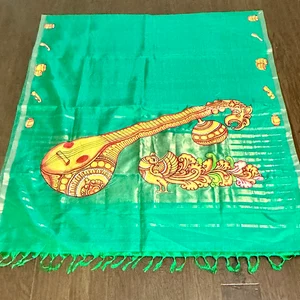
Thanjavur Painting
In the heart of Tamil Nadu, where the Kaveri River weaves through the lush delta, stands the ancient city of Thanjavur. It is a land where stone breathes and colors glow. While the towering Brihadeeswara Temple commands the skyline, a more intimate, luminous treasure resides within the quiet alcoves of its homes and the grand halls of its palaces: the Thanjavur Painting. Known for its opulent gold leaf, vibrant hues, and divine subjects, this art form is not merely a craft but a spiritual invocation—a window into a world where the celestial and the terrestrial meet in a shimmering embrace.
The Birth of a Vision: From Cholas to Nayakas
The roots of Thanjavur painting go back to the 16th century, though its soul was forged much earlier in the fires of the Chola Empire. The Cholas, who ruled between the 9th and 13th centuries, were the original patrons of the arts, covering temple walls with magnificent murals. However, the specific style we recognize today began to take shape under the Nayakas of Thanjavur.
Following the fall of the Vijayanagara Empire in 1565, a wave of artists, musicians, and philosophers migrated south. These artisans, predominantly from the Raju and Naidu communities, brought with them the “Vijayanagara Style”—a tradition of bold lines and rich iconography. Under the Nayaka governors, these migrant artists began decorating the interior walls of palaces and the doors of temples. It was a period of transition, where the sprawling murals of the past began to shrink into portable, intensely detailed panel paintings.
The Maratha Golden Age: The Alchemy of Art
If the Nayakas gave the art form its structure, it was the Marathas who gave it its glitter. In 1676, Ekoji (the half-brother of the great Chhatrapati Shivaji) established Maratha rule in Thanjavur. The Maratha kings were eclectic patrons; they loved the traditional South Indian aesthetics but sought to infuse them with a royal, Persian-influenced opulence.
It was during the reign of Maharaja Serfoji II (1777–1832) that Thanjavur painting reached its zenith. A scholar and a visionary, Serfoji II encouraged the use of precious materials to make the gods appear “alive.” Artists began to move away from wall murals toward Palagai Padam (pictures on wooden planks). This shift was revolutionary. By painting on wood rather than stone, the art became an heirloom—a “portable temple” that a family could cherish for generations.
The Architecture of Divinity: Materials and Technique
A Thanjavur painting is a masterpiece of multi-layered engineering. It begins with a sturdy board, traditionally made from teak or jackfruit wood. To prevent the wood from breathing and cracking the paint, a fine layer of cotton cloth is pasted over it using tamarind seed glue.
The true magic, however, lies in the Gesso work. A paste of limestone (chalk powder) and gum is used to create a raised, three-dimensional relief. This relief work is meticulously applied to the deity’s jewelry, crowns, and the ornate architectural arches (the Prabhavali) that frame the subject. Once the gesso is dry, it is covered with ultra-thin sheets of 22-carat gold leaf. Because pure gold does not tarnish or rust, these paintings retain their celestial glow for over a century. To complete the look, semi-precious stones—traditionally rubies, emeralds, and diamonds—are embedded into the gesso, turning the painting into a literal jewel.
The Cherubic God: Iconography and Subject Matter
The hallmark of a classic Thanjavur painting is the portrayal of the deity. The figures are almost always characterized by rounded, “chubby” faces and large, almond-shaped eyes that seem to follow the viewer with a compassionate gaze. The most beloved subject is Navaneeta Krishna—the infant Krishna holding a ball of butter, his mischievous smile radiating divine innocence.
The subjects are not chosen at random. These paintings are visual narrations of the Puranas and the Epics. Whether it is the Rama Pattabhishekam (Coronation of Rama), Goddess Lakshmi seated on a lotus, or the fierce yet beautiful Goddess Durga, each pose, hand gesture (mudra), and color is strictly governed by the Shilpa Shastras (ancient Indian texts on arts and crafts). Vishnu is blue, Nataraja is chalk-white, and Goddess Sivakami is green. This color coding ensures that the painting is not just a work of art but a textbook of theology.
A Cultural Sentinel: The Impact of the British and Modernity
As Maratha power waned and the British East India Company established a garrison in Thanjavur in 1773, the art form faced a new challenge. The local artists, ever adaptive, began to paint for the British officers. This gave rise to the “Company Style” of Thanjavur art. These paintings often depicted “native” subjects—fairs, festivals, and common people in traditional dress—to satisfy the European curiosity about India. While these works used less gold and focused more on realistic shading, they helped the Thanjavur artists survive during a period of shifting patronage.
In 2008, the Government of India awarded the Thanjavur Painting the Geographical Indication (GI) tag, recognizing that this specific technique is unique to the soil of Thanjavur. Today, while chemical paints have replaced vegetable dyes and plywood often stands in for teak, the heart of the tradition remains. Contemporary artists are now experimenting with secular themes and modern framing, yet they still bow to the same ancient rules of gesso and gold.
The Eternal Glow: Why Thanjavur Art Matters
In a world of mass-produced, digital images, a Thanjavur painting is a slow, meditative labor of love. It is a reminder of an era when art was a form of worship—where the artist would bathe and pray before touching the brush to the board. These paintings are more than just décor; in South Indian households, they are treated as living deities. They are lit with oil lamps, adorned with flowers, and passed down as spiritual dowries.
To own a Thanjavur painting is to own a piece of the history of the South. It is to hold the legacy of the Chola murals, the Nayaka lines, and the Maratha gold in a single frame. As the light hits the 22-carat foil and the gems glitter, one realizes that the “Golden Age” of Thanjavur never really ended; it just moved into the shimmering canvas of its paintings.
Thanjavur painting history, Tanjore art origin, gold leaf painting India, Thanjavur Maratha art, Indian classical painting styles.
How Thanjavur paintings are made, significance of gold in Tanjore art, Serfoji II patronage of Thanjavur art, difference between Mysore and Thanjavur paintings, traditional gesso work technique.
#ThanjavurPainting #TanjoreArt #IndianHeritage #GoldLeafArt #TamilNaduHistory #ClassicalIndianArt #DivineArt #SouthIndiaCulture #ArtHistory #GessoWork