
The Black Gold of the Red Dunes: The Making of Udangudi Panangkarupatti
Starting a deep dive from a simple Wikipedia link like “[Creating Udangudi Panangkarupatti – Wikipedia]” is like opening a humble wooden door only to discover an entire universe of history, chemistry, and culinary magic behind it. For the uninitiated, “Panangkarupatti” might just seem like a difficult-to-pronounce South Indian word for palm jaggery. However, this dark, hemispherical block of unrefined sugar is far more than a pantry staple. It is a testament to human endurance, a product of unique geological anomalies, and a sweet relic of global trade networks that existed long before the modern era.
In a world increasingly dominated by highly processed, chemically bleached, and artificially flavored sweeteners, Udangudi Panangkarupatti stands as a stubborn, beautiful anomaly. It is a sweetener crafted exactly as it was centuries ago—by hand, over open fires, without a single drop of synthetic chemicals. To truly understand why this specific palm jaggery from a small coastal panchayat town in Tamil Nadu is revered globally, we must journey to the arid landscapes of Thoothukudi, climb the towering palmyra trees, and stand beside the boiling vats of golden nectar.
The Terroir: Red Sand Dunes and Desert Winds
When we think of lush, agricultural bounty, we usually picture fertile river valleys or rain-soaked mountains. Udangudi defies this expectation completely. Located in the Thoothukudi district of Tamil Nadu, this region is defined by a striking geological feature: the Theri or red sand dunes. These ancient dunes, dating back to the Quaternary Period, are composed of marine deposits rich in heavy minerals like ilmenite, garnet, and magnetite.
This iron-rich, red soil has an exceptionally low capacity for retaining water. Combined with the region’s harsh, semi-arid climate and minimal atmospheric moisture, one might assume nothing of value could grow here. Yet, it is precisely this environmental stress that creates the magic of Udangudi Panangkarupatti.
The Palmyra palm trees (Borassus flabellifer) that anchor themselves deep into these red dunes must fight for every drop of moisture. Because the groundwater is scarce and the air is dry, the sap (known locally as Pathaneer or Neera) drawn from these trees has a remarkably low water content and an unusually high concentration of sucrose and fructose. While palm sap in wetter regions is diluted by the tree’s abundant water uptake, the Udangudi sap is thick, rich, and intensely sweet straight from the flower stalk. Furthermore, this dry climate imparts a naturally long shelf life to the finished jaggery, allowing it to be stored for months without spoiling or melting easily.
The Harvest: A Death-Defying Daily Ritual
The creation of Udangudi Panangkarupatti is not an industrial process; it is an extreme physical craft. It begins long before the sun rises, with the skilled palmyra climbers of the region. The palmyra tree is a formidable giant, often reaching heights of 60 to 80 feet, with a straight, unbranched trunk crowned by a canopy of fan-like leaves.
To extract the sap, the climbers must scale these towering heights using nothing but traditional climbing loops and sheer upper-body strength. Once at the canopy, the artisan performs a delicate surgical procedure on the tree. They locate the inflorescence—the flower stalks of the tree. For male trees, they gently crush the flowering shoots; for female trees, the main inflorescence. A precise, gentle cut is made at the tip to allow the sweet sap to ooze out drop by drop.
An earthen pot is then carefully tied to the stalk to collect this nocturnal harvest. But there is a crucial, ancient scientific trick employed here: the sap of the palmyra tree is highly susceptible to natural fermentation. If left alone, wild airborne yeasts will quickly convert the sweet sugars into alcohol, creating toddy. To prevent this, the inside of the collection pots is meticulously coated with slaked lime. In the coastal Tiruchendur and Udangudi regions, this lime is traditionally sourced by burning sea shells, adding another layer of localized mineral complexity to the sap. The pot is left overnight, collecting up to two liters of pure, vitamin-rich Pathaneer.
The Alchemy of Boiling: Patience and Purity
Once the sap is harvested in the early morning, the race against time begins. The Pathaneer must be processed immediately before the ambient heat of the day triggers any unwanted fermentation. The liquid is filtered and poured into massive, wide-mouthed iron skillets known as kopparais.
Here begins the slow, hypnotic process of reduction. The vats are placed over traditional open-fire stoves dug into the ground. In a beautiful display of zero-waste sustainability, the fuel used for these fires consists entirely of dried palmyra leaves and branches that have fallen from the very trees that provided the sap.
As the sap boils, it requires constant, vigilant stirring. The artisans use long wooden ladles to keep the liquid moving, preventing it from scorching at the bottom of the pan. During this intense boiling phase, impurities rise to the surface as a frothy scum, which is expertly skimmed off. Instead of using chemical clarifying agents, the makers toss in a handful of crushed castor seeds. The natural oils in the castor seeds act as a potent anti-foaming agent, keeping the violently boiling syrup from spilling over the edges of the skillet.
This is where Udangudi separates itself entirely from commercial, mass-produced jaggery. In many other regions, producers add chemicals like triple superphosphate or phosphoric acid to artificially bleach the jaggery, giving it a lighter, “cleaner” yellow appearance to appeal to uniformed consumers, or to artificially induce rapid crystallization. Udangudi artisans strictly refuse these modern adulterants. Their process relies entirely on time, heat, and physical labor.
After 3 to 5 hours of continuous boiling, the liquid undergoes a profound transformation. The water evaporates, and the sugars caramelize, turning the liquid from a milky white into a thick, bubbling, golden-brown paste. The artisan tests the consistency purely by touch and experience—when the syrup forms a specific thread-like structure between the fingers, it has reached the perfect state.
Molding the Black Gold
The final stage of creation is a race against temperature. The heavy, molten syrup is swiftly removed from the fire. Before it has a chance to solidify in the pan, it is ladled into natural molds. True to its sustainable roots, Udangudi Panangkarupatti is never poured into plastic or metal molds. Instead, the artisans use half-spherical, polished coconut shells.
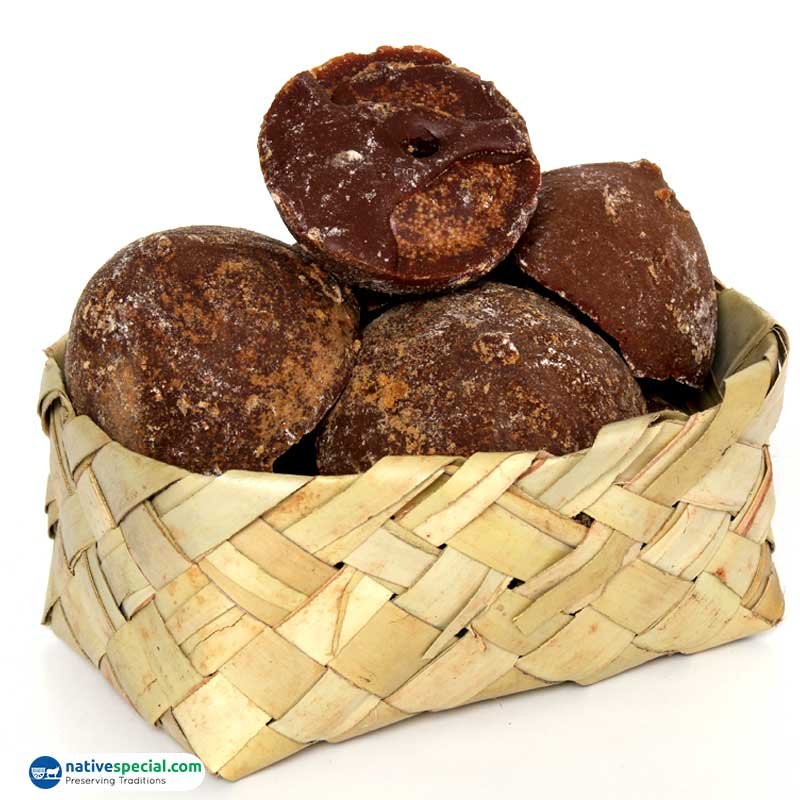
A thin muslin cloth is often used as a final strainer as the hot syrup is poured into the shells. As the syrup sits in the ambient coastal air, it cools and crystallizes. Within an hour or two, it hardens completely. When the coconut shells are tapped, the jaggery drops out in perfect, dark brown hemispheres.
Even the packaging is an art form. The finished blocks are wrapped in traditional pettys—intricately woven baskets made entirely from dried palm leaves. This breathable packaging allows the jaggery to adapt to humidity changes without sweating and melting, preserving its texture for its journey to the market.
A Sweet History: From Coastal Groves to Global Ports
The story of Udangudi Panangkarupatti is intimately tied to the history of Indian Ocean trade. A century ago, this small region was the undisputed capital of palm sweeteners. The British colonial administration recognized the massive economic potential of the Udangudi palm groves. They even laid a dedicated railway line connecting Tiruchendur and the surrounding areas primarily to facilitate the transport of palm juice and jaggery to a large export factory established near Kulasekharapatnam.
Although the factory eventually shuttered and the railway line fell into disuse, the legacy of the trade survived. In its heyday, the nearby bustling markets of Madurai and Tirunelveli housed over 500 wholesale dealers dedicated solely to the trade of Udangudi jaggery. Its fame crossed oceans. Because of its incredible shelf life and robust flavor, it was heavily exported to foreign shores, finding permanent places in the pantries of Sri Lanka (then Ceylon), Malaysia, Singapore, and even reaching the British Isles.
The GI Tag: A Shield Against Imitation
With great fame comes the inevitable plague of counterfeits. As the global demand for healthy, unrefined sugars skyrocketed in recent years, the market was flooded with fake “Udangudi” jaggery. Unscrupulous producers from other regions began mixing cheap refined cane sugar with artificial dark colors, molding it into coconut shells, and passing it off as authentic Udangudi Karupatti.
To protect the livelihood of the traditional palm climbers and preserve this ancient culinary heritage, a long and arduous legal battle was fought. Finally, on October 3, 2023, the Intellectual Property of India officially granted the Geographical Indication (GI) tag to Udangudi Panangkarupatti.
This coveted GI tag acts as a fortress around the tradition. It legally mandates that any product sold under this name must originate from the specific red sand dune regions of the Tiruchendur taluk, must be extracted from the palmyra tree, and most importantly, must be processed using the ancient, chemical-free methods. It is a massive victory for the 15 registered cooperative societies under the Tirunelveli District Palmyra Products Co-operative Federation, ensuring that the artisans receive fair compensation for their grueling labor.
A Nutritional Powerhouse and Ayurvedic Staple
Beyond its rich, complex, smoky-sweet flavor, Udangudi Panangkarupatti is deeply embedded in the traditional medicine systems of India, particularly Ayurveda and Siddha. Because it undergoes no chemical refining or bleaching, it retains 100% of the natural minerals present in the palm sap.
- Iron: It is a phenomenal source of dietary iron, making it a traditional remedy for treating anemia and boosting hemoglobin levels.
- Magnesium & Calcium: Packed with magnesium, which helps regulate the nervous system, and calcium for robust bone health.
- Vitamins: The fresh sap (Pathaneer) itself is recognized as a brilliant source of the Vitamin B complex.
In Tamil households, this jaggery is rarely just a sweetener; it is medicine. During the monsoon and winter months, it is the star ingredient in Sukku Malli coffee—a potent herbal brew made with dry ginger, coriander seeds, and crushed Panangkarupatti, consumed to ward off severe colds, coughs, and throat infections. For nursing mothers and growing children, it is often mixed into traditional sweets and porridges to provide a clean, sustained energy boost without the harsh insulin spike associated with refined white sugar.
A Legacy Cast in Caramel
The journey from a deep Wikipedia dive into the real-world creation of Udangudi Panangkarupatti reveals a profound truth about our food systems. True quality cannot be engineered in a laboratory; it is born from the perfect synergy of challenging environments, generational knowledge, and relentless human effort.
Every block of authentic Udangudi palm jaggery holds within it the fierce heat of the Theri sand dunes, the dizzying heights of the palmyra canopy, the woodsmoke of the boiling vats, and the unbroken spirit of the artisans who refuse to compromise their craft. It is not just a sweetener. It is a piece of living history, crystallized into perfection.